



- Room 1807, Unit 9, Building 2, Shangxing Commercial Street, Shangde Road, Shangxing Community, Xinqiao Subdistrict, Bao'an District, Shenzhen City, China
CONTACT US

WhatsApp


Contact Us
Our team is on stand by, waiting toassist you.

Videos
A large collection of educational videos and tutorials.

About Us
Learn about our company, leadership, and mission totransform manufacturing.

Privacy Policy
Applies to all personal information collected through and/or processed in connection.


Aerospace & UAV
WJ Prototypes is your 3D manufacturing partner from prototype to large scale production.

Consumer Electronics
New Product Introduction Solutions for Consumer Electronics.

Robotics & Automation
Need some assistance bringing your robotic device or parts from the sketch-board to reality?

Medical Devices
The medical industry needs high quality, dependable and safe parts and products.

Automotive
New Product Introduction Solutions for Automotive

Industrial Machinery
The main purpose of industrial prototyping is to take the product from drawings into the real world.


Yes, CNC machining titanium in China is a reliable path to precision parts when a supplier proves process control and traceability. Before you commit, ask for material test reports, a first article inspection plan, CMM inspection records, and documented thermal-management parameters. Your next move: send drawings and request a quote alongside a process-qualification checklist.
TL;DR:
- Suppliers should provide recent CMM inspection reports, detailed process capabilities, and traceability documents like material test reports to verify process control.
- Using the correct titanium alloy grade, specifying the temper and heat number, and referencing AMS or ASTM standards ensures material quality and consistent sourcing.
- Titanium machining requires specialized practices such as high-pressure coolant, low-speed high-torque cutting, and tool wear monitoring to manage heat and prevent rapid tool degradation.
- Certification documentation, including material test reports, first article inspections, and process qualification records, is essential for aerospace and medical titanium parts to ensure traceability.
- Clear, standardized RFQ details—tolerance, material specs, quantities, and inspection requirements—are crucial for comparable quotes and realistic lead times.
Capable shops build titanium programs around a consistent set of processes, and matching those processes to your part geometry is the fastest way to shortlist the right partner. Complex aerospace brackets usually need 5-axis milling for contoured surfaces, while small-diameter medical pins or fasteners are better suited to Swiss turning, which holds tight concentricity on slender parts without the deflection you get from standard turning setups.
A shop’s process list tells you what it can realistically hold to tolerance:
Before you shortlist a supplier, ask for the specifics behind the process list: machine models and brands, axis travel limits, spindle power, maximum work envelope, and sample inspection photos from a comparable titanium job. A shop that can show a recent CMM report for a similar geometry is telling you more than one that simply claims “aerospace experience.” Our own precision CNC machining work illustrates what that inspection evidence should look like for tight-tolerance titanium parts.
The alloy you specify determines strength, corrosion resistance, and how a supplier sources feedstock, so vague callouts like “titanium” invite the wrong material or an unnecessary cost premium. Three families cover most CNC work:
Your drawing should carry more than the alloy name. Specify the temper or condition, a hardness callout when it matters for the application, and a requirement for the mill or heat number to appear on the material test report. NASA guidance on titanium alloy specification treats Ti-6Al-4V and Ti-6Al-6V-2Sn as the primary alloys of interest for flight hardware and recommends calling out applicable SAE AMS specifications, such as AMS6931 or AMS6936 for certain product forms, rather than leaving material sourcing to supplier discretion.
Requiring an AMS or ASTM spec changes how a supplier sources billet. It usually means certified mill stock with full paperwork rather than cut-down bar stock of uncertain history, and that shift can add lead time but removes a major traceability risk. Our CNC machining materials reference covers these grades alongside other common machining materials if you need a side-by-side comparison while finalizing a drawing.
Titanium’s low thermal conductivity is the root of most machining headaches. Heat generated at the cutting edge has nowhere to go, so it concentrates at the tool rather than dissipating into the chip or workpiece the way it would in steel or aluminum. Comparative thermal-conductivity data in the machining literature show this concentration accelerates flank wear and raises cutting forces, which directly caps the material removal rate a shop can safely run. The same study measured how flank wear, cutting force, temperature, and surface finish all shift together as a tool degrades in Ti-6Al-4V milling, which is why tool life and production speed trade off so sharply with titanium compared to other metals.
Titanium’s chemical reactivity compounds the problem: at elevated temperatures it reacts with tool materials, causing adhesive wear that dulls edges faster than pure heat alone would explain. A review of titanium machinability found that high-pressure coolant and optimized cutting environments can meaningfully extend tool life and improve surface quality in controlled studies, which is why HPC systems have become standard equipment on serious titanium programs.
A capable supplier shows this understanding in practice rather than just in a sales pitch. Expect low-speed, high-torque cutting strategies, many-tooth cutters that spread heat across more edges, constant radial-depth toolpaths that avoid sudden load spikes, and defined tool-change intervals tied to measured wear rather than guesswork. Some shops also use workpiece preheating, and experimental work on preheated Ti-6Al-4V milling found it can extend tool life significantly over room-temperature cutting in certain setups, though it is not universal practice.
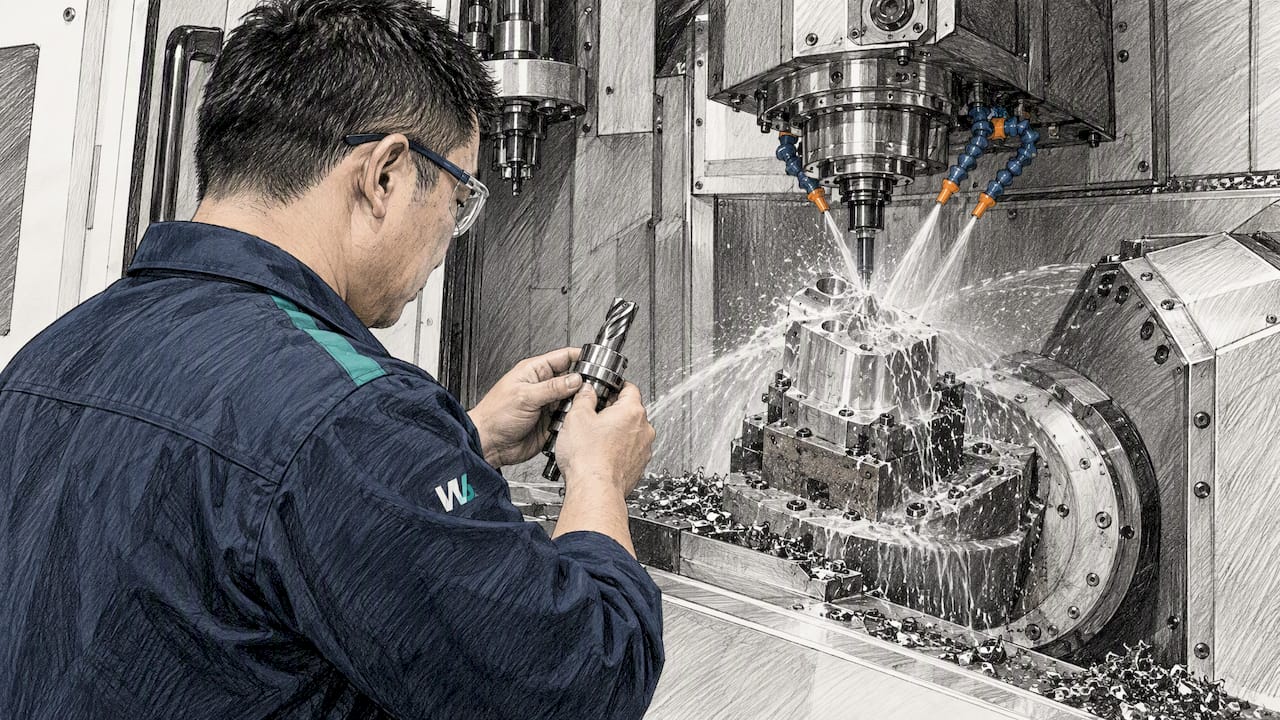
Pro Tip: Ask a prospective supplier for their actual cutting parameters and tool-change log on a past titanium job, not a general capability statement.
Regulated titanium parts live or die on paperwork as much as on machining quality. A finished part with no documented link back to its mill heat is a liability for aerospace and medical buyers, regardless of how clean the machining looks.
Build your acceptance criteria around these documents:
The chain from mill heat number to MTR to finished part is the backbone of acceptable traceability. FAA guidance on premium titanium manufacturing stresses documented process controls and inspection regimes across forging, heat treatment, and machining specifically because gaps in that chain are where material anomalies go undetected until a part is already in service. ISO 9001 certification is a reasonable baseline filter, but it is not a substitute for seeing an actual CMM report and FAI package from a comparable job. Our guide to quality control practices in Chinese CNC shops walks through what a complete inspection package should contain before you sign off on a supplier.
Titanium costs more to machine than most metals for reasons beyond the raw material price. Low material removal rates mean longer spindle time per part, tooling wears faster and adds to overhead, and the documentation a regulated part requires, MTRs, FAI, PQR, adds both labor and schedule.
Expect lead times to vary with part complexity and documentation scope:
To get quotes you can actually compare, structure every RFQ the same way: include full tolerance callouts from the drawing, state whether MTR and FAI are required, specify the finish, state the batch size, and define delivery incoterms. A supplier quoting without that information is guessing, and so are you. Our CNC machining service page outlines what to include in a quote request for titanium and other difficult-to-machine metals.
Technical capability alone does not make a supplier reliable. Documentation discipline and clear communication matter just as much, and screening for both at once saves a failed first order.
Run supplier calls around a short, consistent checklist:
Treat hesitation as information. A supplier that refuses to share an MTR, gives vague answers about tooling, or pushes a large minimum order without offering process evidence first is signaling a gap you will discover later, usually after parts have shipped.
We run CNC machining for titanium under an ISO-certified process, with experience meeting aerospace and medical tolerance requirements. Our team works from your drawings to produce inspection packages and necessary documentation tied to the finished parts.
Send your drawings, required alloy grade, and any AMS or ASTM callouts, and we will return a quote and a process-qualification checklist you can review before committing to a batch.
The most common mistake is treating material certification as a formality instead of a chain. “Certified material” without a mill heat number on the MTR tells you almost nothing about the part in your hand. Starting the inspection and material conversation before the first piece is cut, not after, is what actually prevents rework.
— Nas
We offer CNC machining for titanium parts with ISO-backed process controls and documentation services included. Send your drawings and required alloy grade through our CNC Machining Service page, and you can request a process-qualification checklist alongside your quote.
Yes, titanium is routinely CNC machined using milling, turning, and EDM processes, though its low thermal conductivity and chemical reactivity make it slower and more tool-intensive than steel or aluminum. Shops that use high-pressure coolant, controlled cutting parameters, and tool-wear monitoring produce consistent results on both prototype and production volumes.
Low-speed, high-torque cutting, many-tooth cutters, constant radial-depth toolpaths, and high-pressure coolant are the main practices shops use to manage titanium’s heat concentration and resulting tool wear. Some suppliers also use workpiece preheating, which experimental testing has shown can extend tool life in certain setups.
Require a material test report carrying the mill heat number, a certificate of conformance, a first article inspection report, and CMM inspection data tied to that specific part. For regulated applications, FAA and NASA guidance both stress unbroken traceability from raw material through finished part.
Structure every RFQ identically: include full drawing tolerances, state whether an MTR and FAI are required, specify the finish, state the batch size, and define delivery incoterms. Quotes built on inconsistent information are not comparable, regardless of the price difference shown.
Ti-6Al-4V, also called Grade 5, is the standard choice for most structural aerospace and industrial titanium parts due to its balance of strength, weight, and machinability. Medical implant applications typically call for Ti-6Al-4V ELI, or Grade 23, which has lower oxygen content for improved fracture toughness.
SERVICES
RESOURCES