



- Room 1807, Unit 9, Building 2, Shangxing Commercial Street, Shangde Road, Shangxing Community, Xinqiao Subdistrict, Bao'an District, Shenzhen City, China
CONTACT US

WhatsApp


Contact Us
Our team is on stand by, waiting toassist you.

Videos
A large collection of educational videos and tutorials.

About Us
Learn about our company, leadership, and mission totransform manufacturing.

Privacy Policy
Applies to all personal information collected through and/or processed in connection.


Aerospace & UAV
WJ Prototypes is your 3D manufacturing partner from prototype to large scale production.

Consumer Electronics
New Product Introduction Solutions for Consumer Electronics.

Robotics & Automation
Need some assistance bringing your robotic device or parts from the sketch-board to reality?

Medical Devices
The medical industry needs high quality, dependable and safe parts and products.

Automotive
New Product Introduction Solutions for Automotive

Industrial Machinery
The main purpose of industrial prototyping is to take the product from drawings into the real world.

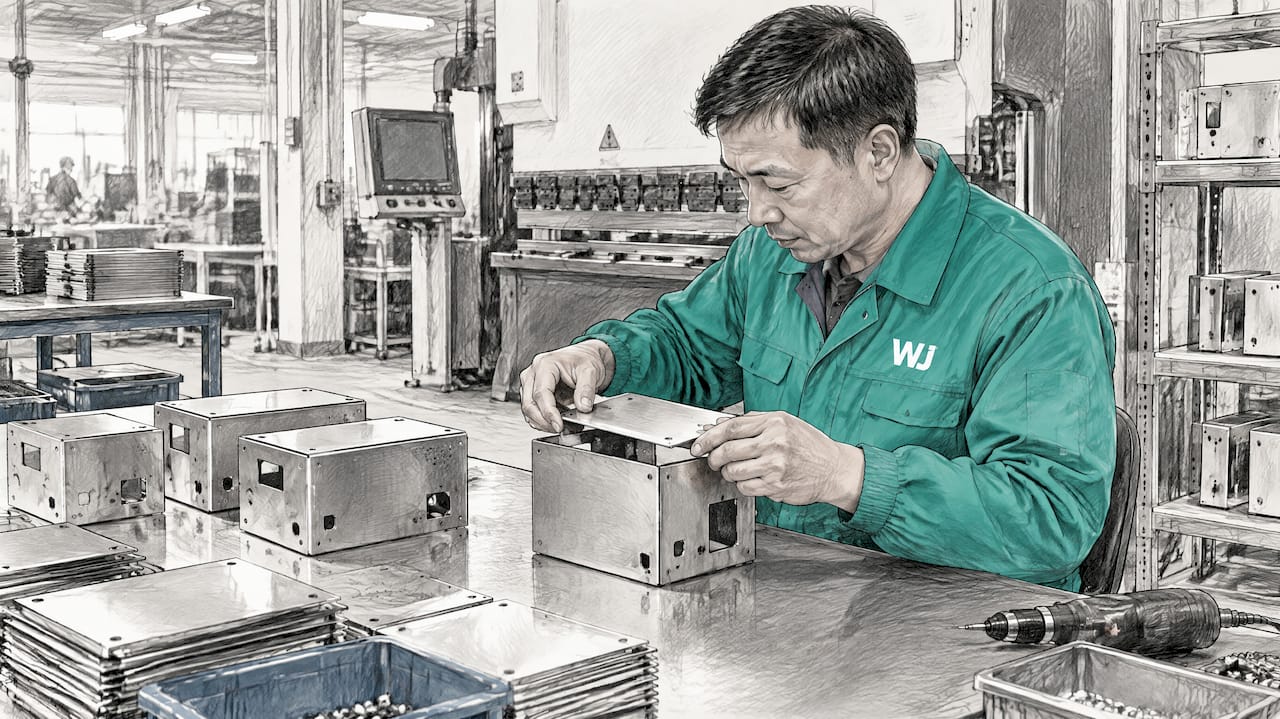
For custom sheet metal housings made in low volume, we recommend starting with WJ Prototypes for its combined prototyping and sheet metal capability, then benchmarking against JUSHUN Metal, Dongguan Lemo Precision Metal Products, RapidDirect, and Komaspec (Komacut). Before committing to any of them, ask for sample parts and a first-article inspection report so you can judge actual quality instead of a sales pitch.
TL;DR:
- Suppliers with laser-cutting and bending capabilities offer the fastest turnaround for low-volume housings, typically within 7 to 15 business days.
- Request a sample part and a first-article inspection report before placing an order to verify quality and avoid relying solely on sales claims.
- Understand that import duties for steel and aluminum from China depend on current antidumping and subsidy rates, which can significantly affect total landed costs.
- Choose a supplier whose process capabilities match your part requirements, and confirm minimum order quantities in writing, especially for finishes and assembly.
- Prioritize process verification through samples and inspection reports over supplier reputation or website polish when managing trade and quality risks.
Once you have a shortlist, the differences that matter are capability fit, minimum order flexibility, and how fast a supplier can turn a drawing into a sample part. We put WJ Prototypes first because its sheet metal work sits alongside CNC machining and additive processes under one quoting system, which matters when a housing needs a machined bracket or a 3D-printed fixture alongside the sheet metal shell.
A few patterns worth noting before you send RFQs:
The labels in a comparison table hide real process differences that affect your cost and schedule. Sheet metal fabrication generally breaks into a few process families: laser cutting paired with press-brake bending, metal stamping with hard tooling, progressive-die stamping for higher-repeat parts, and welded assemblies that combine multiple formed pieces into one housing. Standard sheet metal processes include cutting, bending, welding, and finishing, and each one carries its own cost and lead-time profile.
Laser cutting and bending suit low volumes well because there is no hard tooling to amortize: you pay mostly for cutting time, bending setups, and material. Stamping and progressive tooling make sense once a part repeats into the thousands, since the tooling cost gets divided across many units. A supplier that only stamps may quote cheaply at volume but quote poorly, or decline the job, for a run of 20 or 50 housings.
A few trade-offs show up again and again when comparing quotes for the same housing:
The practical move is to decide how much of that complexity you want one vendor to own. A housing with a powder-coat finish and a pressed logo badge is simpler to manage through a single integrated shop than through three separate vendors stitched together by your own project manager.
Pro Tip: Split your first order into a paid prototype run of 1 to 5 units followed by a separate low-volume pilot of 50 to 200 units. This lets you catch tolerance or finish issues on a cheap sample before committing to tooling or a larger material buy.

Choosing a partner for prototyping and low-volume runs is less about finding the cheapest quote and more about finding a supplier whose process matches your part and whose quality claims you can verify before money changes hands.
When you send an RFQ, include direct questions such as: “Can you provide a first-article inspection report?” and “What is the minimum order quantity for powder-coated assemblies?” A supplier that answers both clearly and quickly is usually easier to work with across the life of the order.
Red flags include vague answers about tooling costs, reluctance to share a sample part, or payment terms that demand full payment before any inspection opportunity. When a supplier is new to you, insist on a third-party inspection before the shipment leaves China, and structure payment as a deposit plus balance on passed inspection rather than full payment upfront.
Pro Tip: Keep your RFQ identical across every supplier, down to the finish callouts and quantity breaks, so the quotes you get back are actually comparable instead of apples to oranges.
Chinese suppliers commonly quote prototype turnaround in a typical range of business days for simple laser-cut-and-bend parts, with finishing, tooling, or inspection requirements adding days on top of that window. A welded assembly or a part requiring anodizing will typically run longer than a single bent bracket.
Your quote is built from a handful of cost drivers, and separating them is the key to comparing suppliers fairly:
One of the clearest signals of a comparable quote is whether the supplier separates tooling or setup cost from unit price, since bundling the two makes it impossible to see how your per-unit cost changes as volume grows. Our sheet metal fabrication workflow guide walks through how engineering requirements feed into that timeline.
Sourcing decisions improve once you understand that Chinese sheet metal capacity clusters by region, and each cluster tends to specialize.
Picking the right cluster affects more than lead time. A supplier embedded in an electronics-heavy cluster can usually source plating or assembly services locally, which simplifies your supply chain and shortens the freight legs between fabrication and finishing. For a highly specialized part, a dedicated specialist shop outside the obvious cluster may still beat a generalist on tolerance or repeatability, so cluster location should inform your shortlist rather than decide it outright.
ISO 9001 describes requirements for a documented quality management system, which means certification tells you a supplier has process controls in place, not that any specific part will meet your drawing. Treat the certificate as a starting point, then verify with your own evidence.
Our guide to managing ISO 2768 tolerance risk covers how to set tolerancing expectations before a part ever reaches the shop floor. A partner resource on quality monitoring outlines practical inspection checkpoints worth building into your own process.
Trade risk is the part most buying guides skip. The U.S. Department of Commerce issued final affirmative determinations in antidumping and countervailing duty investigations of temporary steel products from China on March 11, 2026, with margins and cash deposit rates that vary by exporter. A separate set of final determinations covering aluminum extrusions from China and other countries, issued September 27, 2024, lists published dumping and subsidy rates by producer. Before ordering housings made from steel or aluminum extrusions, check your part’s HTS classification and current duty status, since rates differ by exporter and can change.
Most supplier roundups rank by review count or certificate logos, which rewards marketing polish over actual fit. A supplier with a slick website and a long client list isn’t automatically the right match for a 30-unit pilot run with tight bend tolerances, and a smaller, less-marketed shop with the right process match can outperform it.
The bigger blind spot is trade exposure. Buyers compare lead time and unit price obsessively, then skip the HTS classification check that can swing landed cost more than any fabrication discount. A housing built from steel subject to an active antidumping determination can cost far more delivered than the quote suggested, and that risk sits outside the supplier relationship entirely.
Our own view: prioritize process fit and verification first, price second. Get a sample part, get an inspection report, and check your duty exposure before you ever negotiate unit cost. A cheap quote on an unverified process, or one riding an unchecked tariff exposure, isn’t actually cheap once the shipment lands.
— Nas
We built WJ Prototypes around the exact problem this article addresses: getting from a drawing to a verified low-volume batch without juggling three separate vendors. Our sheet metal fabrication service covers cutting, bending, welding, and finishing, and it sits alongside our CNC machining and 3D printing work under one quoting system, with no minimum order quantity and an ISO-certified process behind it.
We fit well when your housing needs multiple processes coordinated under a single timeline instead of three. When you send us an RFQ, include your drawing with tolerance callouts, your target finish, your expected volume, and whether you need a first-article inspection report before production release. From there, you can get a quote for sheet metal fabrication directly through our site.
Low-volume manufacturing refers to producing a limited batch, typically a handful to a few hundred units, without the hard tooling investment that high-volume stamping requires. It usually relies on laser cutting and press-brake bending rather than progressive dies, which keeps per-unit cost reasonable at small quantities.
Simple laser-cut-and-bend prototypes commonly ship in about 7 to 15 business days from a final drawing, though finishing steps like powder coating or anodizing add time. Welded assemblies or tighter-tolerance parts typically run toward the longer end of that window.
Ask for the certificate itself along with a sample part or first-article inspection report, since ISO 9001 confirms a documented quality management system rather than guaranteeing any specific part meets your drawing. A third-party inspection on your first order adds an independent check beyond the paperwork.
Some steel and aluminum products from China are subject to antidumping and countervailing duty determinations, including a March 2026 determination on temporary steel products and a 2024 determination on aluminum extrusions. Check your part’s HTS classification and current duty status before ordering, since rates vary by exporter.
We have no minimum order quantity for sheet metal fabrication, making it workable for both single prototypes and small pilot batches. Pricing and lead time are provided through an online quote system once you submit your drawing and specifications.
SERVICES
RESOURCES