



- Room 1807, Unit 9, Building 2, Shangxing Commercial Street, Shangde Road, Shangxing Community, Xinqiao Subdistrict, Bao'an District, Shenzhen City, China
CONTACT US

WhatsApp


Contact Us
Our team is on stand by, waiting toassist you.

Videos
A large collection of educational videos and tutorials.

About Us
Learn about our company, leadership, and mission totransform manufacturing.

Privacy Policy
Applies to all personal information collected through and/or processed in connection.
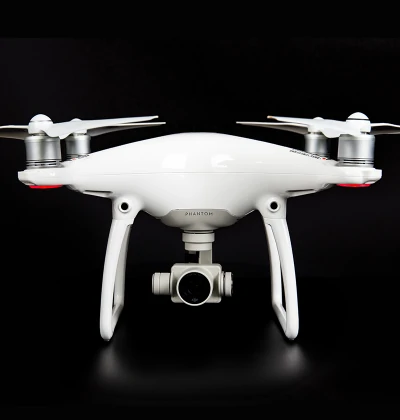

Aerospace & UAV
WJ Prototypes is your 3D manufacturing partner from prototype to large scale production.

Consumer Electronics
New Product Introduction Solutions for Consumer Electronics.

Robotics & Automation
Need some assistance bringing your robotic device or parts from the sketch-board to reality?

Medical Devices
The medical industry needs high quality, dependable and safe parts and products.

Automotive
New Product Introduction Solutions for Automotive

Industrial Machinery
The main purpose of industrial prototyping is to take the product from drawings into the real world.
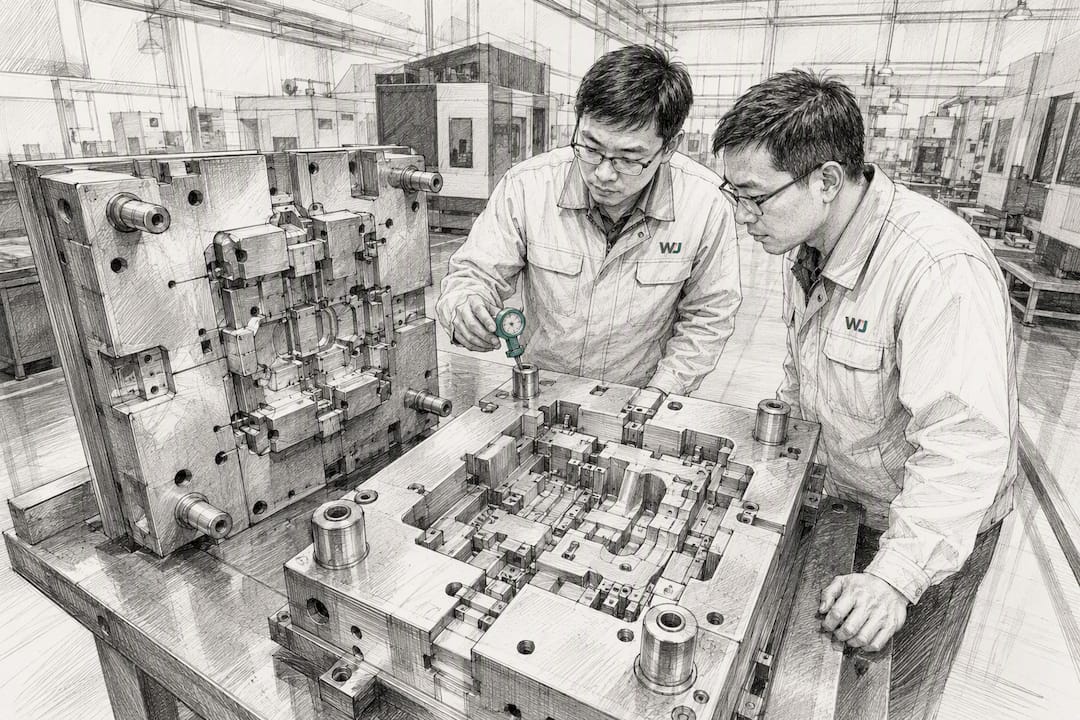
Expect to spend $5,000 to $15,000 on rapid tooling plus $2 to $15 per part for a first small batch, though hardened production tooling can push past $100,000 once you scale. The three variables that swing that number the most are tooling class, annual or first-batch volume, and alloy or part weight. Before you request quotes, standardize your RFQ around tooling type, alloy spec, volume tiers, and inspection level so the numbers you get back actually compare against each other.
TL;DR:
- Rapid tooling in China generally costs $5,000 to $15,000, suitable for design validation, while production tools can exceed $100,000 for high-volume runs.
- Tooling complexity, part size, and features can double or triple costs within each class, influencing lead times from 10 days to 8 weeks.
- For batches under 1,000 units, machining or vacuum casting may be more cost-effective than die casting due to tooling amortization, which favors larger volumes.
- Accurate quotes require detailed breakdowns of tooling, finishing, inspection, and shipping to prevent hidden costs from inflating the initial price.
- Choosing between rapid and production tooling hinges on program volume, part complexity, and design stability, with investments in tooling reflecting their intended lifespan.
Tooling cost is the single biggest lever in any die casting prototype cost in China estimate, and it splits into three distinct classes with very different price tags and use cases.
Rapid or soft tooling runs roughly $5,000 to $15,000. It relies on aluminum inserts or 3D-printed cavities instead of hardened steel, and it’s built for design validation, not for surviving 50,000 shots. Production-capable pilot tooling costs more, typically $20,000 to $80,000 or more, and it bridges the gap between a proof-of-concept part and a tool that can actually support a launch volume. Complex hardened tools with multiple cavities, side-action slides, or tight tolerance requirements climb well above $100,000.
Part complexity moves within each band. A simple bracket with two mounting bosses and no undercuts sits at the low end of its tooling class. A housing with internal ribbing, thin walls under 1.5 millimeters, or a side-core for a window opening can double the tooling price inside the same class, because the mold needs extra slides, lifters, or EDM work to form those features.
Lead time tracks the tooling class closely:
If your goal is a handful of parts to test fit and function, soft tooling gets you there fast. If the same tool needs to survive a production ramp, pay for hardened steel from the start rather than re-tooling later.
Volume is where die casting economics get counterintuitive. The tool itself is a fixed cost, so every part you run absorbs a smaller slice of that upfront investment. Material, cycle time, and labor are variable costs that barely change per unit, but the tooling amortization drops sharply as the batch grows.
A should-cost model built around a 200-gram aluminum bracket in A380 alloy shows how steep that curve is. At 500 units, the modeled per-part cost lands around $14.7. At 5,000 units, it falls to roughly $4.6. Push to 50,000 units, and the same part costs about $1.8 each, once tooling is fully amortized across the run.
| Part type | 50 units | 500 units | 5,000 units | 50,000 units |
|---|---|---|---|---|
| Light bracket (~200g) | High per-unit cost, tooling dominates | ~$14.7 | ~$4.6 | ~$1.8 |
| Medium housing | Often not economical yet | Higher than bracket | Meaningfully lower | Approaches material floor |
| Heavy housing (1kg+) | Rarely worth die casting | Still tooling-heavy | Competitive with CNC | Best economics |
Pro Tip: Run your own part weight and expected annual volume through this same math before you commit to a tool. If your first-year volume sits under 500 units, a rapid tool that costs less upfront often beats a hardened tool you won’t amortize for years.
As a rule of thumb, die casting starts beating machining or short-run injection somewhere around the 500 to 1,000 unit mark for small aluminum parts, and the advantage widens fast past 5,000 units. Below that, tooling amortization eats any savings on a per-part basis.
A quoted tool price that looks great on paper can turn into a much bigger bill once trimming, trial shots, and finishing show up as separate line items. The mold price should itemize every one of these upfront, not after the tool is cut.
Tool life expectations vary enormously by class. A rapid aluminum insert might handle a few hundred to a few thousand shots before wear shows up in wall thickness or surface finish. A hardened H13 steel tool can run hundreds of thousands of cycles with proper maintenance. Buy rapid inserts when you’re still validating the design. Buy hardened tools once the geometry is frozen and you know the program volume.
Before signing off, ask your supplier three direct questions: how many shots is the quoted tool life rated for, what happens if the tool fails before that count, and is a maintenance or refurbishment schedule included in the price. Vague answers here are the biggest predictor of surprise costs later.
The unit price on a die casting quote rarely reflects what actually lands at your dock.
Inspection level is its own cost lever. AQL sampling (checking a statistical subset of a batch) costs the least but carries the most risk of a bad part slipping through. 100% manual inspection costs more in labor. CT scanning for internal porosity or wall thickness verification costs the most per part but catches defects nothing else can see. Match the inspection level to how critical the part actually is, not to habit.
Shipping terms matter just as much. FOB pricing puts freight and import handling on you. CIF bundles freight into the quote but leaves customs clearance on your side. DDP means the supplier handles duties and delivery to your door, usually at a premium that’s worth it if you don’t have a customs broker on retainer. Read more on how these hidden charges compound before comparing quotes on price alone.
Two suppliers quoting the “same part” often aren’t quoting the same thing at all. One RFQ template, sent to every supplier, is the only way to fix that.
Ask every supplier to break out tooling, per-part price at each volume tier, finishing, inspection, packing, and freight as separate lines. A bundled number hides where you actually have room to negotiate.
Pro Tip: Your strongest negotiation lever isn’t asking for a discount, it’s changing the design. Removing undercuts, adding draft angle, or moving a machined feature into the die can cut tooling complexity and per-part cost more than any percentage a sales rep will knock off a quote.
Die casting isn’t always the answer at prototype stage, and picking it by default wastes money on tooling you don’t need yet.
Parts with thin walls, complex internal geometry, or a need for die-cast-specific strength should lean toward die casting even at modest volumes. If you’re still choosing between methods, our comparisons of injection molding prototype costs and vacuum casting walk through the same decision from the other direction.
Size and geometry stack on top of tooling class to set your actual price. A small, simple bracket under 100 grams with a single cavity and no side actions sits at the floor of whatever tooling class you choose, often the low end of that $5,000 to $15,000 rapid-tooling band.
Add complexity and the number climbs fast. A mid-size housing (300 to 800 grams) with ribbing, bosses, and one side-core typically needs a bigger tool and more EDM time, pushing tooling cost toward the middle or upper end of the pilot tooling range. Multi-cavity tools for smaller parts spread tooling cost across more parts per shot, but the tool itself costs more upfront because each additional cavity needs its own cooling and ejection system.
Large housings or structural parts over a kilogram introduce a different problem: shot size and machine tonnage. Bigger parts need bigger machines, which usually means a different supplier tier and sometimes a different per-shot cost structure entirely. Wall thickness uniformity matters here too. A part with wall sections ranging from 1 millimeter to 4 millimeters in the same casting invites warping and porosity, which drives up your scrap rate and inspection cost regardless of tooling class.
The practical takeaway: get your 3D model reviewed for wall thickness consistency and draft angles before you request quotes, not after. A five-minute design review can shift a part from the expensive end of a tooling band to the cheap end of it.
Prototype tooling and production tooling solve different problems, and pricing them the same way is where budgets go wrong. Prototype tooling optimizes for speed and low upfront cost. It accepts a shorter tool life and a higher per-part cost in exchange for getting real metal parts in your hands in weeks instead of months.
Production tooling flips that math. It costs more upfront, often three to ten times more than a rapid insert for the same part, because it’s cut from hardened tool steel rated for hundreds of thousands of cycles. In exchange, per-part cost drops substantially since the tool amortizes across a much larger run and needs far less mid-run maintenance.
The mistake we see most often is treating prototype tooling cost as a rough preview of production cost. It isn’t. A rapid tool quoted at $8,000 doesn’t scale linearly into a $16,000 production tool just because the part is twice as complex. Production tooling pricing depends on cavity count, expected cycle life, and whether the tool needs hot-runner style cooling channels that a soft tool skips entirely.
Budget for both phases separately from the start. Treat your prototype tooling spend as a design validation cost you’ll likely not reuse, and treat production tooling as the capital investment that actually needs to survive your program’s full volume.
Every design change after a tool is cut has a price, and it’s rarely just the cost of re-cutting steel. A minor dimensional tweak, like adjusting a hole diameter by half a millimeter, might only cost a few hundred dollars in EDM rework on a rapid tool. Add a new feature, like a boss or rib that wasn’t in the original design, and you’re often looking at a partial re-cut that can run into the low thousands.
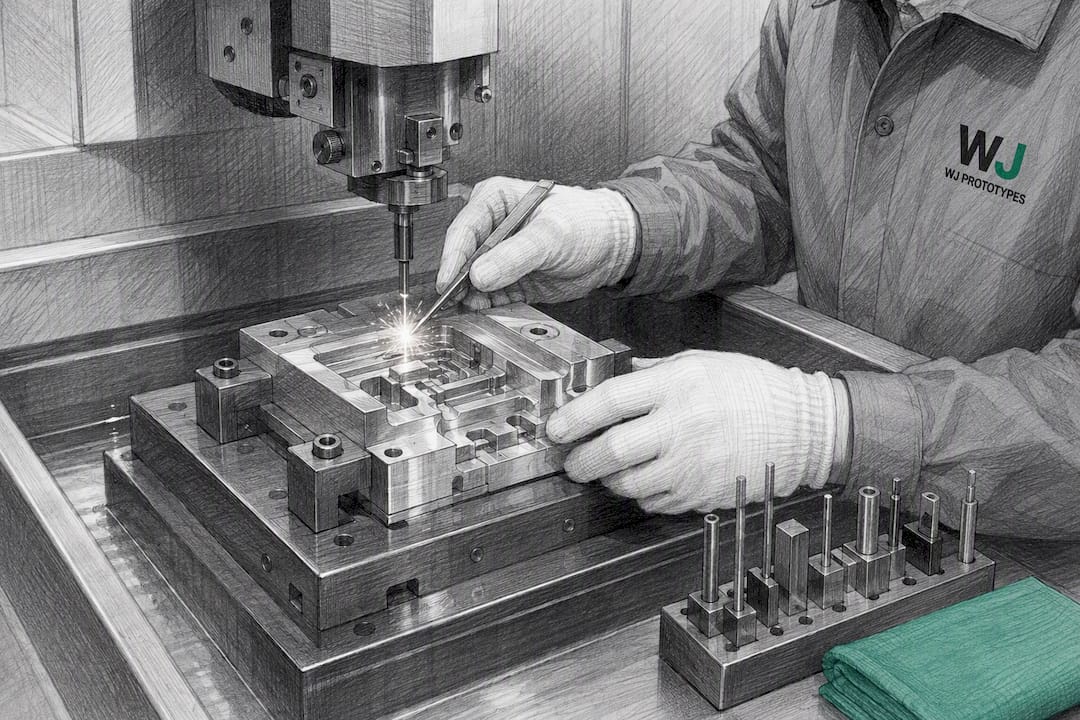
The expensive iterations are the ones that change core geometry, like adding an undercut that requires a new slide, or changing wall thickness enough to affect cooling time and cycle economics. Those changes can mean scrapping the insert entirely and starting over, which erases whatever time and cost advantage you got from choosing rapid tooling in the first place.
This is why locking your design before cutting a tool matters more than shaving a few dollars off the initial quote. Two or three rounds of iteration on a rapid tool is normal and budgeted for in most programs. Five or six rounds usually means the design wasn’t ready for tooling yet, and every one of those rounds adds days to your timeline along with the rework cost.
If you expect significant design uncertainty, ask your supplier about 3D-printed insert tooling before committing to machined aluminum. It costs less to modify or scrap if the design changes again.
That gap is widest on labor-intensive tooling work and narrows somewhat on raw material, since aluminum alloy pricing is a global commodity market.
Other Asian manufacturing hubs, including parts of Southeast Asia, compete on labor cost but often lack the same density of die casting specialists and tooling shops concentrated in China’s manufacturing regions. That density matters more than it sounds: more competing shops means more suppliers bidding on your rapid tooling job, which keeps quotes honest.
The trade-off isn’t free. Longer shipping lead times, time zone communication gaps, and the need for careful supplier vetting are the real cost of that price advantage. A supplier who’s slow to answer technical questions or vague about tool life warranties can cost you more in delays than you saved on the quote. Budget the communication overhead as part of your total cost comparison, not as a footnote.
Tooling lead time is only part of your real timeline. Add design finalization, sampling rounds, and shipping, and a rapid-tooling program typically runs 6 to 10 weeks from signed RFQ to parts in hand. A production tooling program, including sampling and approval cycles, stretches to 12 to 18 weeks in many cases.
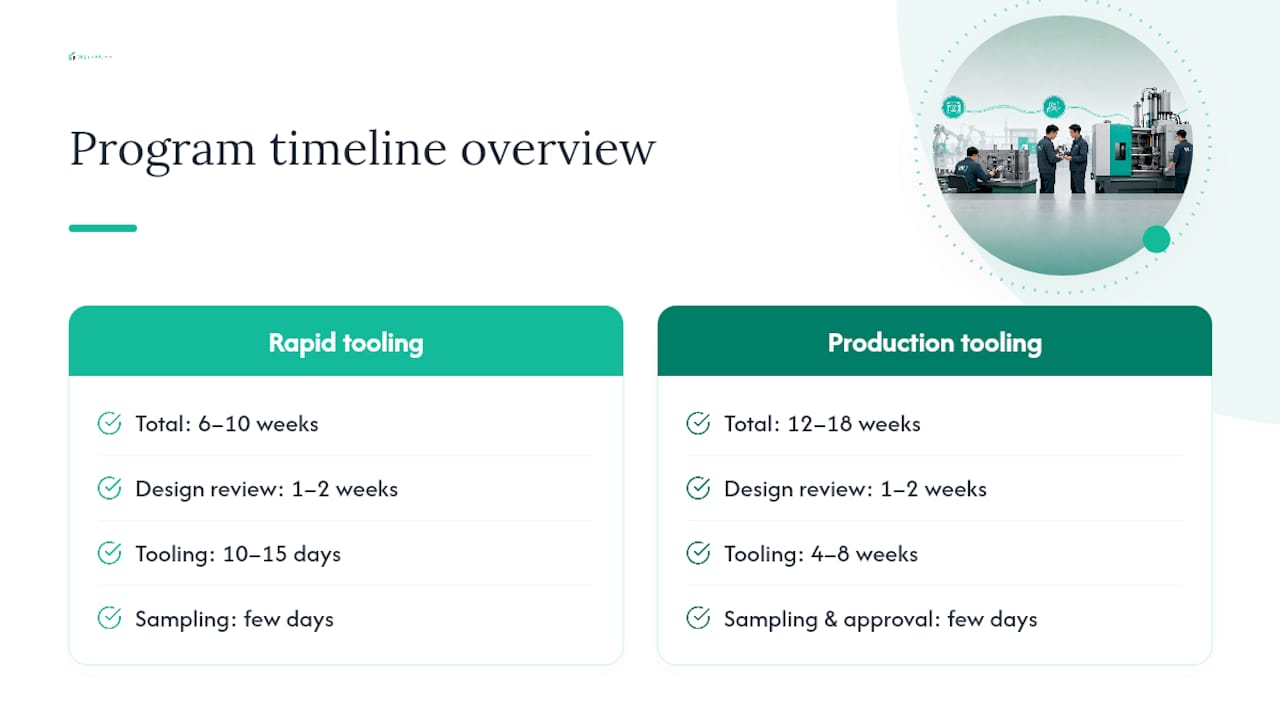
Break that down and it looks roughly like this: 1 to 2 weeks for final design review and DFM feedback, then 10 to 15 days for rapid tooling or 4 to 8 weeks for pilot and production tooling. First-shot samples typically ship within a few days of tooling completion, but post-processing adds time on top of that. CNC machining of secondary features adds 3 to 7 days. Surface finishing like anodizing or powder coating adds another 5 to 10 days depending on batch size and finisher availability.
Then there’s shipping. Air freight from China to the US typically takes 5 to 9 days door to door. Ocean freight takes 25 to 40 days but costs a fraction of the price, which matters if you’re shipping a production batch rather than a handful of samples. Customs clearance adds a few more days unless you’ve arranged DDP terms in advance.
Build your program calendar around the slowest realistic case, not the fastest quoted one. A supplier’s “10 days for tooling” rarely accounts for a design revision round or a holiday shutdown, both of which happen more often than buyers expect.
Cost reliability isn’t just about getting a low number, it’s about getting a number that holds up once production starts. The single best predictor of quote reliability is whether a supplier is willing to itemize every line: tooling, per-part price at multiple volumes, finishing, inspection, and freight, as separate figures rather than one bundled total.
Ask for photos or video of a comparable tool they’ve built before, not just finished parts. Tooling craftsmanship is where quality problems usually originate, and a supplier proud of their tool-making work will show it without hesitation. Confirm ISO certification status directly rather than taking a website badge at face value, and ask what quality management system governs their inspection process.
Check how they handle disputes over defective tooling or missed tolerances. A supplier with a clear, written policy on rework and tool warranty is telling you they’ve dealt with this before and have a process for it. One who gets vague or defensive is telling you something too.
Finally, weigh communication speed as a cost factor, not just a convenience. A supplier who answers technical questions within a day saves you weeks of back-and-forth over a multi-month tooling program, and that time has real dollar value even though it never appears on the quote itself.
We built our die casting service around exactly this problem: buyers getting burned by bundled quotes that hide tooling amortization and secondary costs. Our process itemizes tooling, part price, and finishing separately, the same structure this guide recommends. On one recent aluminum housing program, starting with rapid tooling let the client validate three design revisions before committing to a hardened production tool, avoiding a costly re-cut. Our instant quote tool lets you submit the same specs to every supplier you’re comparing, so the numbers you get back actually mean something.
— Nas
This provider offers transparent quoting for die casting prototype cost in China: quotes break out tooling, per-part price across volume tiers, finishing, and inspection as separate line items, so you know what you’re paying before committing.
Our die casting service covers rapid and production tooling in aluminum and zinc alloys, with in-house CNC finishing, surface treatments, and inspection up to full dimensional reporting, all backed by ISO quality management. If your part also needs a different process at prototype stage, our CNC machining and vacuum casting services run through the same instant quoting system.
To get started, upload your drawing and specify alloy, volume tiers, and tolerance requirements through our online quote form. A project manager reviews your file and typically returns an itemized quote within a few business days. Submit your specs now and get a comparable, line-by-line quote instead of a single bundled number.
Rapid tooling for a die cast prototype typically runs $5,000 to $15,000, plus $2 to $15 per part for a small first batch depending on size and complexity. Production-capable tooling costs more upfront but drops the per-part price substantially at higher volumes.
China’s die casting industry includes thousands of manufacturers ranging from small tooling shops to large ISO-certified operations serving aerospace and automotive clients. WJ Prototypes is one such ISO-certified provider offering both rapid and production tooling with itemized quoting.
Cost depends heavily on method: CNC machining suits one to 20 units cheaply without tooling investment, while die casting requires $5,000 or more in tooling but drops per-part cost sharply past a few hundred units. Vacuum casting and short-run injection molding fill the gap between those two extremes for plastic or rubber parts.
There’s no single “best” supplier since fit depends on your part’s alloy, tolerance, and volume needs. The more useful question is which suppliers itemize tooling, per-part cost, and finishing separately in their quotes and can show proof of comparable tool-making work, since that transparency predicts reliability better than any general reputation claim.
Rapid tooling costs $5,000 to $15,000 and lasts a few hundred to a few thousand shots, while production tooling costs $20,000 to $80,000 or more but survives hundreds of thousands of cycles. The choice depends on whether your design is finalized and what volume you expect in year one.
SERVICES
RESOURCES