



- Room 1807, Unit 9, Building 2, Shangxing Commercial Street, Shangde Road, Shangxing Community, Xinqiao Subdistrict, Bao'an District, Shenzhen City, China
CONTACT US

WhatsApp


Contact Us
Our team is on stand by, waiting toassist you.

Videos
A large collection of educational videos and tutorials.

About Us
Learn about our company, leadership, and mission totransform manufacturing.

Privacy Policy
Applies to all personal information collected through and/or processed in connection.

Aerospace & UAV
WJ Prototypes is your 3D manufacturing partner from prototype to large scale production.

Consumer Electronics
New Product Introduction Solutions for Consumer Electronics.

Robotics & Automation
Need some assistance bringing your robotic device or parts from the sketch-board to reality?

Medical Devices
The medical industry needs high quality, dependable and safe parts and products.

Automotive
New Product Introduction Solutions for Automotive

Industrial Machinery
The main purpose of industrial prototyping is to take the product from drawings into the real world.
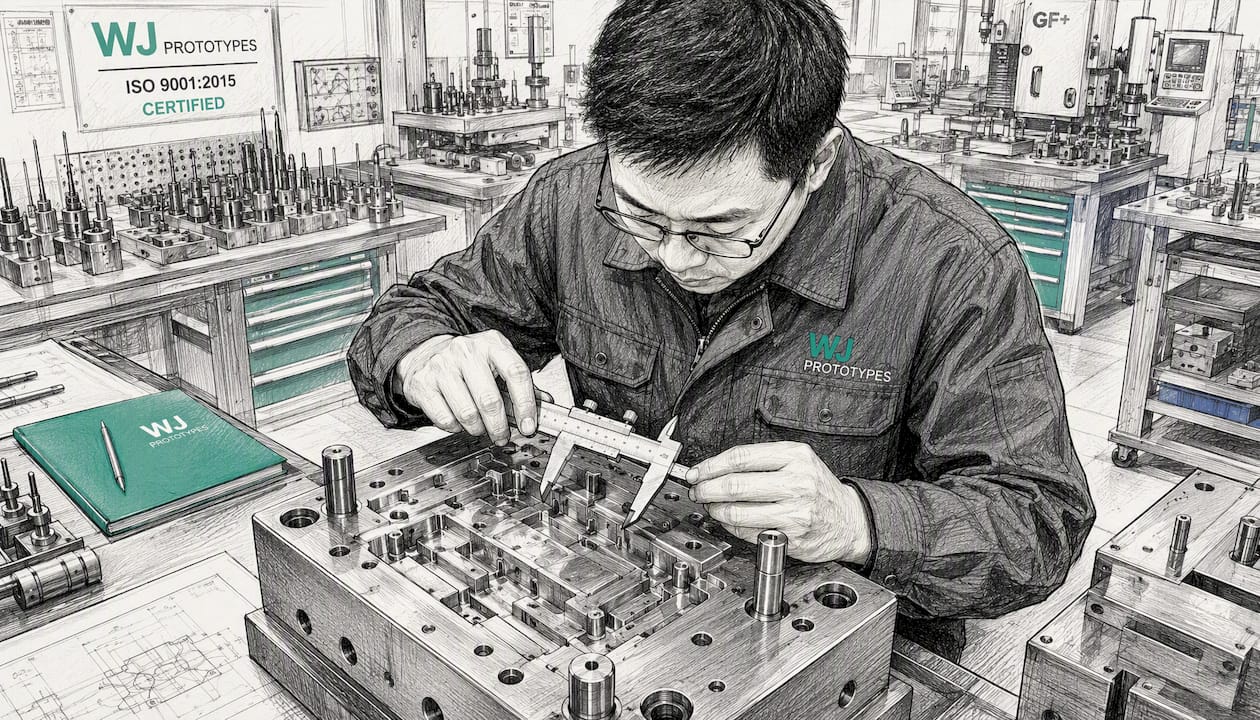

Relax every nonfunctional dimension to the nearest standard tolerance band, and hold tight tolerances only on mating and functional features. That single rule drives more total cost swing in Chinese injection molding than any material choice or vendor negotiation. A prototype mold in China typically runs $1,000 to $3,000, while a hardened production tool with tight cavities climbs to $20,000 to $80,000 or more. The gap between those numbers is almost entirely tolerance-driven.
The fastest way to find your breakpoint is a POR/POT ranking (percentage of range from average, percentage of tolerance) borrowed from production tolerance research, then amortizing tooling cost against your real production volume.
Quick math: if tighter tooling adds $8,000 but saves $0.15 per part in scrap and inspection, you need roughly 53,000 parts to break even.
Total cost in Chinese injection molding is minimized by relaxing nonfunctional tolerances to standard bands and reserving tight tolerances for features that genuinely need them.
| Point | Details |
|---|---|
| Rank by POT, not intuition | Calculate percentage of tolerance for every dimension before deciding what to tighten. |
| Tooling bands respond to specs | China prototype tools run $1,000 to $3,000; complex production tools reach $20,000 to $80,000+. |
| Run the break-even math | Divide the tooling cost delta by the per-part savings delta to find your justified volume. |
| Request two-option quotes | Ask every factory for both a P20 prototype quote and an H13 production quote. |
| Build feasibility review into the process | WJ Prototypes applies POR/POT ranking and T1/T2 trial stages before full production release. |
Every tolerance you specify is a promise about repeatability, and every promise costs something to keep. A tolerance band is the allowed deviation around a nominal dimension. Two related metrics matter more in practice than the raw tolerance number: POT (percentage of tolerance from dimension) tells you how tight a spec is relative to the part’s own scale, and POR (percentage of range from average) tells you how a mold actually performs once you’re running production data through it.
Here’s the part most engineers miss: identical decimal tolerances carry wildly different difficulty depending on where they sit. The number on the drawing looks the same. The manufacturing reality is not.
General tolerancing standards such as DIN 16901 give a reasonable starting point, but they weren’t built specifically around injection molding’s shrinkage behavior, so treat them as a first pass rather than a final spec.
Pro Tip: Before you flag a part as out-of-tolerance, check your gage’s repeatability. A lot of “failed” parts are actually measurement noise, not molding error, especially below 0.1 mm.
A practical starting POR of 0.2% to 0.3% gives you a baseline before real production data refines it.
Tighter tolerances don’t just add a line-item fee. They ripple through the entire tooling build and every part that comes off it afterward.
On the tooling side, here’s what actually gets more expensive:
On the per-part side, tight tolerances raise:
In China’s tooling market, these choices are exactly what push a quote from one price band into the next. Haizol’s factory-price data shows mid-volume tools running $5,000 to $15,000, with complex, tight-tolerance production tools climbing past $20,000. The steel grade you choose, the cavity count you request, and the finish class you specify are the three levers that move you between those bands, often more than the part’s size or shape does.
The POR/POT method exists because raw tolerance numbers lie about difficulty. Ranking dimensions this way tells you where to spend your tooling budget and where you’re wasting it.
Take a 2.0 mm feature with a ±0.05 mm tolerance against a 200.0 mm feature with the same ±0.05 mm tolerance. Same tolerance, opposite risk profile.
Pro Tip: *Rank every dimension on your drawing by POT before you send it out for quotes.
Design-for-manufacturability isn’t a checklist you run once. It’s a running negotiation between what the part needs to do and what the tool can hold cheaply.
The trade-off question comes down to volume and precision needs:
One vignette worth remembering: a housing that needed a tight bore for a bearing press-fit got that bore added as a secondary drilling and reaming operation instead of an EDM’d mold feature. The tool quote dropped by roughly a third, and the secondary op added pennies per part, a clear win below moderate production volumes.
Your inspection plan should match your tolerance risk, not run on autopilot. Loose tolerances on noncritical dimensions rarely need more than periodic sampling.
Pro Tip: Never specify a tolerance tighter than your gage’s measurement uncertainty. If your CMM has 0.01 mm repeatability, a ±0.02 mm tolerance leaves almost no margin for confidence in a pass/fail call. A quick gage R&R review before finalizing tight specs saves rework later.

Chinese moldmakers quote based on assumptions you may never see written down, and those hidden assumptions are the biggest source of quote spread. Haizol’s factory data shows the cheapest quarter of quotes for a given job running roughly 30% below the median, and the priciest quarter running up to twice the cheapest quarter at median. The gap almost never comes from one factory being dishonest. It comes from unstated assumptions about cavity count, steel grade, surface finish, and how many trial rounds are included.
To close that gap on your end:
The core question procurement teams keep circling back to is simple: is the tighter, pricier tool actually worth it at your volume? A break-even calculation answers that in one line.
Break-even volume = (delta tooling cost) ÷ (delta per-part cost savings)
That number should directly inform your cavity count and steel grade decision, not just your tolerance spec. A single-cavity prototype tool makes sense under a few thousand units. A multi-cavity, hardened production tool starts paying off once you’re running tens of thousands of parts, exactly where the amortization math tips in its favor.
Callout: at 30,000 units, tooling cost per part converges regardless of which tool you chose. Every part beyond that point is where the tighter tool’s savings compound.
Send factories a drawing and a checklist together.
A two-option request forces transparency:
Requiring both from every factory, rather than one open-ended quote, is one of the simplest ways to expose hidden assumptions before you commit. Confirm ownership terms and post-delivery polish or repair support in writing before final payment.
Finding the sweet spot between tolerance and tooling cost works best as a structured process, not a guess on the first drawing review. WJ Prototypes runs new injection molding projects through a sequence built around exactly the POR/POT logic covered above.
Pro Tip: Ask any manufacturing partner for real POR data samples and a matching SPC plan during feasibility review, not after the tool is cut. As an ISO-certified manufacturer, WJ Prototypes ties that data to the mold design process from the start.
The most expensive mistake I see is leaving critical dimensions unmarked on a drawing and letting steel grade and cavity count get decided late, after the quote is already in hand. By then, changing either one means a new quote cycle and a delayed schedule.

Two moves fix most of the damage: run a POR/POT ranking before the RFQ goes out, and always request two-option quotes, P20 prototype against H13 production, from every factory you consider. Cost discipline in this business is less about negotiating harder and more about asking better questions earlier.
If you’re weighing a prototype tool against a production-grade tool right now, don’t guess your way through the steel grade decision. WJ Prototypes offers a feasibility review that runs your drawing through POR/POT ranking before you commit to a quote, so you know exactly which dimensions justify tighter tooling and which ones don’t.

Beyond injection molding itself, WJ Prototypes supports the secondary-operation strategy covered above, if a bore or thread is cheaper to machine after molding than to build into the tool, CNC machining in China covers that step without a second vendor relationship. Submit your drawing through the online instant quote system and request a feasibility review alongside your tooling quote. That single step catches the expensive tolerance mistakes before steel gets cut, not after.
Tolerances typically range from ±0.05 mm on small, tightly controlled features to ±0.2 mm or looser on larger, nonfunctional dimensions, though the real difficulty depends on POT relative to part size, not the raw number alone.
Chinese tooling runs $1,000 to $3,000 for simple prototype molds, $5,000 to $15,000 for mid-volume tools, and $20,000 to $80,000 or more for complex, tight-tolerance production tools.
There’s no universal answer since it depends on volume, tolerance requirements, and lead time, but China consistently offers tooling prices 30% to 60% below Western suppliers for comparable specifications, which is why partners like WJ Prototypes focus on that market.
Total per-part cost combines amortized tooling cost, calculated as depreciated tooling price divided by parts produced, plus material, cycle time, and scrap or inspection costs tied to your tolerance requirements.
SERVICES
RESOURCES