



- Room 1807, Unit 9, Building 2, Shangxing Commercial Street, Shangde Road, Shangxing Community, Xinqiao Subdistrict, Bao'an District, Shenzhen City, China
CONTACT US

WhatsApp


Contact Us
Our team is on stand by, waiting toassist you.

Videos
A large collection of educational videos and tutorials.

About Us
Learn about our company, leadership, and mission totransform manufacturing.

Privacy Policy
Applies to all personal information collected through and/or processed in connection.

Aerospace & UAV
WJ Prototypes is your 3D manufacturing partner from prototype to large scale production.

Consumer Electronics
New Product Introduction Solutions for Consumer Electronics.

Robotics & Automation
Need some assistance bringing your robotic device or parts from the sketch-board to reality?

Medical Devices
The medical industry needs high quality, dependable and safe parts and products.

Automotive
New Product Introduction Solutions for Automotive

Industrial Machinery
The main purpose of industrial prototyping is to take the product from drawings into the real world.


A DMLS (direct metal laser sintering) part costs anywhere from under $100 for a small aluminum bracket in a full build to several thousand dollars for a large titanium or Inconel part, and the spread comes from a handful of lines you can control: machine time, how many parts share a build, support structures, and post-processing. Price guides published for the US market in 2026 commonly place small prototypes in the low hundreds of dollars and larger, complex parts in the thousands. Your own number depends on your geometry, alloy and quantity, which is why a quote on the actual file beats any table. If you want a figure for your part, you can upload the model for an instant quote on our DMLS 3D printing service page, with no minimum order quantity.
Public price guides from US-facing service providers in 2026 cluster around three bands. Small prototypes in aluminum or stainless steel, printed as-built, tend to land in the low hundreds of dollars. Standard functional parts, with some finishing, tend to run from several hundred dollars to the low thousands. Large or complex parts in titanium or nickel superalloys such as Inconel can reach into the thousands or more per piece.
Treat those bands as planning estimates, not quotes. Three things make any published range unreliable for your project:
The broader metal 3D printing cost question has the same answer: the process is priced by build, not by gram of finished part, so the same bracket can cost very different amounts depending on what else is on the plate.
DMLS is a laser powder bed fusion process: a laser fuses thin layers of metal powder on a build plate, and the part grows from the bottom up. Research on powder bed fusion cost modeling, such as a University of Arizona study on part geometry and cost, uses a process-based model that adds machine, material, labor and post-processing costs for each build. A practical quote follows the same logic.
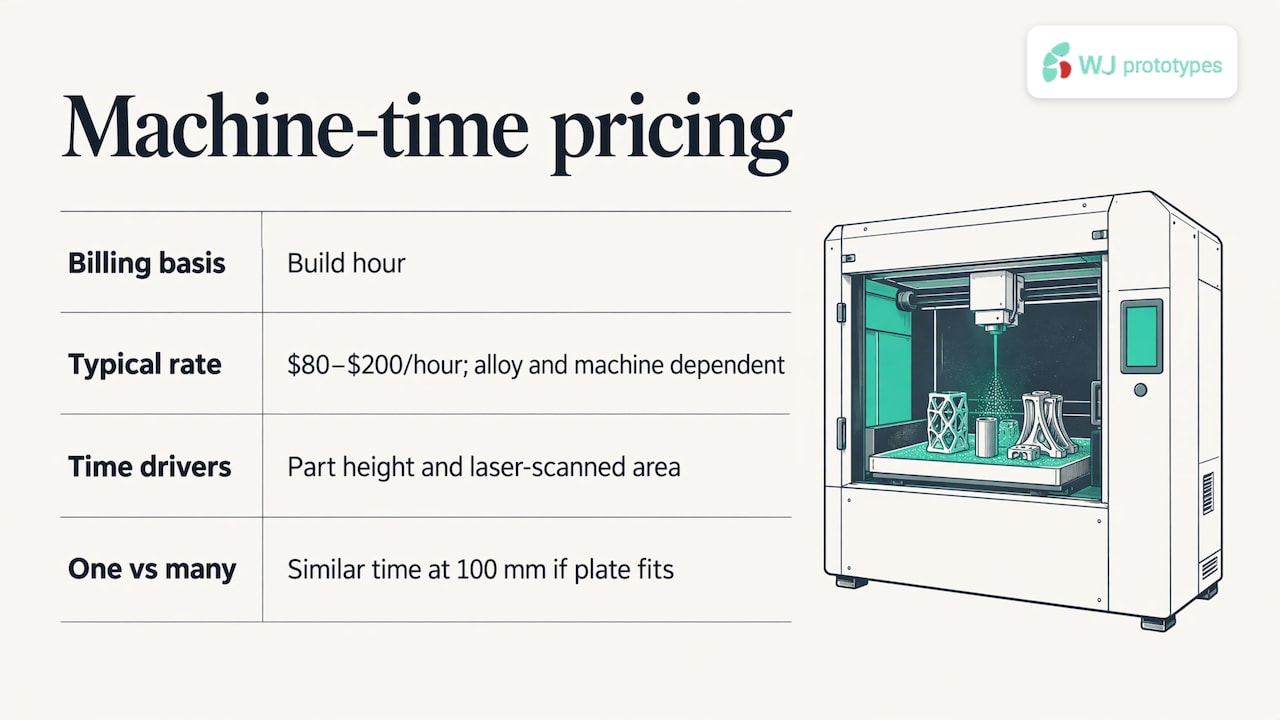
This is the dominant line. Metal printers are expensive capital equipment, so providers bill by the build hour, and service-bureau guides generally place rates at roughly $80 to $200 per hour depending on alloy and machine. Build time depends mainly on part height (the number of layers) and the amount of area the laser has to scan in each layer. A 100 mm tall build takes about the same time whether it holds one part or many, as long as they share that height and fit on the plate.
Powder for stainless steel and aluminum is relatively affordable, while titanium and nickel alloys cost several times more per kilogram. Some powder is lost to supports and to unusable material, but for most parts powder is a minor share of the final price. Do not choose an alloy on powder price alone: the machine rate and post-processing for harder alloys often matter more.
Build preparation covers file checking, orientation, support generation, nesting and machine loading. It is a fixed cost per build. On a single part it lands entirely on that part; on a 20-part build it is split 20 ways.
DMLS parts come off the machine welded to a steel plate and full of internal stress. Typical steps include:
Provider guides put post-processing at roughly 30% to 60% of total part cost, and a part listed at a few hundred dollars as printed can be well above that once finished and inspected. The reason is simple: every step above is skilled labor or a separate machine cycle, and none of it scales down for a one-off.
Per-part cost falls as parts share a build. Published comparisons show a small aluminum or stainless bracket dropping by roughly a third to a half when you go from one piece to ten, and further at fifty. An activity-based costing study of laser powder bed fusion in Nature’s npj Advanced Manufacturing found the lowest cost per part at the point where the build plate is fully used, which is the same effect seen from the research side.

The numbers below are illustrative assumptions, not a quote and not WJ Prototypes pricing. They show how the lines interact for a 316L stainless bracket of about 40 cm³.
| Cost line | 1 part per build | 20 parts per build |
|---|---|---|
| Build preparation (fixed $150 per build) | $150.00 | $7.50 |
| Machine time ($100/hr; 6 hr for one part, 30 hr shared by 20) | $600.00 | $150.00 |
| Powder and consumables | $60.00 | $60.00 |
| Post-processing (stress relief, plate removal, support removal, finishing) | $250.00 | $150.00 |
| Total per part | $1,060.00 | $367.50 |
Two things stand out. First, the same part drops by about two thirds without any change in design or supplier. Second, post-processing does not fall as steeply as machine time, because support removal and finishing are hands-on work per part. That is why a prototype run of five and a production run of fifty are priced so differently, and why the right question is rarely “what does one part cost” but “what does the quantity I actually need cost”.
For one-offs, setup and machine time are carried by a single part. At ten pieces most of that is spread out. Beyond that, the economics depend on whether the geometry is one that machining or casting handles badly. DMLS earns its place where the part has internal channels, lattices, consolidated assemblies or shapes that would require expensive tooling or heavy material removal.
A useful rule when planning a program:
That last comparison is worth doing in numbers. Our guides on CNC machining versus 3D printing for fast prototypes and choosing between CNC and 3D printing for aerospace and automotive prototypes walk through where each method wins. Once a part moves into repeat batches, traceability matters as much as unit price, and shops that run batch and quality records through batch and quality tracking software keep consistency as volumes grow.
The most reliable saving is more parts per build. Ask for a quote at several quantities (for example 1, 10 and 50) so you see the curve rather than a single point. If you will order the same part repeatedly, consolidating orders into one build can beat several small ones.
Supports consume powder, laser time and removal labor. Rotating a part to reduce overhangs or total height can change the price noticeably. Design rules such as chamfered walls and teardrop-shaped holes avoid supports entirely; a Springer chapter on design for additive manufacturing shows a steel manifold block redesigned from 7.4 kg to about 600 g with proportional cuts in print time and cost.
Less volume means less scanning. Hollowing, lattices and topology optimization lower build time, though only where the part’s stiffness and fatigue requirements allow it. Be aware that a solid block and a lattice of the same overall volume are not always priced very differently, so reduce volume that is actually removed from the part, not merely patterned.
As-printed DMLS surfaces are rough and dimensional accuracy is limited, so any face that must mate, seal or carry a bearing needs secondary machining. Limiting tight tolerances to those features, and leaving the rest as-printed, avoids paying for CNC time on faces that do not need it.
If 316L or AlSi10Mg meets the strength, temperature and corrosion requirement, using it instead of titanium or Inconel cuts powder cost and usually machine rate. If the application truly needs titanium or a nickel superalloy, the premium is part of the job.
Each finishing step adds handling, lead time and risk. Decide up front which operations the part needs (heat treatment, HIP, machining, coating, inspection) so the quote covers them in one pass rather than as change orders.
Express builds carry a premium in published pricing guides. When the schedule allows, a standard lead time gives the supplier room to schedule your parts with others in the same build.
A quote can only be as precise as the information behind it. Prepare:
Ask for the quote to be itemized into build preparation, machine time, material, post-processing, inspection and shipping, so you can compare options like for like and see which line to attack first. For the full process behind these lines, see our DMLS manufacturing workflow guide, and for the technology itself, what DMLS is and how it works. If you are choosing between powder bed processes, DMLS versus SLM covers the differences that affect cost and part properties.
Engineers often ask us for a single price for a DMLS part, and the honest answer is that a metal part has no single price. It has a price at a given quantity, in a given orientation, with a given finishing path. Change any one of those and the number moves.
That is why we start from the file rather than a rate card. Our teams review the geometry, and the DMLS service page gives you an instant online quote. We work with no minimum order quantity, so a team that needs three parts to validate a design can order three, and a team ready to move to a small series can ask for the same part at ten or fifty and see the curve.
We are an ISO certified manufacturer with experienced engineers and dedicated project managers, and we cover DMLS alongside CNC machining, sheet metal, vacuum casting, injection molding and die casting. That matters for cost, because the cheapest route for a part is sometimes a hybrid: printed near-net shape, then machined on the critical faces. Having these processes under one roof means you can compare them on one project instead of juggling suppliers.
Our advice is to treat the first quote as a conversation about design. Orientation, support strategy and tolerance placement are all things we can discuss before a single layer is printed.
Nas
WJ Prototypes offers DMLS, SLS, MJF, SLA and FDM printing, plus CNC machining and the casting and molding processes, to engineering teams, startups and procurement managers worldwide. Pricing is set per project after you submit the specification, so you pay for the part you actually need. To see the cost of your own geometry at your own quantity, start on the DMLS 3D printing in China page and request a quote. If your part might suit machining better, the CNC machining service is quoted the same way.
Metal printers cost far more to buy and run than polymer machines, and metal parts need stress relief, plate removal and often machining before they are usable. Powder is a small part of the price. Most of the cost is machine time and skilled post-processing.
Yes, up to the point where the build plate is full. Parts nested in the same build share preparation and machine time, so unit price can fall by half or more between one piece and a full plate. Post-processing falls more slowly because much of it is per-part labor.
It depends on geometry and quantity. For complex shapes with internal features, or parts that would waste most of a billet, DMLS can win at low volumes. For simple prismatic parts, CNC machining is usually cheaper, and the gap widens as quantity grows. Quoting both on the same file is the quickest way to know.
Include heat treatment, removal from the build plate, support removal, any CNC machining of critical features, surface finishing, inspection and shipping. Asking for an itemized quote makes these visible, so the delivered price is not a surprise.
Multiply the expected build hours by the machine rate, add powder and preparation, then add post-processing as a share of the total. Divide the build total by the number of parts that fit in one build. Use that only to set a budget, then confirm it with a quote on your actual file.
SERVICES
RESOURCES