



- Room 1807, Unit 9, Building 2, Shangxing Commercial Street, Shangde Road, Shangxing Community, Xinqiao Subdistrict, Bao'an District, Shenzhen City, China
CONTACT US

WhatsApp


Contact Us
Our team is on stand by, waiting toassist you.

Videos
A large collection of educational videos and tutorials.

About Us
Learn about our company, leadership, and mission totransform manufacturing.

Privacy Policy
Applies to all personal information collected through and/or processed in connection.

Aerospace & UAV
WJ Prototypes is your 3D manufacturing partner from prototype to large scale production.

Consumer Electronics
New Product Introduction Solutions for Consumer Electronics.

Robotics & Automation
Need some assistance bringing your robotic device or parts from the sketch-board to reality?

Medical Devices
The medical industry needs high quality, dependable and safe parts and products.

Automotive
New Product Introduction Solutions for Automotive

Industrial Machinery
The main purpose of industrial prototyping is to take the product from drawings into the real world.


The cost of an SLS part is set by how much build chamber it occupies, how much powder it consumes, and how much hand finishing it needs. It is not set by the volume of plastic in the part alone. Powder prices run from about $45 to $100 per kilogram depending on material and order size, but a small part’s price is mostly machine time, labor and packing. That is why a single part can cost far more than one part in a batch of fifty. At WJ Prototypes we quote SLS 3D printing with no minimum order quantity, so you can order one part or a full run and see how the cost per part changes.
This guide shows where the money goes, what published figures say, how to read a quote, and the design choices that lower the price before you ask for one.
Selective laser sintering (SLS) builds parts by fusing thin layers of nylon powder with a laser. The parts sit inside a bed of loose powder, which supports them, so no support structures are needed. That freedom is why SLS suits functional prototypes, enclosures, ducting and low-volume end-use parts with complex geometry.
It also changes how the price is built. In a filament or resin process, you can often estimate the cost from the amount of material used. In SLS, the cost comes from the whole build:
The practical consequence is that a quote reflects how well your parts fit into a build, not just how big they are.
Buyers rarely see a clean price list for SLS parts, so it helps to anchor on the figures that are public.
Powder. The cost-per-part paper cited above reports powder prices of $45 to $100 per kilogram, with the low end reached through bulk orders. That is the raw input. It is not what you pay per kilogram of finished parts, because a share of powder is not recycled and machine and labor time sit on top.
A worked outsourced example. A comparison based on four service-bureau quotes priced a four-part prototype build at $163.32 outsourced, or $40.83 per part. The same paper priced a four-part drill-casing prototype at $234.34. Those are prototype-scale orders, which show the typical order of magnitude for small nylon parts: tens of dollars per part, not hundreds, once a few parts share a build.
Equipment. The reason most teams outsource SLS is the capital behind it. Printer hardware in one published price guide runs from around $10,000 for low-cost systems to more than $500,000 for large industrial machines, and post-processing equipment adds from $999 to $50,000 on top. Those costs, plus powder handling and operator time, are what a quote spreads across your parts.
| Cost input | Published reference | What it means for your quote |
|---|---|---|
| Powder | $45 to $100 per kg | Material choice and order size move the price |
| Small outsourced build | $163.32 for four parts ($40.83 each) | Prototype-scale per-part cost for nylon |
| Printer hardware | About $10,000 to $500,000+ | Capital that service pricing spreads across many customers |
| Post-processing systems | $999 to $50,000 | Depowdering and finishing are real cost lines |
These are reference points from published papers, not quotes. Your price depends on geometry, material, finish and quantity, and powder prices move with the market.
PA12 (nylon 12) is the common default for SLS and the baseline most quotes assume. Flexible TPU, glass-filled or carbon-filled nylons and other specialty powders cost more per kilogram and can have different refresh and handling requirements. If a standard nylon meets the load, temperature and chemical needs of the part, choose it. Our 3D printing materials page lists what is available.
The bounding box is the smallest rectangular box that encloses your part. It determines how the part can be arranged in the chamber. A long, thin part may use little powder but still block a lot of build space. A part that fits snugly with others costs less than one with an awkward envelope.
Packing density is how much of the build volume is filled with parts. The cost-per-part paper recommends filling gaps and using cavities, orienting parts to reduce build height, and spacing parts closer together where the risk allows. Build time follows the height of the stack, so a tall build for one part spends the same chamber time as a tall build for twenty.
This is the single biggest reason that price per part falls with quantity. It is also why a lone part for a quick check often costs more than you expect, and why ordering your parts together in one request is cheaper than ordering them one at a time.
Setup, file preparation, depowdering and inspection are partly fixed per job. Spread across ten parts, they matter less than across one. In SLS, quantity helps in two ways: fixed labor spreads out, and parts nest more densely. Because we set no minimum order quantity, you can compare one, ten and fifty on the same file and decide where the curve flattens for your part.
As-printed SLS parts have a slightly grainy matte surface. If that works for your fit and function tests, it is the least expensive finish. Each added step (bead blasting, dyeing, smoothing, painting) adds labor and handling time. Specify finish by surface, not for the whole part: a cosmetic face and a hidden internal face rarely need the same treatment.
Take a small housing printed in PA12. Say you want a single unit to check fit.
Order four of the same housing and they nest together in one cycle. The fixed work is shared. The public comparison above shows the same effect in numbers: a four-part build at $163.32 works out to $40.83 per part, so the per-part price comes from the build, not the part’s weight.
The lesson for planning: if you expect revisions, group parts that can print together, and send the full set in one request.
These changes cost nothing at the design stage and reduce powder, build height or labor.
If you are unsure whether SLS is the right process at all, our comparisons of SLA and SLS, SLS and MJF and DMLS and SLS set out the differences by part requirement. For a view on cost across processes for production-style parts, see the CNC machining versus 3D printing cost analysis.
A quote is only as precise as the information behind it. Prepare these before you submit:
With these, the price is confirmed against your actual specification rather than a guess, and later changes are less likely to alter it.
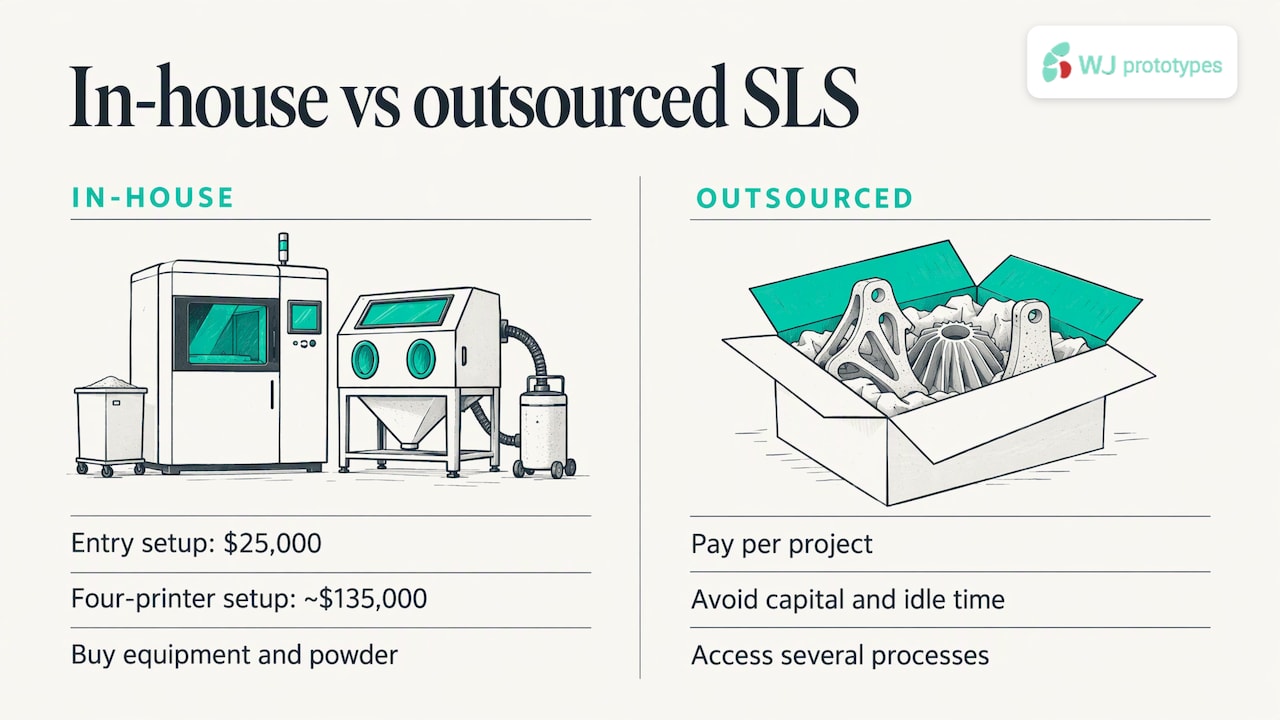
The figures above show the case. Building an in-house SLS capability means buying a printer, buying depowdering and sifting equipment, buying powder in volume, and training someone to run it. One published production-volume setup of four printers, three sieving systems and related equipment is listed at approximately $135,000. Even an entry setup of a printer plus a depowdering kit is listed at $25,000.
For a team that needs a handful of prototypes per month, or a bridge run of a few hundred parts, paying per project avoids that capital and the idle time between jobs. You also get access to several processes on one order: if the SLS part proves out, the same team can move to CNC machining, vacuum casting or injection molding as volumes grow.
We also keep a China-specific breakdown in our SLS printing cost article for China, and a process and materials overview in SLS 3D printing: process, materials and applications.
WJ Prototypes is an ISO certified manufacturer with experienced engineers and global delivery. We offer SLS alongside SLA, MJF, FDM, DMLS, CNC machining, sheet metal, vacuum casting, injection molding and die casting, with instant online quoting and a dedicated project manager on your order. Upload your file on the SLS 3D printing page, confirm the specification, and the price is set against that specification. There is no minimum order quantity, so one part is as welcome as a full run.
Most cost surprises in SLS come from the quote request, not the printer. A file is sent with no quantity, no finish and no tolerances, the first price assumes the simplest case, and the real specification arrives later and changes it.
We built our process around avoiding that. Instant online quoting gives you a starting point fast, and your dedicated project manager and our engineers confirm the specification before you pay, so the price you approve matches the part you need.
Our advice to design and procurement teams is to decide early what really matters on the part: the load, the fit, the visible faces. Spend on those, and leave the rest as-printed, in standard nylon, nested with other parts. That is where SLS is at its most cost-effective, and with no minimum order quantity you can test that approach with a single part before committing to a run.
Nas
A single part bears the full share of build time, powder refresh and labor for its build, and nothing is shared with other parts. Powder alone is priced at roughly $45 to $100 per kilogram, and the chamber is occupied for the entire cycle. Ordering several parts together in one request spreads those costs.
It depends on the part. SLS usually becomes more economical as quantity rises, because many parts nest into one build without supports. For one small, detailed cosmetic part, other processes can fit better. Our SLA versus FDM guide and SLA versus SLS comparison help you choose by requirement.
A 3D file in STEP or STL, the material, the quantity, the finish, any critical tolerances and your required lead time. With those, the quote reflects your real specification and is less likely to change after you confirm.
Hollow solid sections with powder escape holes, orient parts to keep builds short, combine assemblies into one printed piece, use standard nylon, and limit finishing to the surfaces that need it. Ordering parts together lets them nest more densely.
No. We set no minimum order quantity, so you can order a single prototype or a production-scale run. Pricing is confirmed through an online quote after the specification is checked.
SERVICES
RESOURCES