



- Room 1807, Unit 9, Building 2, Shangxing Commercial Street, Shangde Road, Shangxing Community, Xinqiao Subdistrict, Bao'an District, Shenzhen City, China
CONTACT US

WhatsApp


Contact Us
Our team is on stand by, waiting toassist you.

Videos
A large collection of educational videos and tutorials.

About Us
Learn about our company, leadership, and mission totransform manufacturing.

Privacy Policy
Applies to all personal information collected through and/or processed in connection.

Aerospace & UAV
WJ Prototypes is your 3D manufacturing partner from prototype to large scale production.

Consumer Electronics
New Product Introduction Solutions for Consumer Electronics.

Robotics & Automation
Need some assistance bringing your robotic device or parts from the sketch-board to reality?

Medical Devices
The medical industry needs high quality, dependable and safe parts and products.

Automotive
New Product Introduction Solutions for Automotive

Industrial Machinery
The main purpose of industrial prototyping is to take the product from drawings into the real world.

TL;DR:
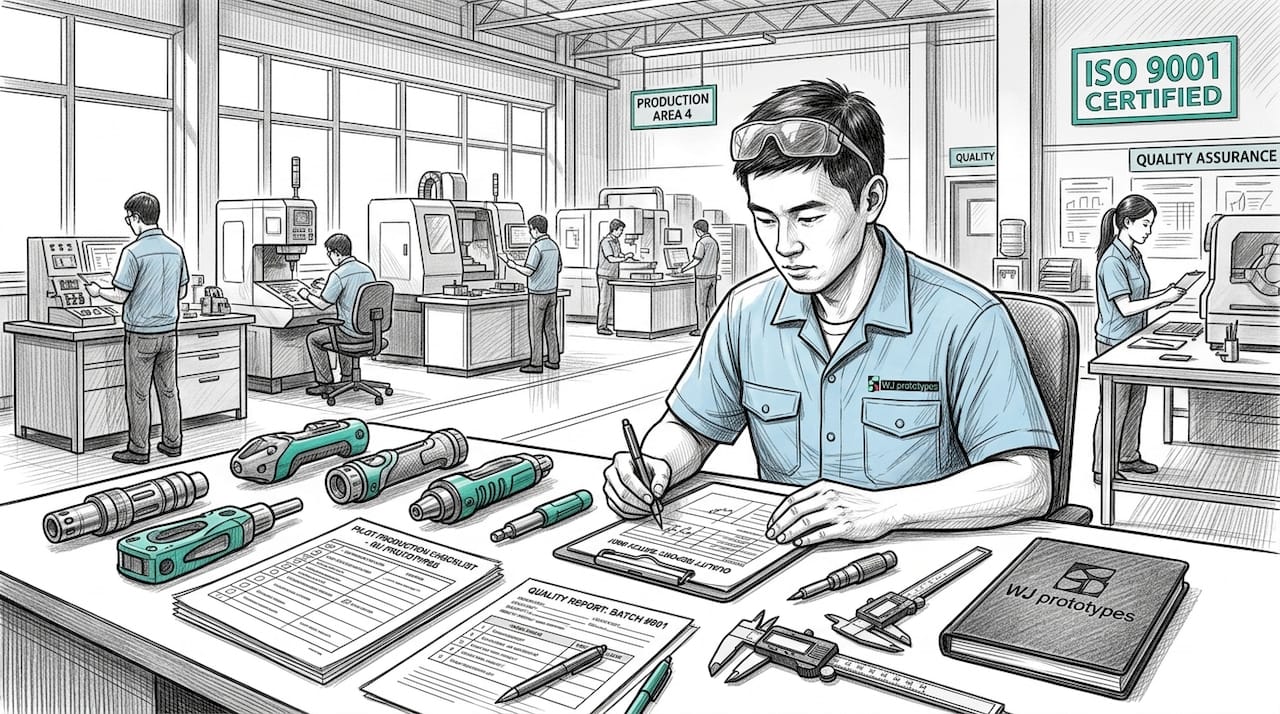
- Pilot production is a limited-scale manufacturing process that validates tooling, procedures, and throughput before full-scale production. It differs from prototypes by focusing on process capability, not design functionality, and relies on actual production equipment to identify manufacturing issues. Conducting a well-structured pilot run reduces costly errors, ensures quality, and supports confident scaling by collecting critical process data and involving cross-functional sign-off.
Pilot production is defined as a limited-scale manufacturing run designed to validate tooling, assembly sequences, quality inspection methods, and throughput before committing to full-scale production. It sits between prototype development and mass manufacturing, occupying the critical zone where design intent meets production reality. Engineers at companies like Toyota, Medtronic, and Honeywell use pilot runs to stress-test their manufacturing systems under near-real conditions, not to refine the product concept itself. The distinction matters enormously: a prototype answers “does this design work?” while a pilot run answers “can we build this reliably, at cost, and at scale?”
Pilot production validates the manufacturing process including tooling, assembly sequence, quality inspection, and throughput before mass production begins. The product design is essentially locked at this stage. What gets tested is the system that produces it: the fixtures, the operator procedures, the inspection checkpoints, and the cycle times.

A prototype, by contrast, exists to confirm that a design functions as intended. It is often built by hand, using non-production tooling, and measured against engineering specifications rather than manufacturing efficiency metrics. Prototypes tolerate variability because their purpose is learning about the design. Pilot runs do not tolerate variability because their purpose is proving the production system can eliminate it.
The third stage, full-scale production, assumes all those questions have been answered. Scaling up before completing a proper pilot run is one of the most expensive mistakes a product team can make. Rework, recalls, and line shutdowns at volume cost orders of magnitude more than catching the same problem during a controlled pilot run of 50 to 500 units.
Pro Tip: Treat your pilot run as a formal manufacturing audit, not a large prototype build. Document every deviation, no matter how minor. Those deviations are your data.
A well-structured pilot production process follows a defined sequence of steps, each with measurable exit criteria. Skipping steps or treating the pilot as an informal trial undermines the entire exercise.
Tooling and mold stress testing deserves special attention during step four. Injection molds, die casting dies, and CNC fixtures behave differently under sustained production conditions than they do during initial setup. Running the pilot at production-representative cycle rates exposes wear patterns, thermal drift, and dimensional variation that short-run testing never reveals.
Pro Tip: Build a traceability requirement into your pilot protocol from day one. Every unit produced should carry a unique identifier linked to the process data recorded during its production. This turns your pilot run into a searchable database, not just a pass/fail exercise.

The three stages serve fundamentally different purposes, use different equipment configurations, and generate different types of data. Conflating them leads to either premature scaling or unnecessary delays.
| Stage | Primary purpose | Equipment used | Key output |
|---|---|---|---|
| Prototype | Design validation | Lab tools, hand-built fixtures | Functional confirmation, design data |
| Pilot run | Manufacturing process validation | Production tooling, actual line setup | Process capability data, FPY, scrap rate |
| Mass production | Volume output | Fully optimized production line | Finished goods at target cost and quality |
The prototype stage answers questions about geometry, material performance, and functional fit. Engineers at this stage accept hand-built variability because the goal is learning, not consistency. The pilot plant serves as a pre-commercial system primarily for learning and validating new technologies before designing full-scale systems, which is why flexibility matters more than efficiency at this stage.
Mass production assumes all process questions are resolved. The line runs at takt time, operators follow locked procedures, and quality control is statistical rather than 100% inspection. Introducing unresolved process questions at this stage is where companies generate expensive scrap, miss delivery commitments, and damage customer relationships.
The pilot run is the bridge. It uses production-representative equipment and real operators, but operates at reduced volume specifically to generate the process data needed to make the scale-up decision with confidence. Pilot plants provide critical data on process physics and variability that is essential for designing commercial-scale operations and reducing scale-up risk.
The strategic case for running a proper pilot is straightforward: the cost of finding a problem during a 200-unit pilot run is a fraction of the cost of finding the same problem after launching at 50,000 units per month.
“Pilot production should target manufacturing process validation, not product concept testing. The focus is on proving that tooling, operator procedures, quality checks, and throughput can reliably produce consistent results.” — innovation.world
One underappreciated benefit is the training value. Operators who run the pilot become the most knowledgeable people on the line when full production begins. They have seen the failure modes, they understand the critical parameters, and they have context that no training document can fully convey.
Measurement is what separates a pilot run from an expensive trial. Without predefined metrics and acceptance thresholds, teams cannot make objective Go/No-Go decisions.
The core metrics for any pilot run include first pass yield, scrap rate, cycle time against takt time, and process capability indexes (Cpk) for critical dimensions. FPY measures the percentage of units that pass all quality checks without rework on the first attempt. A low FPY during the pilot signals either a process problem or an inspection problem, and distinguishing between the two requires operation-level data collection, not just end-of-line results.
Cpk values quantify how well a process produces output within specification limits relative to its natural variation. A Cpk of 1.33 or higher is the standard acceptance threshold for most automotive and electronics applications. Achieving this during the pilot run is a prerequisite for confident scale-up, not a post-launch goal.
Acceptance Quality Level (AQL) sampling plans define the minimum sample sizes needed to make statistically valid quality decisions. Running a pilot with fewer units than the AQL plan requires produces data that cannot support a defensible Go/No-Go decision. Most pilot protocols in precision manufacturing specify a minimum of 30 to 300 units depending on the complexity of the process and the risk level of the application.
Predefined pilot protocols with measurable exit criteria and cross-team sign-off from manufacturing, quality, and engineering significantly improve the quality of scale-up decisions. The sign-off requirement is not bureaucratic overhead. It forces every function to confront the data honestly before committing to production.
One additional consideration: controlled pilot environments do not fully replicate real-world conditions, which means integration points and realistic load variability require attention beyond the pilot itself. Teams that treat a successful pilot as a guarantee of production success skip the final validation steps that close the gap between controlled and real-world conditions.
Pro Tip: Track scrap and rework distributions by operation, not just by product. A 3% overall scrap rate looks acceptable until you discover that 90% of it comes from a single assembly step. Operation-level data turns a vague problem into a solvable one.
Pilot production is the manufacturing validation stage that determines whether a process can reliably produce conforming parts at scale, and skipping it is the single most expensive shortcut in product development.
| Point | Details |
|---|---|
| Pilot run definition | A limited-scale production run that validates tooling, procedures, and throughput before mass production. |
| Core metrics to track | Measure FPY, scrap rate, cycle time, and Cpk values at the operation level, not just at final inspection. |
| Pilot vs. prototype | Prototypes validate design; pilot runs validate the manufacturing system. They answer different questions. |
| Go/No-Go gating | Cross-functional sign-off on predefined exit criteria is required before any scale-up decision is made. |
| Risk mitigation value | Identifying defects and bottlenecks at pilot scale costs a fraction of the same discovery at full production volume. |
My honest experience with pilot production is that most engineering teams treat it as a formality rather than a genuine learning exercise. They run the units, check the boxes, and move on. The result is that they scale up a process they do not fully understand, and the problems they should have found at 200 units find them at 20,000.
The most valuable pilot runs I have seen share one characteristic: the team went in expecting to find problems. They designed the protocol to surface failure modes, not to confirm that everything was fine. That mindset shift changes everything. It changes what metrics you collect, how you respond to deviations, and how honestly you interpret the data at the Go/No-Go gate.
Cross-department involvement is the other factor that separates effective pilots from performative ones. When quality, manufacturing, engineering, and supply chain all define the exit criteria together, the resulting protocol reflects the actual risks of the process. When one department owns the pilot alone, the criteria tend to reflect what that department can control, which is never the full picture.
The prototype validation strategies you use before the pilot run matter too. Teams that arrive at the pilot stage with well-documented prototype data move faster and make better decisions because they already understand the design’s sensitivities. The pilot then focuses entirely on the manufacturing system, which is exactly where it should focus.
One final point: a successful pilot does not guarantee production success. Controlled conditions never fully replicate the variability of a running production environment. The pilot closes most of the risk gap. Closing the rest requires ongoing process monitoring after scale-up, not a single validation event.
— Yu
When you are ready to move from validated prototype to pilot run, the manufacturing process you choose determines the quality of the data you collect. Wjprototypes offers CNC machining services and injection molding capabilities specifically suited to the precision tolerances and traceability requirements that pilot production demands. Whether your pilot requires tight-tolerance metal components, functional plastic housings, or die cast structural parts, Wjprototypes delivers production-representative parts with the documentation and quality controls your Go/No-Go gate requires. Explore injection molding materials for your pilot tooling validation, or request an instant quote to discuss your specific pilot production requirements with an experienced engineer.
A pilot run is a limited-scale production run that validates tooling, operator procedures, quality inspection methods, and throughput before full-scale manufacturing begins. It uses production-representative equipment and generates process capability data to support Go/No-Go scale-up decisions.
Most precision manufacturing pilot protocols specify between 30 and 300 units, depending on process complexity and application risk level. The minimum sample size must satisfy the AQL sampling plan defined in the pilot protocol to produce statistically valid quality data.
First pass yield, scrap rate, cycle time against takt time, and Cpk values for critical dimensions are the core metrics. A Cpk of 1.33 or higher is the standard acceptance threshold for automotive and electronics applications before scale-up is approved.
Prototyping validates product design using non-production tooling and accepts variability as part of the learning process. Pilot production validates the manufacturing system using actual production tooling and measures process consistency, not design functionality.
No. Controlled pilot environments do not fully replicate real-world production variability, which means integration points and load conditions at full scale can expose gaps the pilot did not surface. Ongoing process monitoring after scale-up is required to close the remaining risk.
SERVICES
RESOURCES