



- Room 1807, Unit 9, Building 2, Shangxing Commercial Street, Shangde Road, Shangxing Community, Xinqiao Subdistrict, Bao'an District, Shenzhen City, China
CONTACT US

WhatsApp


Contact Us
Our team is on stand by, waiting toassist you.

Videos
A large collection of educational videos and tutorials.

About Us
Learn about our company, leadership, and mission totransform manufacturing.

Privacy Policy
Applies to all personal information collected through and/or processed in connection.
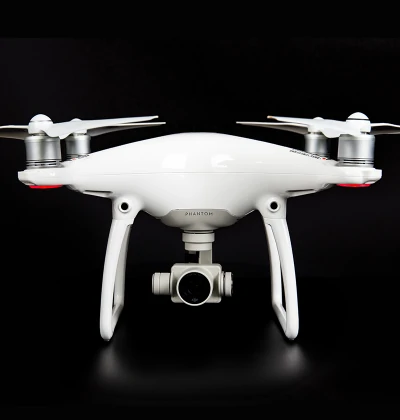

Aerospace & UAV
WJ Prototypes is your 3D manufacturing partner from prototype to large scale production.

Consumer Electronics
New Product Introduction Solutions for Consumer Electronics.

Robotics & Automation
Need some assistance bringing your robotic device or parts from the sketch-board to reality?

Medical Devices
The medical industry needs high quality, dependable and safe parts and products.

Automotive
New Product Introduction Solutions for Automotive

Industrial Machinery
The main purpose of industrial prototyping is to take the product from drawings into the real world.

TL;DR:
- Physical prototype validation verifies real-world performance and regulatory compliance beyond digital simulations.
- Multi-phase testing, including concept review and environmental tests, reduces development risks and ensures design success.
- Industry-specific standards demand precise testing and documentation, with material fidelity critical for accurate validation results.
Relying solely on CAD models and simulation software to greenlight a product is one of the most expensive mistakes a development team can make. Even the most sophisticated finite element analysis can’t replicate the unpredictable stresses of real-world operation. Physical prototype testing verifies that a design meets requirements, user needs, and regulatory standards before you commit to full production. In aerospace, automotive, and medical sectors, where a single failure can ground a fleet, trigger a recall, or harm a patient, prototype validation isn’t optional. It’s a core engineering discipline. This guide breaks down what validation actually involves, how it differs by industry, and the specific strategies that reduce development risk.
| Point | Details |
|---|---|
| Physical validation is essential | Simulation alone is not enough—testing real prototypes catches failures before production. |
| Use production-like materials | Always validate using materials and methods close to those planned for manufacturing. |
| Regulations drive validation rigor | Aerospace, automotive, and medical fields demand strict, industry-specific testing to avoid risk. |
| Document every test and result | Detailed records are critical for compliance and traceability during audits. |
Prototype validation is not the same as prototyping. Building a model confirms you can manufacture a shape. Validation confirms that the shape actually works, survives its environment, and satisfies every stakeholder from the regulator to the end user. The industrial prototyping process defines validation as the phase where physical prototypes go through mechanical, environmental, and performance tests to verify they meet design intent.
In regulated industries, this isn’t a best practice. It’s a legal obligation. The FDA requires medical device makers to conduct design validation under 21 CFR Part 820. Aerospace programs follow Federal Aviation Regulations that mandate functional testing of every critical control system. Automotive suppliers operate under FMVSS standards with defined pass/fail criteria for crash, emissions, and durability. Skip these steps and you face product recalls, liability exposure, and project shutdowns.
The stakes become clear when you look at what validation actually catches. A medical device validation framework is designed to surface problems that simulation misses, including assembly interference, snap-fit failures under temperature variation, and human factors issues that only appear when a real user holds the device.
Key validation objectives across all three sectors include:
Digital simulation is a powerful design tool, but it will never replace physical testing for final regulatory approval. Models are only as accurate as the assumptions built into them, and assumptions fail at scale.
For prototyping in automotive and medical contexts, validation also functions as an audit trail. Every test, every measurement, and every deviation must be documented and traceable. That record is what regulators review, and it’s what protects your team if a product is ever challenged post-launch.
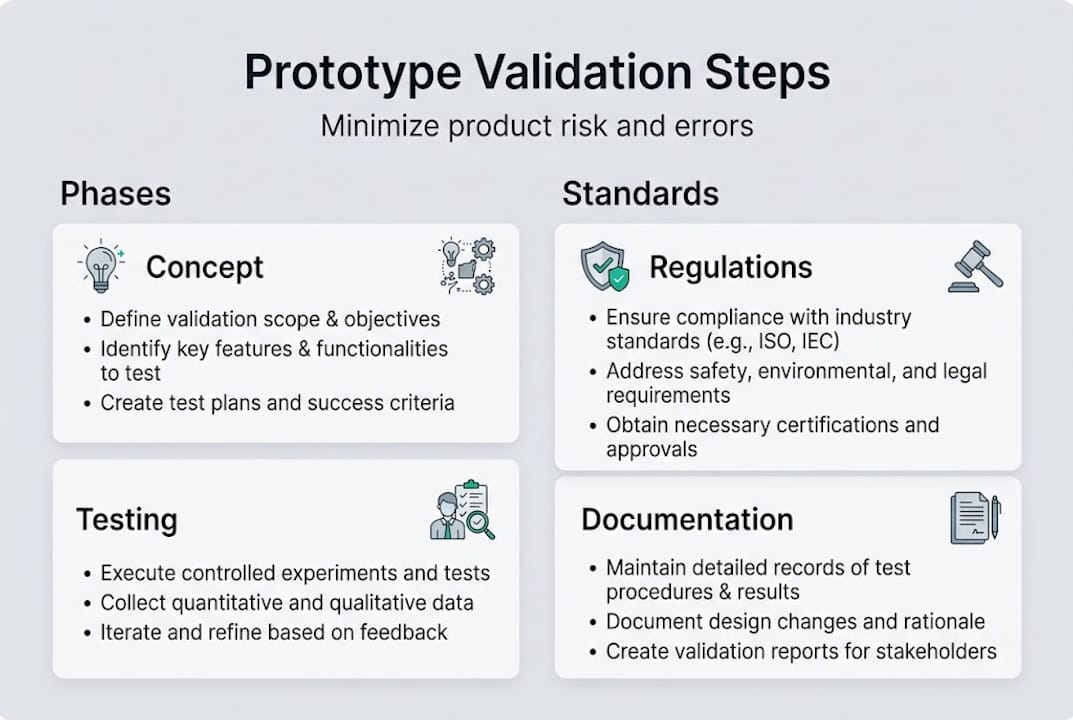
Validation doesn’t happen in a single test session. It progresses through a structured sequence that mirrors the maturity of the design itself. Rushing through early phases to get to functional testing is a common mistake that generates misleading data and wastes resources.
Here are the typical validation phases your team should follow:
Following rapid prototyping steps that align with these phases helps teams avoid building high-fidelity prototypes before the concept has been properly stress-tested at lower fidelity.
The choice between low-fidelity and high-fidelity prototypes shapes your validation data quality significantly:
| Factor | Low-fidelity prototype | High-fidelity prototype |
|---|---|---|
| Primary use | Concept validation, ergonomics | Functional, regulatory, performance testing |
| Cost | Low | Medium to high |
| Material match | Often generic or substitute | Production-equivalent |
| Risk of misleading data | High for structural tests | Low when materials match production |
| Best suited for | Early design phases | Final validation and compliance testing |
Physical prototypes remain essential for real-world de-risking even as digital tools improve. A simulation can’t tell you if a snap-fit releases properly after 10,000 cycles at 40°C. A physical prototype can.

Pro Tip: Always use production-equivalent materials and processes for your functional and regulatory validation phases. Testing an SLA resin prototype when your final part will be injection-molded polycarbonate will produce results that don’t transfer. The rapid prototyping best practices your team follows must account for this gap explicitly.
Each sector operates under its own regulatory framework, and understanding the specific demands of your industry changes how you plan and execute validation.
Aerospace teams follow Federal Aviation Regulations including FAR Part 25, which requires that control systems under extreme loads show no jamming, excessive friction, or disconnection. Vibration and fatigue testing must reflect in-service conditions across a full flight envelope, not just nominal operating points.
Automotive suppliers work within FMVSS standards and OEM-specific requirements. Crash simulation must be validated with physical sled tests and instrumented dummies. Thermal cycling, corrosion resistance, and electromagnetic compatibility are standard requirements before any component reaches a vehicle integration test.
Medical teams face medical prototype compliance requirements under FDA 21 CFR Part 820 and ISO 13485. Human factors validation, which tests how real users interact with the device under stress or fatigue, is a formal regulatory requirement, not an afterthought.
| Industry | Key standard | Critical test types | Documentation required |
|---|---|---|---|
| Aerospace | FAR Part 25 | Vibration, fatigue, extreme load | Test reports, traceability matrix |
| Automotive | FMVSS, OEM specs | Crash, thermal, EMC | FMEA, DVP&R, control plan |
| Medical | FDA 21 CFR 820, ISO 13485 | Human factors, biocompatibility | DHF, risk management file |
Across all three sectors, material selection in prototyping directly affects whether your validation data is meaningful. Using a substitute material because it’s cheaper or faster to process can produce false confidence in a design that will fail in service.
Final validation units must closely match mass production per IAQG 9102 First Article Inspection standards. This is not just a quality guideline. It’s a compliance requirement that affects certification.
Key compliance documentation your team must prepare includes:
Even teams with solid processes stumble when they underestimate the practical complexity of validation. Here are the five most common pitfalls that derail validation programs in aerospace, automotive, and medical development:
The best teams use force measurement techniques including multi-axis load cells and distributed sensor arrays to capture real data during functional tests. This is especially valuable in crash testing and ergonomic validation, where single-axis measurements miss critical load paths.
Pro Tip: Design your challenge tests at the outer limits of your material spec and operating environment, not the nominal center. If your component is rated to 80°C, test at 90°C. If your load spec is 500N, challenge at 600N. This approach reveals margin and catches brittle failure modes before production.
Cross-disciplinary reviews are the structural backbone of a strong validation program. Mechanical engineers, manufacturing engineers, quality teams, and regulatory specialists need to review test plans before execution. Selecting prototype materials and defining stop criteria before testing starts prevents endless iteration and keeps the program on schedule. The benefits of rapid prototyping are only realized when the validation cycle is disciplined and well-documented.
After working across aerospace, automotive, and medical programs, the pattern that consistently drives validation failures isn’t a bad test setup or missing equipment. It’s organizational. Teams treat validation as a hardware event when it’s really a communication event.
The most dangerous assumptions aren’t caught by sensors. They’re buried in design freeze decisions made without input from manufacturing, quality, or the end user. By the time physical tests start, those assumptions are locked into the prototype, and any failure triggers an expensive redesign loop rather than a quick fix.
Iterative prototyping insights consistently show that teams who involve all stakeholders before design freeze catch more issues at lower cost than those who run parallel tracks and reconcile at validation.
Your biggest validation risk is not the test, but the assumptions you failed to question at design freeze.
Simulation and physical tests are only as strong as the cross-functional reviews that precede them. Reset your validation standard: it begins with the questions you ask at the design table, not the data you collect in the test lab.
If your team is preparing for a critical validation cycle, having the right manufacturing partner makes a measurable difference. At WJ Prototypes, we support aerospace, automotive, and medical development teams with production-grade prototypes built from validated materials and processes. Whether you need precision parts from our CNC machining materials library or production-representative parts through custom injection molding, our engineering team can help you specify the right approach for each validation phase. We work with your timeline and compliance requirements, not against them. Reach out to discuss your next prototype validation program and get a fast, accurate quote from our team.
Prototype validation tests a prototype’s performance and compliance against defined standards, while prototyping simply creates the physical model without confirming it meets real-world requirements. Validation is the structured, evidence-based confirmation step that follows prototyping.
No. Physical prototypes are essential for capturing behaviors that simulations can’t model accurately, including assembly interference, thermal drift, and human interaction effects. Regulators in aerospace, automotive, and medical sectors require documented physical test results, not simulation reports.
Mechanical stress, vibration, and environmental exposure tests are the highest priority because they directly mirror in-service failure conditions. Per FAR requirements, control systems under extreme loads must demonstrate no jamming or disconnection across the full operating envelope.
Using production-like materials ensures that test results reflect actual product behavior, including fatigue life, thermal response, and dimensional stability. A prototype built from substitute materials may pass tests that the final production part would fail.
SERVICES
RESOURCES