




- Room 1807, Unit 9, Building 2, Shangxing Commercial Street, Shangde Road, Shangxing Community, Xinqiao Subdistrict, Bao'an District, Shenzhen City, China
CONTACT US

WhatsApp


Contact Us
Our team is on stand by, waiting toassist you.

Videos
A large collection of educational videos and tutorials.

About Us
Learn about our company, leadership, and mission totransform manufacturing.

Privacy Policy
Applies to all personal information collected through and/or processed in connection.


Aerospace & UAV
WJ Prototypes is your 3D manufacturing partner from prototype to large scale production.

Consumer Electronics
New Product Introduction Solutions for Consumer Electronics.

Robotics & Automation
Need some assistance bringing your robotic device or parts from the sketch-board to reality?

Medical Devices
The medical industry needs high quality, dependable and safe parts and products.

Automotive
New Product Introduction Solutions for Automotive

Industrial Machinery
The main purpose of industrial prototyping is to take the product from drawings into the real world.

TL;DR:
- Global prototyping enables faster, cost-effective iterations by partnering with international manufacturing facilities.
- It is essential for regulated sectors like aerospace, medical, and automotive to ensure compliance and quality.
- A hybrid ‘glocal’ approach combines global efficiency with local control to optimize project outcomes.
A prototype that arrives in 24 hours and costs 30% less than anything your local shop quoted — that’s not a fantasy, it’s how product teams at fast-moving startups are operating right now. If you’re still assuming that quality manufacturing requires proximity, you’re leaving speed and budget on the table. For product managers and design engineers in aerospace, automotive, and medical sectors, the margin for slow iteration is essentially zero. Global prototyping enables 24/7 operations, diverse manufacturing capabilities, and real cost efficiencies that reshape how teams bring ideas to market. This article breaks down what global prototyping actually is, why it matters for your sector, and how to apply it without sacrificing quality or compliance.
| Point | Details |
|---|---|
| Accelerated development | Global prototyping enables rapid turnaround, cutting development cycles by up to 30 percent. |
| Significant cost savings | Startups and SMEs can reduce production costs by 20 percent while avoiding planning waste. |
| Strategic scalability | Global and hybrid models provide both scalability and FLEXIBILITY for fast-growing teams. |
| Sector-specific compliance | Choosing partners with regulatory expertise ensures smooth transitions from prototype to production. |
Global prototyping means partnering with manufacturing facilities across international borders to build, test, and iterate physical product prototypes. Instead of relying solely on local shops with limited equipment and capacity, your team taps into a distributed network of specialized facilities, each offering different capabilities, materials, and turnaround times. The model works because manufacturing doesn’t sleep: when your engineering team clocks out in San Francisco, a facility in Shenzhen is already machining your next revision.
The mechanism is straightforward. You submit a CAD file, receive design for manufacturability (DFM) feedback, approve materials and tolerances, and receive parts often within days. Digital communication tools, cloud-based project management, and standardized quality frameworks have made cross-border coordination far more reliable than it was even five years ago. The complexity that once made global manufacturing feel risky has been largely replaced by structured workflows and real-time visibility.
Market data reinforces the trend. The global prototyping market is growing at an 11.45% CAGR toward $8.45B by 2031, driven heavily by aerospace, automotive, and healthcare demand. These sectors aren’t experimenting with global prototyping — they’re already scaling it.
Why now? Three converging factors are pushing global prototyping services into the mainstream:
| Factor | Local prototyping | Global prototyping |
|---|---|---|
| Turnaround time | 2 to 4 weeks typical | 1 to 5 days common |
| Material options | Limited to local stock | Broad, sector-specific |
| Cost | High overhead passed to client | Competitive, volume-friendly |
| Compliance expertise | Varies widely | Standardized in top facilities |
| Scalability | Constrained by capacity | Built for scaling |
For startups working under funding pressure and SMEs competing against larger players, this table isn’t academic. It’s the difference between winning a bid and losing one.
Global prototyping doesn’t just cut costs — it restructures how fast your team can learn. Every iteration cycle teaches you something. The faster you iterate, the faster you reach a validated design. That’s the real competitive advantage.
On the cost side, the numbers are significant. Global prototyping delivers up to 30% reduction in development time and up to 20% off production costs in aerospace applications, while also eliminating the 25 to 30% planning waste that fuzzy early-stage specifications typically generate. For a startup spending $200,000 on development, that’s $40,000 to $60,000 back in your budget.
“The fastest path to a fundable prototype is a clear design brief combined with a global manufacturing partner who gives you real DFM feedback before you cut the first part.” — Experienced prototyping engineers know this truth, even when pitch decks ignore it.
Here’s a direct comparison showing where global prototyping outperforms in-house or local-only approaches:
| Capability | In-house / local | Global prototyping partner |
|---|---|---|
| DFM feedback | Often informal or absent | Structured, often same-day |
| Material sourcing | Self-managed, slow | Handled by partner |
| Scaling to production | Major internal investment | Built into the service model |
| Certification support | Rarely included | Available in ISO-certified facilities |
| Prototyping speed | Days to weeks | Often within 24 to 48 hours |
For cost-effective prototyping at scale, the benefits go beyond price:
Pro Tip: When evaluating global partners, prioritize platforms that provide written DFM feedback, hold ISO 9001 or sector-relevant certifications, and explicitly support scaling from prototype to production. A partner who only quotes and ships isn’t a partner — they’re a vendor.
Not every project is a fit for a fully global model. Knowing when to go global, stay local, or combine both is what separates experienced product teams from teams that regret their sourcing decisions six months in.
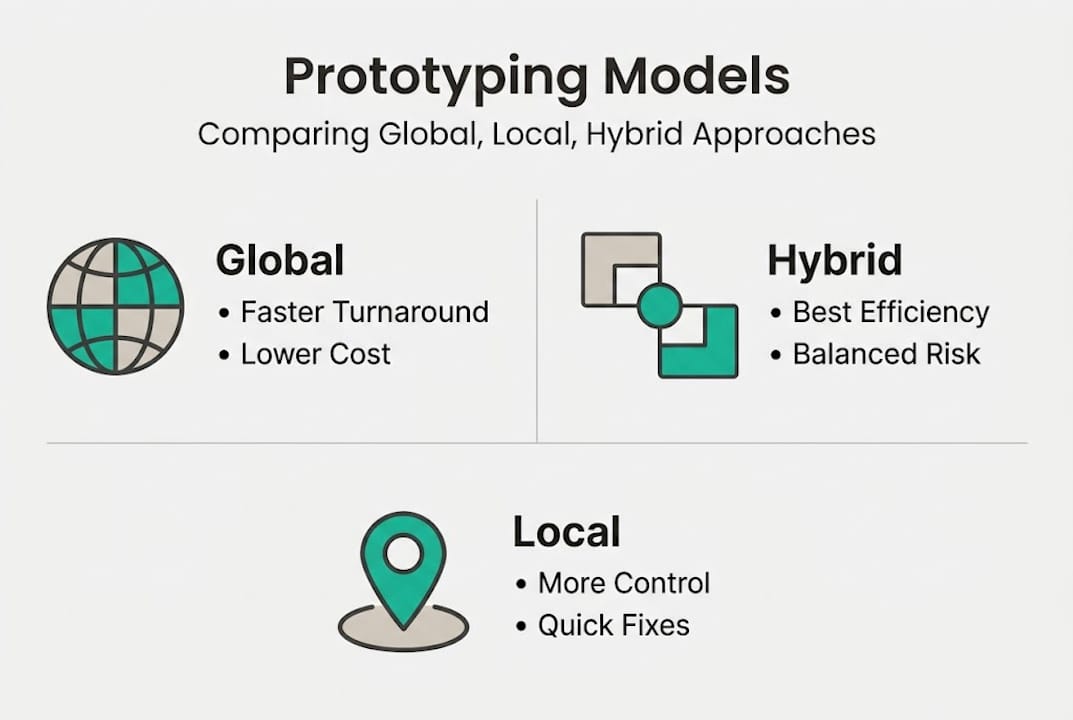
Global models offer cost, flexibility, and scalability, but risks include timezone gaps and communication delays. Local models provide tight feedback loops and hands-on control, but come with higher overhead and limited material access. Hybrid approaches, sometimes called “glocal,” combine both: use global manufacturing for efficiency and volume, local partners for complex coordination or highly sensitive design reviews.

Here’s how the three models compare across project-critical criteria:
| Criteria | Global | Local | Hybrid (glocal) |
|---|---|---|---|
| Cost | Low | High | Medium |
| Speed | High | Medium | High |
| Control | Medium | High | High |
| Material access | Excellent | Limited | Excellent |
| Compliance support | Strong (vetted partners) | Variable | Strong |
| Best suited for | Standard to complex parts | Highly sensitive IP | Regulated sector products |
How do you choose? Use this decision sequence:
Industrial prototyping in China has matured significantly, and rapid prototyping in China now supports some of the world’s most demanding specifications. The key is partner selection, not geography alone.
“Glocal isn’t a compromise — it’s a strategy. The teams winning in regulated sectors use global manufacturing discipline with local coordination intelligence.”
For teams tracking manufacturing process efficiency, the hybrid model consistently outperforms pure-local approaches on both cost and timeline without sacrificing quality oversight.
Sector context matters. Global prototyping looks different for a cardiac implant team than for an automotive bracket engineer. Applying it well means understanding what each sector demands from a compliance and iteration standpoint.
Global prototyping networks allow rapid development, handle sector-specific regulations, and support seamless scaling from early prototype to production volumes. Here’s how that plays out in practice:
Aerospace Aerospace parts require AS9100 alignment, material traceability, and often specialized alloys. The aerospace prototyping process benefits from global DMLS and CNC capabilities that produce flight-grade geometries without the cost of full production tooling. Rapid prototyping compresses the test-fly-modify cycle dramatically.
Medical The medical device prototyping path involves biocompatibility testing, FDA or CE documentation, and strict dimensional tolerances. Global partners with ISO 13485 alignment help teams build compliant prototypes faster than in-house teams can procure materials.
Automotive Automotive teams need functional prototypes for vibration, heat, and fatigue testing. Global facilities with injection molding, CNC machining, and SLS capabilities produce test-ready parts within days rather than the weeks a traditional tooling shop requires.
Here’s a practical sequence for applying global prototyping in any regulated sector:
Key factors to verify in your global partner:
Pro Tip: Never select a global prototyping partner based on price alone. Regulatory compliance failures at the prototype stage cascade into expensive redesigns, delayed approvals, and lost contracts. Vet for sector experience first, then negotiate on cost.
Most articles will tell you global prototyping saves money and speeds up iteration. Both are true. What they won’t tell you is that the biggest failure point isn’t timezone gaps or shipping logistics — it’s communication culture.
A partner who responds slowly to DFM questions, gives vague answers about material substitutions, or delays flagging tolerance issues until after parts are cut is more expensive than a local shop charging twice the price. Responsiveness and technical transparency are the traits that actually determine whether a global partnership delivers or disappoints.
Second, startups and SMEs often chase the lowest quote and then discover mid-project that their chosen partner has no experience with FDA documentation or AS9100 traceability. Sector experience is non-negotiable in regulated industries. A cost-effective prototyping guide should always frame cost savings relative to risk reduction — not as a standalone metric.
The teams that succeed with global prototyping treat partner vetting as a design activity, not a procurement task. They evaluate communication speed, certification depth, and DFM rigor the same way they evaluate part tolerances. That mindset shift is what separates a smooth prototype cycle from a three-month delay.
If your team is ready to move from concept to functional prototype in days rather than weeks, WJ Prototypes offers the full-stack manufacturing capabilities your sector demands. From CNC machining in China with aerospace-grade precision to additive manufacturing for medical and automotive applications, we support your project from first DFM review through low-volume production. Explore the full range of CNC machining materials available for your next prototype, and get an instant quote through our platform. ISO-certified, engineer-supported, and built for the speed that product teams in regulated sectors actually need.
Global prototyping enables teams to iterate designs rapidly by leveraging international manufacturing partners with 24/7 production access, cutting weeks of local shop lead time down to days.
The primary risks are communication delays across time zones and difficulty verifying sector-specific regulatory compliance — both manageable with proper partner vetting.
A glocal model balances flexibility and cost savings from global manufacturing with the tight coordination and feedback control that complex or regulated projects require locally.
They use vetted global manufacturing networks that provide sector-specific materials like titanium alloys, PEEK, and medical-grade resins alongside engineers experienced in their industry’s compliance requirements.
SERVICES
RESOURCES