



- Room 1807, Unit 9, Building 2, Shangxing Commercial Street, Shangde Road, Shangxing Community, Xinqiao Subdistrict, Bao'an District, Shenzhen City, China
CONTACT US

WhatsApp


Contact Us
Our team is on stand by, waiting toassist you.

Videos
A large collection of educational videos and tutorials.

About Us
Learn about our company, leadership, and mission totransform manufacturing.

Privacy Policy
Applies to all personal information collected through and/or processed in connection.


Aerospace & UAV
WJ Prototypes is your 3D manufacturing partner from prototype to large scale production.

Consumer Electronics
New Product Introduction Solutions for Consumer Electronics.

Robotics & Automation
Need some assistance bringing your robotic device or parts from the sketch-board to reality?

Medical Devices
The medical industry needs high quality, dependable and safe parts and products.

Automotive
New Product Introduction Solutions for Automotive

Industrial Machinery
The main purpose of industrial prototyping is to take the product from drawings into the real world.
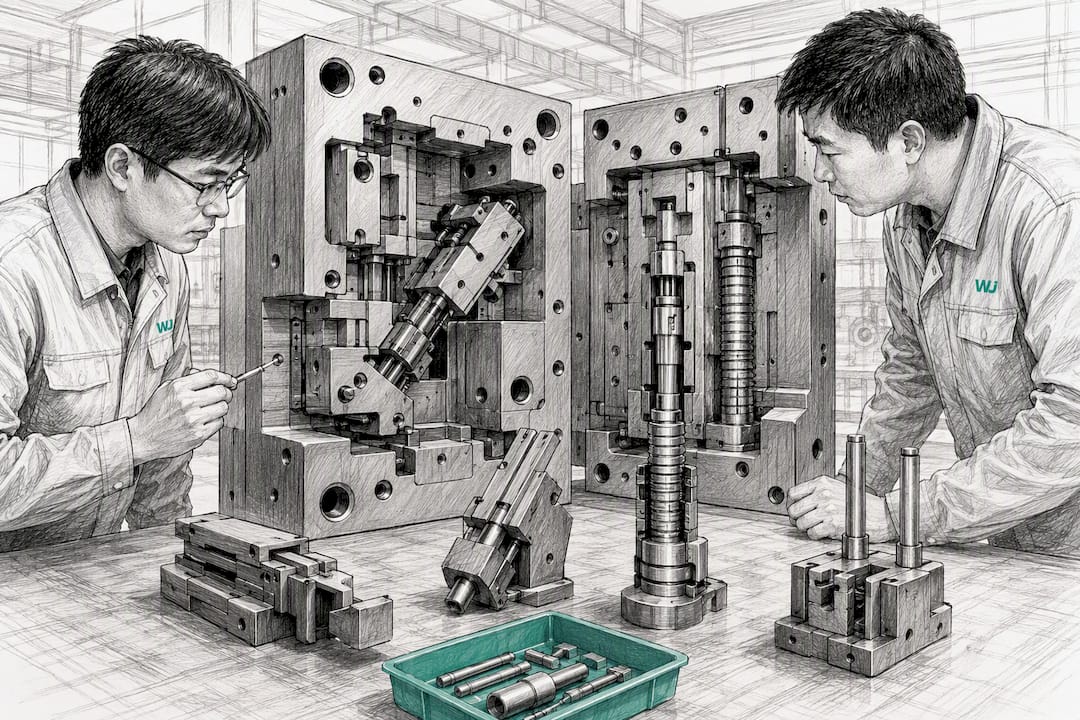
Chinese injection molders handle undercuts by matching the part’s function to one of four mechanical strategies: side-action sliders, lifters, collapsible or unscrewing cores, and bump-off elastic demolding. Each trades tooling cost against cycle time and long-term maintenance. The right call is simple in practice: redesign the feature out when volumes are low or the geometry allows it, and invest in tooling when the undercut is functionally essential and volume justifies the spend. What follows covers the mechanisms, the cost math, and exactly what to ask a Chinese supplier before you sign off on a mold.
TL;DR:
- Mechanical solutions for undercuts vary in cost and complexity, with sliders and lifters suitable for external and internal features, respectively.
- Redesigning the part to eliminate or simplify undercuts typically costs less at low volumes but may be less effective with high production requirements.
- Adding mechanisms increases tooling cost and cycle time, requiring careful consideration of production volume and part function.
- Chinese molders often handle undercut-specific mechanisms in-house, emphasizing early DFM review and detailed communication before tooling starts.
- Requesting demold videos and clear specifications during RFQ processes ensures better control and reduces costly errors in handling undercuts.
An undercut is any feature that physically blocks a mold from opening in a straight line. Picture the mold splitting into two halves along the draw direction, the axis the part travels as it’s ejected. If any geometry hangs below, wraps around, or reaches back into that path, the mold can’t release the part without either breaking it or building extra hardware to get out of the way first.
Undercuts fall into two broad categories:
Draft angle, wall thickness, and material stiffness all change how forgiving an undercut actually is. A shallow undercut on a flexible polypropylene part might release with a bit of forced flexing and no extra tooling at all. The same geometry in a rigid, glass-filled nylon will crack before it deforms enough to clear the core, so it needs a mechanical workaround. That’s the first thing a competent DFM review checks: not just where the undercut sits, but whether the material has any give in it.
Four mechanisms cover almost every undercut a designer will encounter, and each one answers a different geometry problem.
Side-actions and sliders handle external undercuts by moving a section of the mold sideways before the main opening stroke. Cam pins mounted on the stationary side push angled slides outward as the mold opens; heavier or high-cycle tools swap the cam pin for hydraulic cylinders that give more controlled, repeatable motion. Sliders are the default choice for external features like snap-fit ledges, side holes, and window openings, and they scale well from a single simple slide up to nested, multi-directional slides for parts with undercuts pointing in more than one direction, according to DinosaurSE’s design guide.
Lifters solve internal undercuts, typically an inward-facing lip or rib inside a boss or housing. A lifter rides an angled pin as the ejector plate moves, lifting up and away from the undercut on a diagonal path rather than a straight pull. Timing matters here: the lifter has to clear the undercut before the part is fully pushed off the core, so ejection sequencing is a real design variable, not an afterthought.
Collapsible cores and unscrewing mechanisms are built for internal threads and are the standard route once volumes justify the tooling investment. Unscrewing cores use a rack-and-gear or hydraulic motor to rotate the threaded core out of the part before ejection, and they hold up well over long production runs, though they add real cost and complexity to the tool.
Bump-offs, also called elastic or forced demolding, skip mechanical hardware entirely. The part flexes over the undercut as it’s pushed off the core, which only works within specific durometer and geometry limits, DinosaurSE notes — shallow snap-fits in TPE or TPR are the classic case, while anything rigid or deep enough to stress-crack the material is off the table.
Pro Tip: Ask your supplier to sketch the ejection sequence, not just the mechanism. A lifter and a slider that fire in the wrong order can gouge a part that looks perfectly fine on paper.
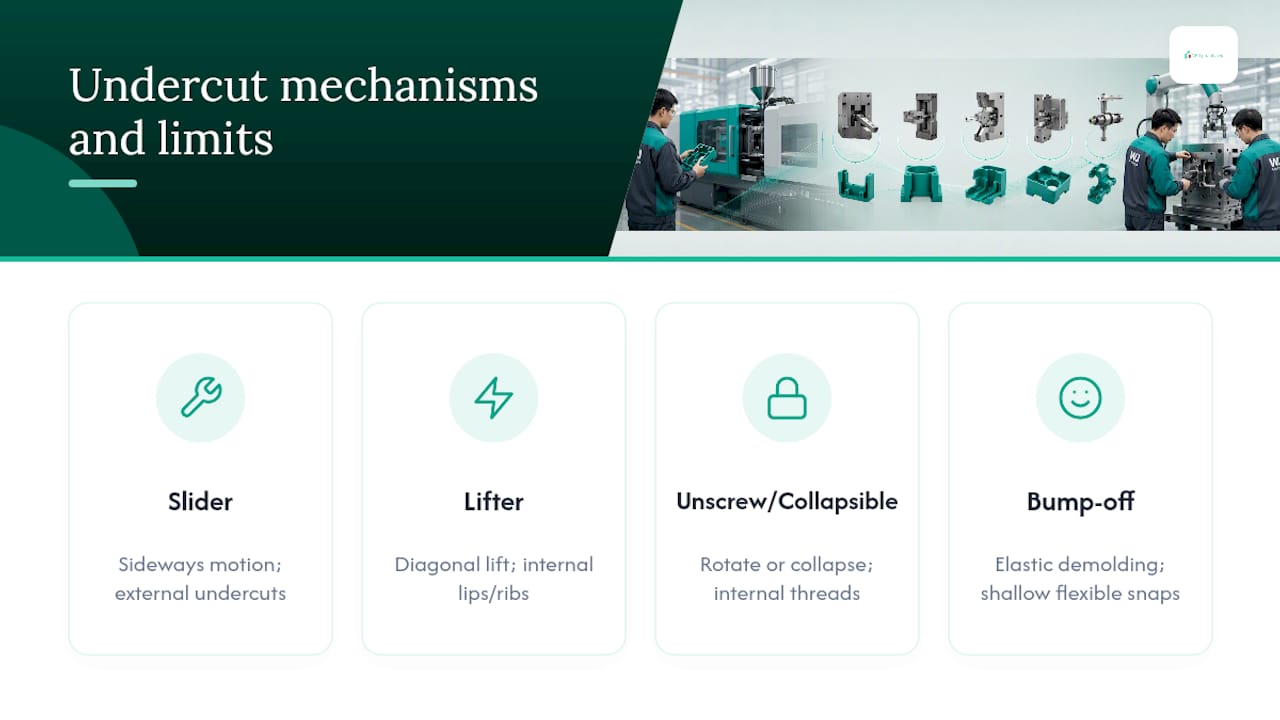
Every added mechanism means more moving steel, tighter tolerances between components, and more wear points to service over the tool’s life.
Not every undercut deserves a mechanism. Before committing to sliders or lifters, run the feature through a short set of redesign tactics that either eliminate the undercut or shrink what the tooling has to do.
The decision usually comes down to four variables: production volume, whether the undercut is functionally necessary or just convenient, aesthetic or assembly requirements, and how tight the tolerance is on the feature itself. At low volumes, redesign almost always wins on cost, since tooling for a slide or lifter can add a meaningful chunk to the mold price before you’ve made a single part. At higher volumes, that same tooling cost amortizes down to pennies per unit, and the undercut’s functional benefit (a cleaner assembly, fewer fasteners) starts to outweigh the upfront hit.
Pro Tip: Get two quotes from your supplier early: one with the undercut redesigned out, one with tooling added. Seeing both numbers side by side makes the volume math obvious in a way no rule of thumb can.
Material choice narrows the field further. Rigid engineering plastics like ABS or polycarbonate almost always need a mechanical solution for anything beyond the shallowest undercut, while flexible materials open up bump-off demolding as a genuine cost-saver.
Adding a slider, lifter, or unscrewing mechanism to a mold raises the base tooling price, and the increase scales with how many actions the tool needs and how precisely they have to time against each other. A single simple slide adds modest cost; a multi-slide tool with nested actions or a full unscrewing assembly can push tooling cost up substantially compared to a straight-pull mold.
Cycle time takes a hit too, since every mechanical action needs time to move before the mold fully opens or before ejection starts. A few things to budget for beyond the sticker price:
None of this is a reason to avoid mechanisms when the part genuinely needs them. It’s a reason to fold tooling amortization honestly into your per-part price from the first quote rather than discovering the real cost after a few thousand cycles. If your annual volume is high enough, the added tooling spend often disappears into a fraction of a cent per part; if it’s not, that same spend can dominate your unit economics.
A standard workflow at Chinese mold shops follows a predictable sequence: DFM review, mold machining, assembly, T0 and T1 sample runs, trial production, and first-article inspection, as outlined in sourcing guides covering the China injection molding process. Undercut-specific mechanisms get flagged and reviewed during that first DFM pass, well before steel gets cut.
Machine range matters more than most designers expect. Many Chinese factories run in-house tooling departments alongside presses spanning roughly 90 to 1,200 tons of clamping force, which lets a single shop handle a wide range of parts from small connector housings to larger industrial enclosures with internal ribs and side holes, per the same sourcing overview. That in-house tooling capability is what actually lets a factory machine and fit a slide or lifter correctly rather than farming it out.
A few things worth putting directly in your RFQ:
Watching the demold happen, even on video, catches timing problems that a static sample simply can’t show.
Getting comparable quotes on an undercut feature depends on what you send, not just who you send it to.
Pro Tip: Put the demold video requirement in writing before tooling starts, not after you’ve received a sample that doesn’t match spec. Suppliers who plan for it from day one rarely have a problem delivering it.
WJ Prototypes runs undercut geometry through a DFM review before any steel gets cut, checking parting line, mechanism choice, and tolerance risk against the part’s actual function. The company’s tooling capabilities include machining and fitting slides, lifters, and unscrewing cores in-house rather than outsourcing these tasks, and quality assurance and first-article inspection processes are conducted before trial production begins.
The DFM guidance WJ Prototypes has published on designing out undercuts lays out the same redesign-versus-tooling logic covered above, and the broader injection molding workflow guide walks through what to expect at each sample stage.
A few things guide that recommendation in practice:
The mistakes that cost the most time aren’t technical, they’re procedural: DFM done too late to change anything, tolerance specs left vague enough that a supplier guesses, and demold videos skipped because the sample “looked fine.” Every one of those is fixable by moving the conversation earlier. Bring your supplier the CAD before you’re locked into a geometry, not after tooling has already started.
— Nas
WJ Prototypes reviews undercut geometry before you spend a dollar on steel, so you find out whether a redesign beats a mechanism while the part is still a CAD file, not after a mold is half-cut. That review runs alongside in-house tooling for sliders, lifters, and unscrewing cores, backed by ISO-certified QA and first-article inspection on every job, whether you need a handful of prototypes or a production run in the low thousands.
If you’re weighing whether an internal thread needs an unscrewing core or a threaded insert, or whether a snap-fit can skip mechanical tooling altogether, send the CAD over and get a straight answer instead of a guess. Start with a quote through WJ Prototypes’ injection molding service in China and you’ll know the mechanism, the rough cost delta, and the sample timeline before you commit to a single line item.
You mold an undercut using a mechanism that moves out of the way before or during ejection: a side-action slider for external features, a lifter for internal ones, an unscrewing core for threads, or elastic bump-off demolding for shallow undercuts in flexible material.
China remains a leading choice for complex tooling work because many factories combine in-house toolmaking with clamping forces spanning roughly 90 to 1,200 tons, letting one shop handle both mechanism design and part production under one roof, per sourcing guides on the China process.
There is no single, universally agreed largest injection molder. The industry is fragmented across thousands of manufacturers worldwide, ranging from large multinational suppliers to specialized regional shops.
China’s molding sector includes a wide mix of large multinational suppliers and specialized regional shops. WJ Prototypes is one option for designers who need DFM support alongside in-house tooling for undercut-heavy parts.
No. Shallow undercuts in flexible materials often release through elastic bump-off demolding with no added mechanism, and many rigid-material undercuts can be redesigned out entirely through a parting line change or added draft.
SERVICES
RESOURCES