




- Room 1807, Unit 9, Building 2, Shangxing Commercial Street, Shangde Road, Shangxing Community, Xinqiao Subdistrict, Bao'an District, Shenzhen City, China
CONTACT US

WhatsApp


Contact Us
Our team is on stand by, waiting toassist you.

Videos
A large collection of educational videos and tutorials.

About Us
Learn about our company, leadership, and mission totransform manufacturing.

Privacy Policy
Applies to all personal information collected through and/or processed in connection.

Aerospace & UAV
WJ Prototypes is your 3D manufacturing partner from prototype to large scale production.

Consumer Electronics
New Product Introduction Solutions for Consumer Electronics.

Robotics & Automation
Need some assistance bringing your robotic device or parts from the sketch-board to reality?

Medical Devices
The medical industry needs high quality, dependable and safe parts and products.

Automotive
New Product Introduction Solutions for Automotive

Industrial Machinery
The main purpose of industrial prototyping is to take the product from drawings into the real world.
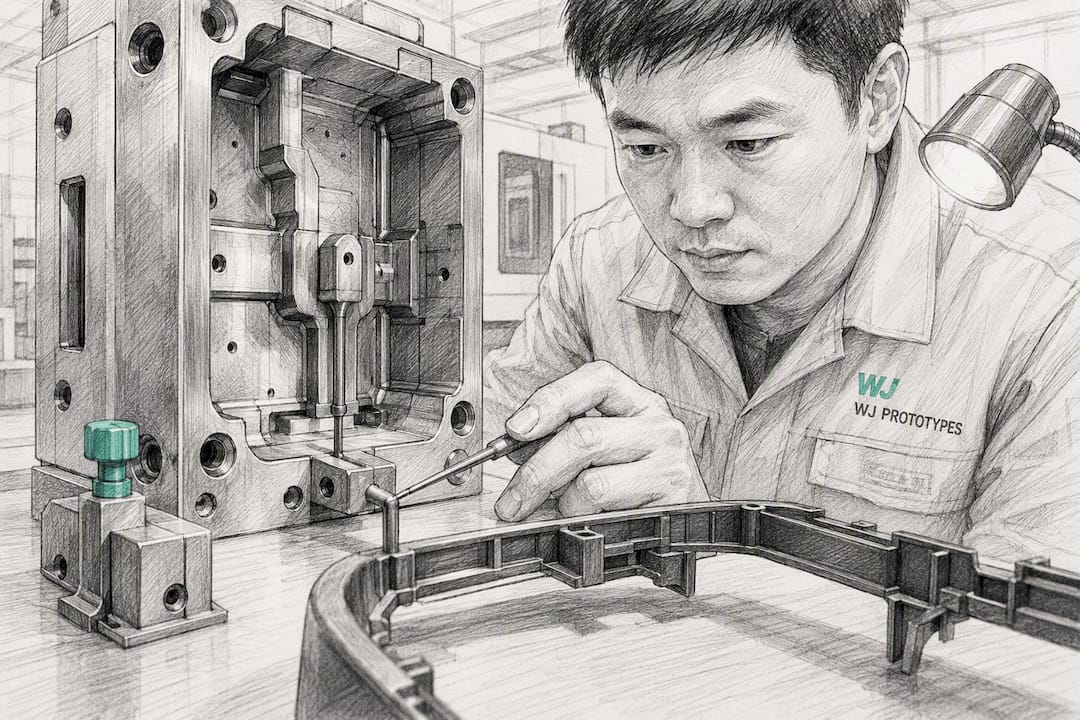
Gate type and placement determine whether your part ships with visible flow marks, weld lines, or warp, and most tooling failures with Chinese suppliers trace back to an incomplete RFQ rather than a bad factory. The single most important move you can make before contacting any supplier is to lock down gate preferences on your drawings and require an NNN agreement before releasing full CAD files. Everything else in the sourcing process builds on that foundation.
TL;DR:
- Choosing the right gate type and placement is crucial to prevent visible marks, warping, or weld lines in the final part, especially for cosmetic surfaces.
- Locking down gate preferences in your drawings and requiring an NNN agreement before sharing CAD files significantly reduces tooling rework and legal risks in China.
- Providing comprehensive files, including GD&T and material specifications, and following DFM best practices minimizes rejected tooling and unplanned costs.
- Budget 3 to 6 weeks for mold building in China, with additional time for sampling, revisions, and shipping, while negotiating free revisions and staged payments lowers project risk.
- Protecting intellectual property requires a Chinese-specific NNN agreement and staged payments; standard NDAs offer limited enforceability in Chinese courts.
Gate selection changes how plastic fills the cavity, where weld lines form, and how much cosmetic cleanup the part needs after molding. Get it wrong and you inherit sink marks, visible witness marks on a customer-facing surface, or a cycle time nobody budgeted for.
Hot-runner systems cost more to tool but cut material waste and scrap rates because there’s no cold runner to grind and reprocess, a real advantage on high-volume production. For a bridge tool or a prototype run of a few hundred units, a cold runner with a simple edge or pin gate is usually the more economical call. Gate location also matters more than most engineers assume: placing a gate near a load-bearing rib or a thin wall section can create a weld line exactly where the part sees the most stress in service.
Pro Tip: If a specific face of your part must stay cosmetically clean, say so explicitly in the RFQ. “No visible gate on Surface A” is a one-line instruction that saves a mold revision later.
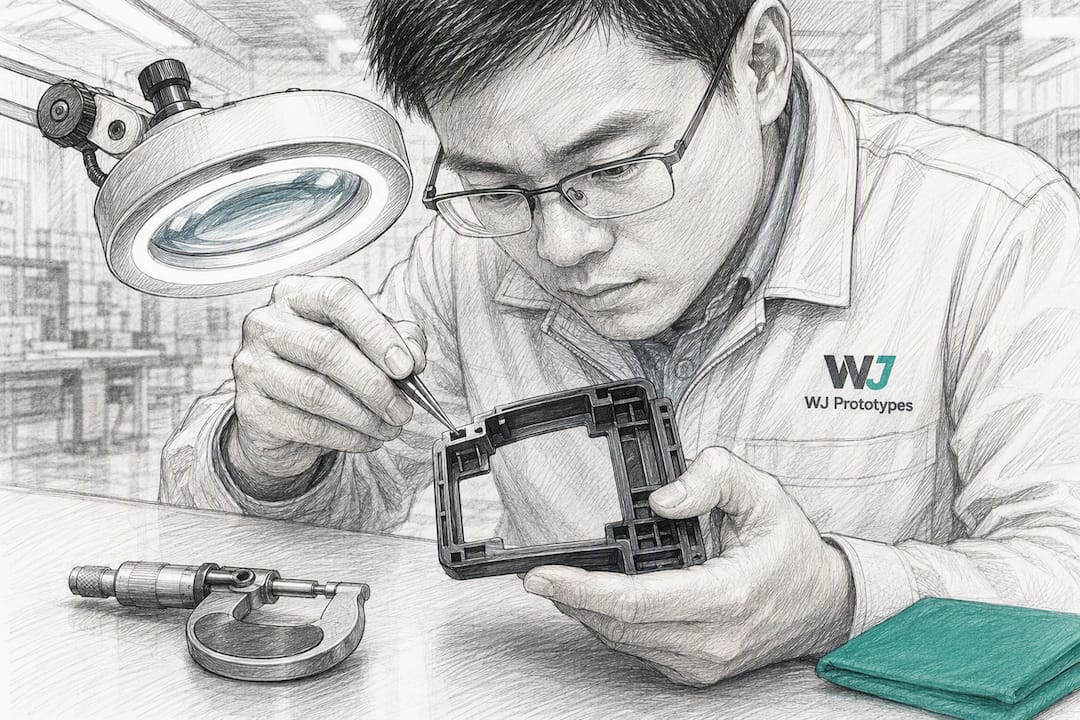
Incomplete documentation is the leading cause of rejected tooling and unplanned rework charges when sourcing molds from China, and it’s almost always avoidable. A supplier working from a bare STEP file without dimensioned drawings will fill in gaps with assumptions, and those assumptions rarely match what you actually need.
Send these files with every RFQ:
Before the drawing goes out, run it against basic DFM rules. Wall thickness should stay within a consistent range for the resin chosen, typically 1 to 3 millimeters for most engineering thermoplastics, with no abrupt transitions. Draft angles of at least 1 to 2 degrees per side keep parts from dragging on ejection. If your part has an undercut, decide up front whether you want a lifter, a collapsible core, or a secondary machining operation, because each option changes tooling cost differently.
The mistake that costs the most money isn’t a missing dimension. It’s a factory assuming your part is symmetric, guessing at a draft angle, or picking a gate location based on what’s easiest to machine rather than what your part actually needs. A DFM-first approach treats the RFQ as a risk-reduction document, not a formality you rush through to get a number back faster.
You have two main routes: working directly with a factory, or going through a sourcing platform or trading company that aggregates multiple shops. Direct factory relationships tend to give you better pricing and more control over engineering conversations, but they demand more of your own due diligence. Marketplaces and sourcing agents standardize quote formats and often bundle NNN coverage into the transaction, which is genuinely useful if you don’t have in-house legal support for Chinese contracts.
Whichever route you choose, request the same information on every quote so you can compare them honestly:
Red flags worth walking away from: a quote with no steel grade specified, a price dramatically below every other bid with no explanation, or a factory that won’t put cavity count in writing. If three quotes come back with wildly different assumptions about your gate location or wall thickness, that’s a sign your RFQ wasn’t specific enough, not that the suppliers are careless.
Pro Tip: Ask every supplier the same clarifying question and see how they answer. A shop that pushes back with a smart engineering question about your gate placement is usually more capable than one that just says “no problem” to everything.
Single-cavity prototype molds from Chinese suppliers commonly run in the $1,000 to $3,000 range, with production-grade, multi-cavity steel tools climbing well beyond that depending on part complexity and cavitation. Matched specification for specification, Chinese factory quotes typically land 30 to 60% below equivalent Western tooling, which is the core economic reason so many teams source overseas in the first place.
Price variance across quotes usually comes down to four things:
Lead time is where budgets actually slip. Mold build typically runs 3 to 6 weeks for a moderately complex part, then you need time for T1 sampling, a revision round if T1 reveals issues, T2 approval, and finally ocean or air freight. Build in at least two extra weeks beyond the factory’s stated schedule for the first program with a new supplier. Negotiate a set number of free revisions into the tooling price up front, and consider staged payments (deposit, T1 approval, balance on T2 sign-off) rather than paying the full tool price before you’ve seen a sample.
A standard Western NDA carries limited weight in a Chinese court. An NNN agreement, drafted under Chinese jurisdiction, is the instrument that actually gives you legal standing to stop a factory from using your design, producing unauthorized units, or selling directly to your competitors.
Before sending complete tooling files, put these in place:
Withhold your most detailed manufacturing drawings and any proprietary assembly information until the NNN is signed and the deposit is paid. A serious supplier will not object to this sequence.
T1 samples are where gate-related problems surface first, and catching them here is dramatically cheaper than catching them after mass production starts.
Most contracts specify that the mold becomes buyer property once fully paid, but “ownership” on paper doesn’t mean the mold is easy to move. Physical transfer between factories requires its own checklist: a documented inventory of the tool and any spare inserts, a qualified freight carrier experienced with industrial molds, and an agreed inspection process at both ends so damage disputes don’t turn into finger pointing.
Sometimes moving a mold costs more in downtime and shipping than it’s worth, especially for smaller aluminum tools. In those cases, refurbishing locally or building a fresh insert at the new supplier is often the more economical path.
Pro Tip: Request your mold’s engineering drawing and cavity/core CAD data as a deliverable when the tool ships. Without it, a new supplier is refurbishing blind.
WJ Prototypes works through the same gate and DFM decisions covered above on every injection molding program, starting with a documentation review before quoting begins.
Clients get a documented paper trail at each stage rather than a single opaque quote number, which matters most when a gate location or material substitution needs sign-off mid-program.
Specify the gate in the RFQ, or the factory will pick the location that’s easiest to machine, not the one your part needs. A complete RFQ paired with a signed NNN removes most of the tooling rework risk before it starts, because the disputes that eat schedule almost always trace back to something nobody wrote down. And when you’re comparing quotes, remember price is an output, not an input: check steel grade and cavity count first, because two numbers that look similar can represent very different tools.
— Nas
Some providers offer a direct path to production tooling with DFM-checked quotes that include cavity count, steel grade, and tonnage details upfront, reducing back-and-forth during sourcing.
That transparency matters most in the weeks right after you decide to move from prototype to production tooling, when gate location and material grade decisions still need engineering sign-off. WJ Prototypes pairs injection molding tooling with ISO-backed quality documentation and a dedicated project manager who tracks revisions through T1 and T2 approval, so you’re not chasing status updates across time zones. If your part has material grade questions, the injection molding materials reference lists the specs worth including in your RFQ. Submit your CAD files and target volume through the instant quote system, note any gate placement requirements up front, and you’ll get a specification-backed number back instead of a placeholder estimate.
Submarine (tunnel) gates and hot-runner valve gates are the most common choices for cosmetic parts because they leave minimal or no visible vestige on the finished surface.
Single-cavity prototype molds typically run $1,000 to $3,000, with production tooling priced higher based on cavity count, steel grade, and part complexity.
No. A standard Western NDA has limited enforceability in Chinese courts; an NNN agreement drafted under Chinese jurisdiction is the instrument that actually protects your design.
Mold build typically takes 3 to 6 weeks, plus additional time for T1 sampling, revisions, T2 approval, and shipping, so most programs should budget several extra weeks of buffer.
Yes, WJ Prototypes reviews submitted CAD for wall thickness, draft, and gate placement issues as part of its injection molding quoting process, with pricing available through its instant quote system.
SERVICES
RESOURCES