



- Room 1807, Unit 9, Building 2, Shangxing Commercial Street, Shangde Road, Shangxing Community, Xinqiao Subdistrict, Bao'an District, Shenzhen City, China
CONTACT US

WhatsApp


Contact Us
Our team is on stand by, waiting toassist you.

Videos
A large collection of educational videos and tutorials.

About Us
Learn about our company, leadership, and mission totransform manufacturing.

Privacy Policy
Applies to all personal information collected through and/or processed in connection.


Aerospace & UAV
WJ Prototypes is your 3D manufacturing partner from prototype to large scale production.

Consumer Electronics
New Product Introduction Solutions for Consumer Electronics.

Robotics & Automation
Need some assistance bringing your robotic device or parts from the sketch-board to reality?

Medical Devices
The medical industry needs high quality, dependable and safe parts and products.

Automotive
New Product Introduction Solutions for Automotive

Industrial Machinery
The main purpose of industrial prototyping is to take the product from drawings into the real world.
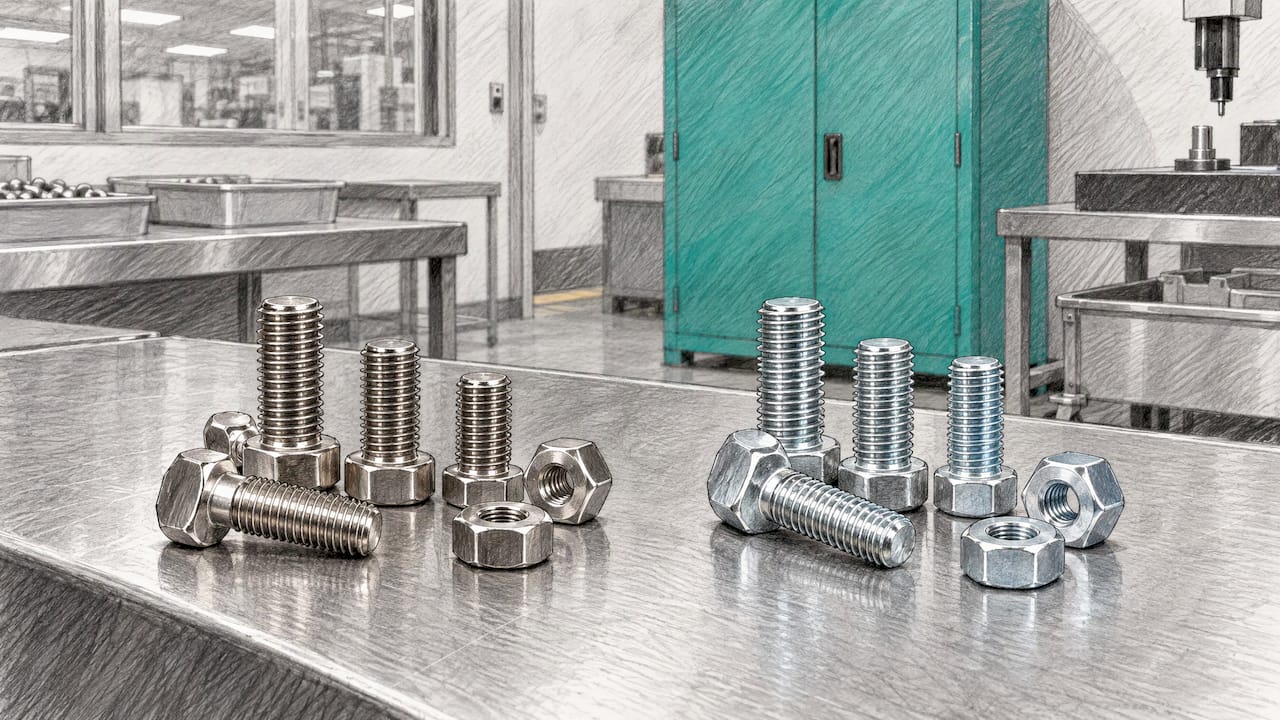

Zinc plating is the economical, sacrificial choice for steel hardware that needs basic corrosion protection. Nickel plating, and electroless nickel in particular, is the choice when you need hardness, uniform thickness on complex shapes, or resistance to harsher chemistry. Zinc-nickel alloy sits between them for parts that must survive long salt-spray exposure. The right answer depends on the base metal, the service environment, the tolerance and the strength of the steel, and it has to be written into the drawing, not left as “plated, silver”.
We machine and fabricate prototype and low-volume parts for engineering teams, and finish selection is one of the decisions that most often changes a part after the first drawing is released. This guide gives you the comparison and the checks to make before you request a quote.
The core difference is the protection mechanism. Zinc is more reactive than steel, so it corrodes first and protects the steel underneath, even where the coating is scratched. That is why zinc is described as sacrificial protection for steel hardware and is plated to ASTM B633, the common specification for electrodeposited zinc. Nickel behaves differently. It is nobler than steel, so it works as a barrier: while the layer is intact and pore-free it protects very well, but once it is breached the steel underneath is not protected sacrificially.
That single distinction explains most of the selection logic:
“Nickel plating” covers two quite different processes, and the keyword you searched often means one or the other.
Electrolytic nickel uses current to deposit the metal, so the thickness follows the current distribution. Electroless nickel (EN) deposits chemically from a hot solution, with no current. In practice that means electrolytic deposits can vary 2:1 or worse between edges and recesses, while electroless nickel is uniform to about ±10%. The electroless process is aqueous and runs at about 190°F, and blind holes or obstructed areas can still receive less coating even though the deposit is uniform where solution reaches.
For a tight-tolerance machined part, that uniformity matters. A 2:1 swing in thickness on a threaded or bored feature can push you out of tolerance, while EN lets you plan for a predictable growth per surface.

The figures below come from plating specifications and plating shops. Treat them as typical ranges and confirm the values for your own specification and supplier.
| Property | Zinc (ASTM B633) | Zinc-nickel (ASTM B841) | Electroless nickel (ASTM B733) |
|---|---|---|---|
| Protection mechanism | Sacrificial | Sacrificial plus barrier | Barrier |
| Typical thickness | 5–25 µm | Set by class in the specification | 5–75 µm |
| Thickness uniformity | Varies with part geometry | Varies with part geometry | Uniform to about ±10% |
| Corrosion life | Hours to white corrosion depend on passivate | Over 1,000 hours salt spray to red rust | Depends strongly on phosphorus grade and thickness |
| Hardness | Soft | 250–350 Vickers | HRc 40–45 as deposited, up to HRc 65–70 baked |
| Relative cost | Lowest | Higher than zinc | Higher than zinc |
| Typical use | Fasteners, brackets, hardware | Automotive, aerospace, marine | Valves, tooling, connectors, complex machined parts |
Salt-spray hours are the number everyone quotes, and they are the number most often misread.
Plain zinc is thin and its life depends heavily on the passivation (the chromate conversion layer applied on top). A yellow-chromate zinc finish reaches about 96 hours of neutral salt spray to white corrosion, the white powdery zinc corrosion product. The same source notes that new-generation clear trivalent chromates perform equally well, while older clear chromates reach about 12 hours. Red rust, which is the steel itself corroding, is a function of the zinc thickness. So a clear passivate on a thin deposit and a yellow passivate on a thick deposit are very different parts, even though both are “zinc plated”.
The phosphorus content of electroless nickel sets its personality. ASTM B733 groups the deposits as low (1–4 wt% P), average (5–9 wt% P) and high (10 wt% P or more). A published academic review reports that high-phosphorus deposits resist chlorides and simultaneous mechanical stress, that grades around 3–5 wt% P resist concentrated caustic soda, and that the amorphous structure of Ni-P gives better corrosion resistance than polycrystalline materials.
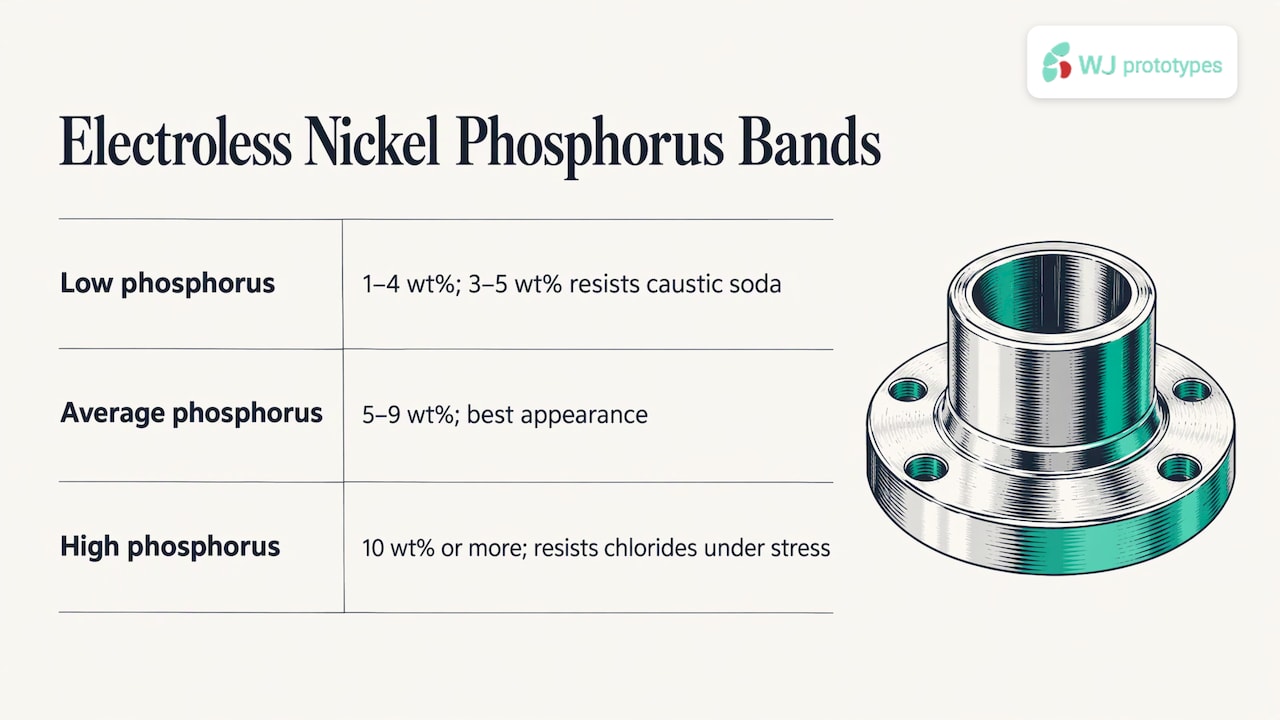
A plating shop describes high-phosphorus (10–13%) EN as offering superior corrosion protection and hardness above 65 Rc after post-plate thermal treatment, while medium phosphorus (5–9%) gives the best appearance. In short, choose high phosphorus for corrosion and chloride exposure, and medium phosphorus when cosmetic finish matters.
If your real question is “which one lasts longest on steel in a harsh environment”, the answer is often neither pure metal. Zinc-nickel combines zinc’s sacrificial action with nickel’s barrier effect. One U.S. plating shop reports that it exceeds 1,000 hours of salt spray to red rust, is preferable to plain zinc when parts contact aluminum, and is used in automotive, aerospace and marine applications per ASTM B841 and AMS 2417.
One limit is worth knowing for aerospace and space hardware: another U.S. finisher does not recommend zinc-nickel on space-application connectors, because particles can evaporate in vacuum and condense on optics and electrical components.
If the surface will slide, seal or take repeated contact, nickel wins. Mid- and high-phosphorus electroless nickel is hard as deposited, and when baked reaches hardness similar to hard chromium. That is why EN appears on valve bodies, hydraulic components, tooling and robotic joints.
Zinc is a soft, thin sacrificial layer. It is not intended as a wear surface, and it is not a high-temperature finish either: zinc and its chromate passivation lose performance as temperatures climb, so check the supplier’s stated limit against your operating temperature before you commit.
Electroless nickel has its own process notes. Stainless and non-ferrous substrates may need post-plate thermal treatment for adhesion, and high-phosphorus EN often discolors after heat treatment for maximum hardness. If appearance matters as well as hardness, say so on the drawing.
Both electroplating routes introduce hydrogen into the steel, and high-strength steel can crack in service as a result. The practical rule from plating guidance: parts above about 1,000 MPa (145 ksi) or 31 HRC must be baked at 190–220°C (375–430°F) within a few hours of plating per ASTM B850.
This matters for spring steels, hardened fasteners, landing-gear-class components and any heat-treated alloy steel. Put these three things on the drawing:
Electroless nickel is deposited without current, but you should still confirm the relief-bake requirement for hardened steel with your plater. For a safety-critical part, make the call-out explicit rather than assuming.
Zinc is the lower-cost process, and zinc-nickel costs noticeably more because of its alloy chemistry and tighter process control. Electroless nickel pricing follows nickel: nickel metal makes up 55–65% of raw-material cost in electroless nickel solutions, and market-price movements feed into solution prices after a lag of several weeks. That market report also estimates that U.S. demand is led by aerospace at roughly a quarter to a third of the total, followed by oil and gas and by electronics and connectors, each at about 15–20%.
On lead time, a plating-industry guide gives 2–5 business days for zinc on standard parts and 5–10 days for nickel and electroless nickel, with certification and salt-spray testing adding about a week. Plan for that when you schedule a prototype build: a part that needs EN, a relief bake and a certificate adds real time after machining.
The per-part price depends on surface area, rack or barrel loading, thickness class, volume and certification, so a single price per square inch is rarely meaningful. For small prototype lots, the setup and minimum lot charge usually matter more than the unit rate.
| Situation | Start with | Why |
|---|---|---|
| Steel brackets, fasteners and housings used indoors or in mild environments | Zinc with a suitable passivate | Sacrificial protection at the lowest cost |
| Steel parts in road salt, marine or underhood environments | Zinc-nickel | Long salt-spray life, sacrificial and barrier action |
| Zinc-coated steel touching aluminum | Zinc-nickel | Preferable to plain zinc in aluminum contact |
| Tight-tolerance machined parts with bores or threads | Electroless nickel | Uniform thickness to about ±10% |
| Wear surfaces, valve parts, tooling | Electroless nickel, baked | Hardness approaching hard chromium |
| Chloride, caustic or sour-service exposure | High-phosphorus EN | Amorphous deposit with strong chemical resistance |
| Space hardware with connectors | Electroless nickel | Zinc-nickel is not recommended for vacuum applications |
| High-strength steel above about 1,000 MPa | Either, with relief bake | Hydrogen embrittlement control per ASTM B850 |
Across sectors, electroless nickel is used in automotive, aerospace, space exploration, electrical, oil and gas and tooling applications, with post-plate heat treatments offered to meet Class 2, 3 and 4 requirements per AMS 2404 and MIL-C-26074. Zinc and zinc-nickel dominate in fastener and structural-hardware work.
A call-out such as “zinc plated, silver” leaves almost everything open. A complete specification names:
Also think about the base material. Aluminum, stainless steel and titanium take different pretreatments than carbon steel, and in some cases a different finish altogether, such as chem film or anodize on aluminum. If you are still choosing the substrate, our comparison of 304 and 316 stainless steel shows where a corrosion-resistant base can remove the need for plating at all.
We manufacture prototype and low- to medium-volume parts through CNC machining and sheet metal fabrication, with a wide range of materials and finishes, no minimum order quantity and dedicated project managers. Because plating changes dimensions, edges and thread fit, the best time to settle the finish is before machining, not after. When you submit a part through our instant quote, state the finish and the standard you need so that tolerances and material choices are confirmed against it at specification stage. Our CNC machining materials page lists the base metals we work with, and the CNC design guide covers features that behave well with surface treatments.
Most plating problems we see discussed by engineering teams start on the drawing, not in the tank. A finish named by metal alone, with no standard, thickness or heat treatment, invites rework at exactly the moment you need parts quickly.
Our approach is to treat finish as part of the part. Decide the substrate, tolerance and coating together, confirm them with a project manager at quote stage, and let the quote reflect the real specification. That keeps prototype lots moving and avoids surprises when the same part scales from a handful to a production run.
For machined and fabricated parts, we would rather help you settle the specification early, with our ISO-certified processes and engineers behind the build, than fix an out-of-tolerance bore after plating.
Nas
Neither is better in general. Zinc gives sacrificial protection to steel at lower cost, while nickel gives a harder, more uniform barrier, especially as electroless nickel. Choose by the environment, the tolerance and the base metal.
Zinc is electroplated and protects steel by corroding first. Electroless nickel is deposited chemically with no current, so thickness is uniform to about ±10% and it can reach very high hardness after baking. Electroless nickel suits complex, tight-tolerance parts, and zinc suits general hardware.
For steel in harsh environments, often yes. Zinc-nickel combines sacrificial and barrier protection and is reported to exceed 1,000 hours of salt spray to red rust. It is specified under ASTM B841 and AMS 2417, but it is not recommended for space connectors in vacuum.
Yes, if the steel is above roughly 1,000 MPa tensile strength or 31 HRC. Plating guidance calls for baking at 190–220°C within a few hours of plating per ASTM B850, to reduce the risk of hydrogen-related cracking in service.
A plating-industry guide gives about 2–5 business days for zinc and 5–10 days for nickel and electroless nickel on standard parts, plus about a week for certification and salt-spray testing. Confirm the schedule with your plater before you fix a delivery date.
SERVICES
RESOURCES