



- Room 1807, Unit 9, Building 2, Shangxing Commercial Street, Shangde Road, Shangxing Community, Xinqiao Subdistrict, Bao'an District, Shenzhen City, China
CONTACT US

WhatsApp


Contact Us
Our team is on stand by, waiting toassist you.

Videos
A large collection of educational videos and tutorials.

About Us
Learn about our company, leadership, and mission totransform manufacturing.

Privacy Policy
Applies to all personal information collected through and/or processed in connection.
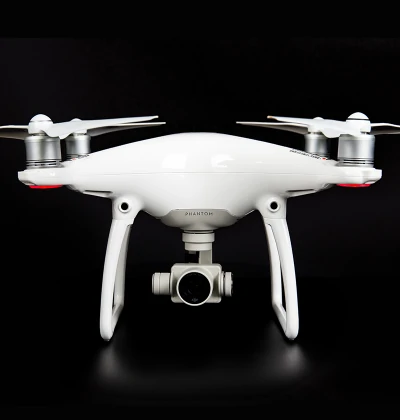

Aerospace & UAV
WJ Prototypes is your 3D manufacturing partner from prototype to large scale production.

Consumer Electronics
New Product Introduction Solutions for Consumer Electronics.

Robotics & Automation
Need some assistance bringing your robotic device or parts from the sketch-board to reality?

Medical Devices
The medical industry needs high quality, dependable and safe parts and products.

Automotive
New Product Introduction Solutions for Automotive

Industrial Machinery
The main purpose of industrial prototyping is to take the product from drawings into the real world.
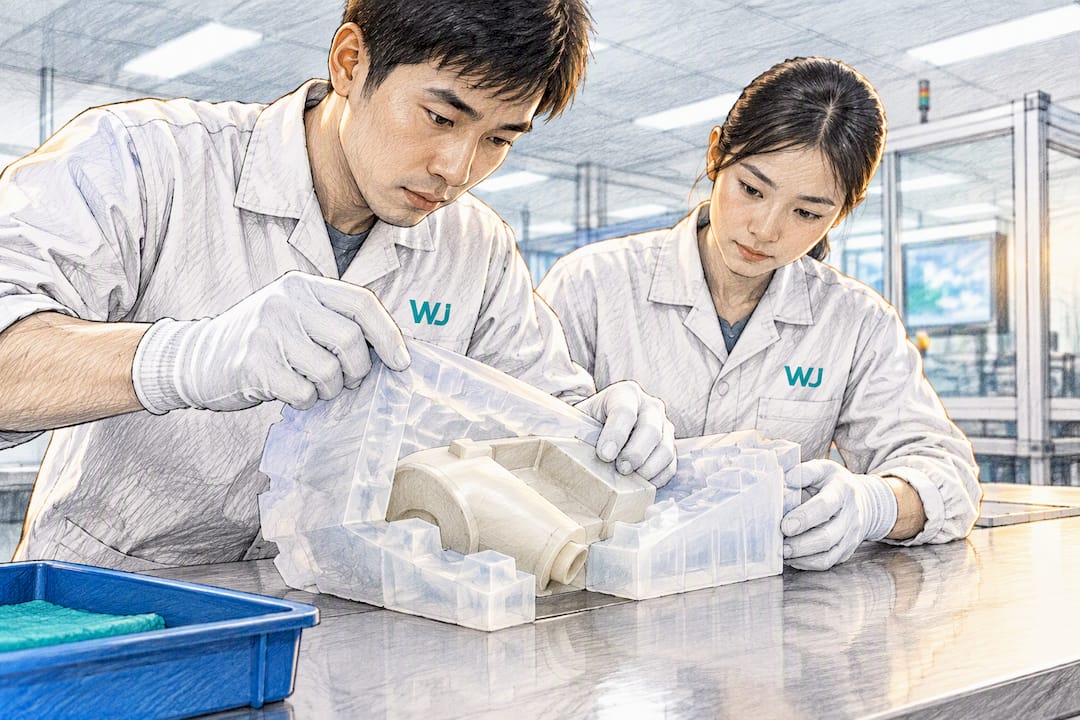
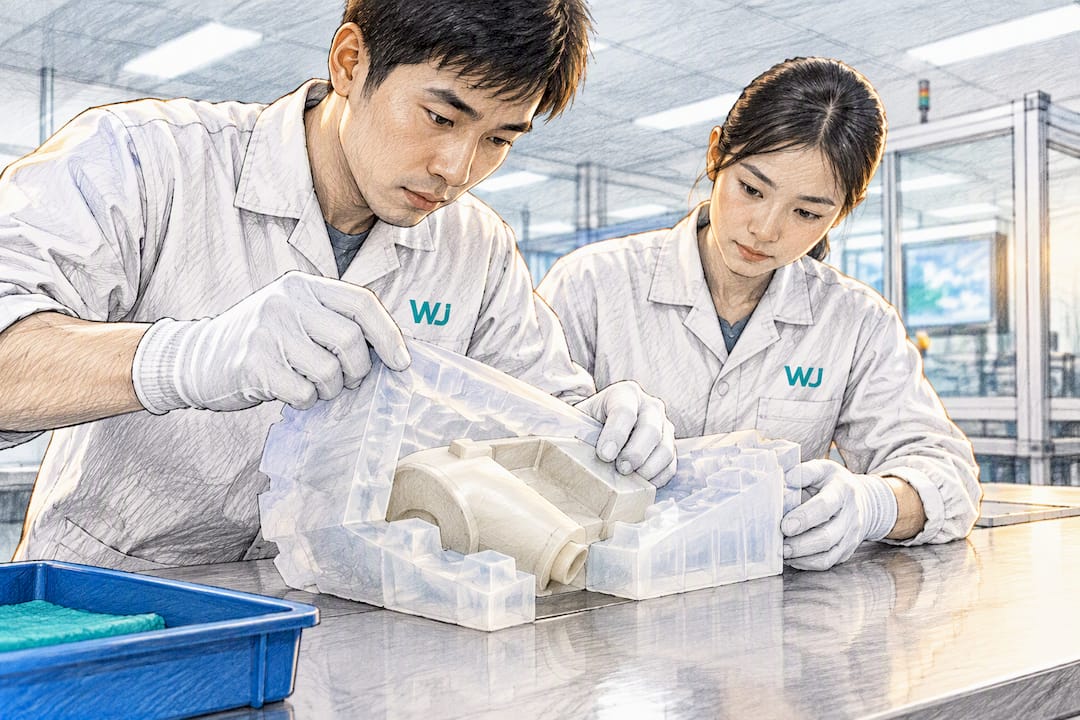
For functional, production-like prototypes in small batches, vacuum casting is usually the fastest route to accurate, production-like parts. Single tight-tolerance parts or one-off quick iterations still favor 3D printing or CNC machining. The trade-offs to weigh are lead time, mold cost amortization, and silicone mold service life, all documented in the Wiley review on industrial vacuum casting, with vendors running this workflow daily.
TL;DR:
- Vacuum casting offers a cost-effective way to produce small batches of parts with material properties close to final production plastics when more than a few units are needed.
- The process is ideal after initial 3D printing and CNC prototyping stages but before hard tooling for larger volume production.
- Silicone molds in vacuum casting typically last under a few hundred shots, so planning for mold replacement is crucial in cost and timeline estimates.
- Material selection, mold shot life, and surface finish depend heavily on the master pattern quality and resin formulation.
- For high-tolerance, metal, or function-critical parts, CNC machining remains the preferred method despite longer lead times and higher per-unit prices at low volumes.
Choosing between prototyping methods comes down to four practical axes: how fast you need a part, how much you are willing to spend per unit versus up front, how closely the part must behave like the final product, and how tight the tolerances need to be.
3D printing wins on raw speed for a single iteration since there is no tooling step. CNC machining takes longer per part but delivers true production-grade materials and tight tolerances. Vacuum casting sits in between on turnaround but changes the cost curve entirely: once a silicone mold exists, each additional cast part costs far less than the mold itself, which is why the method becomes attractive as soon as you need more than a handful of identical parts.
Material fidelity is where vacuum casting earns its reputation. Cast urethane resins can be formulated to mimic the flexibility, rigidity, or heat resistance of production plastics like ABS or polypropylene, something most 3D printing materials cannot match for functional testing. The Wiley review notes that this material versatility often makes vacuum casting the preferred option when 3D-printed parts would not replicate end-use mechanical or thermal behavior.
Surface finish and tolerances still favor CNC for parts with critical mating features or metal-like precision. Vacuum casting reproduces the surface finish of its master pattern closely, but it inherits any imperfection in that master, so a rough or poorly finished pattern shows up in every cast part.
An industry guide comparing these methods lays out representative lead time and cost thresholds that help set expectations before you request a quote.
Vacuum casting follows a repeatable sequence, and understanding each step helps you communicate specifications to a vendor without back-and-forth delays.
Design for vacuum casting the way you would for injection molding: keep wall thickness consistent, add draft to vertical faces, and plan for shrinkage compensation in the master pattern rather than the finished part. Undercuts are workable but need to be flagged early since they affect how the mold splits.
Pro Tip: Send your vendor the intended end-use material (ABS, PP, silicone rubber) rather than just a shape file, so they can recommend a casting resin that matches its mechanical behavior.
Material choice matters as much as geometry. Cast polyurethanes come in formulations that range from rigid and glass-filled to soft and rubber-like, each mapped to a specific production plastic or elastomer. A detailed walk-through of this workflow is available in WJ Prototypes’ vacuum casting guide.
Vacuum casting is not always the right call, and knowing when to reach for a different method saves both time and budget.
In a typical development plan, teams move from a printed form model to a CNC functional prototype, then to a vacuum-cast pilot batch, and finally to hard tooling once volumes justify it. Different prototyping techniques serve different objectives (form, function, manufacturability), and a Cambridge Design Science review frames method selection around exactly this staged progression. A closer breakdown of when CNC beats printing, and vice versa, is covered in WJ Prototypes’ CNC versus 3D printing guide.
Matching method to project stage gets easier with a short checklist rather than a gut call.
When drafting an RFQ, ask suppliers directly about mold shot life, material datasheets, inspection reports, sample photos, expected lead time, and available finish options. Silicone molds in vacuum casting typically have a limited service life, often under a few dozen to a few hundred shots depending on resin and mold design, which constrains how far you can push a single mold before quality drops, as the Wiley review explains.
Pro Tip: Treat a vendor’s refusal to share mold shot-life data or QA inspection reports as a red flag, not a minor omission.
Vacuum casting is often included as part of a broader manufacturing offering that also includes SLA, SLS, MJF, DMLS, CNC machining, sheet metal fabrication, injection molding, and die casting, sometimes backed by ISO certification and design review before quoting.
A typical vacuum casting quote accounts for master pattern requirements, an estimate of expected mold shots, available resin options mapped to production plastics, finishing choices, and inspection documentation. Engineers evaluating any China-based vendor for this work should expect the same baseline:
More detail on how this fits into a broader prototype-to-production plan is in WJ Prototypes’ guide to scaling from prototyping to production.
The most common mistake is skipping the material-realism check: teams validate a design on a 3D print, then discover the production resin behaves nothing like it under load. The second is ignoring mold shot life during planning and getting caught mid-batch. Sequence rapid prints, then functional CNC, then a vacuum-cast pilot, then tooling, and bring a trusted vendor in early rather than after the first surprise.
— Nas
Some companies offering vacuum casting may also provide related services like SLA, SLS, CNC machining, injection molding, and die casting, facilitating pilot batches to move to higher-volume tooling without restart. Features such as ISO certification, no minimum order quantities, and online quote systems can improve the quoting process for vacuum casting.
To get an accurate proposal, include your CAD files, target quantity, the production material you want your casting resin to match, and any required minimum mold shot life.
Start a request through WJ Prototypes’ vacuum casting service page to get quantities, materials, and lead time confirmed before committing.
Vacuum casting produces small batches of parts that closely match the material properties and surface finish of production plastics. It fits functional testing, appearance models, and pilot production runs where a handful to a few hundred identical parts are needed.
Silicone molds in vacuum casting typically have limited service life, often less than several hundred shots depending on resin and mold design, as detailed in the Wiley review on industrial vacuum casting. Once the mold degrades, quality declines and replacement is necessary.
Vacuum casting usually costs less per part than CNC machining once you need more than a few identical units, since the silicone mold cost is spread across the batch. For a single part or very tight tolerances, CNC often remains the better value.
Vacuum cast parts can closely mimic the material behavior of injection molded plastics for pilot runs and functional testing, but they are not a permanent substitute at higher volumes because silicone molds wear out faster than steel injection tooling.
Yes, WJ Prototypes offers vacuum casting alongside 3D printing, CNC machining, and injection molding, with quotes available through its vacuum casting service page.
SERVICES
RESOURCES