



- Room 1807, Unit 9, Building 2, Shangxing Commercial Street, Shangde Road, Shangxing Community, Xinqiao Subdistrict, Bao'an District, Shenzhen City, China
CONTACT US

WhatsApp


Contact Us
Our team is on stand by, waiting toassist you.

Videos
A large collection of educational videos and tutorials.

About Us
Learn about our company, leadership, and mission totransform manufacturing.

Privacy Policy
Applies to all personal information collected through and/or processed in connection.
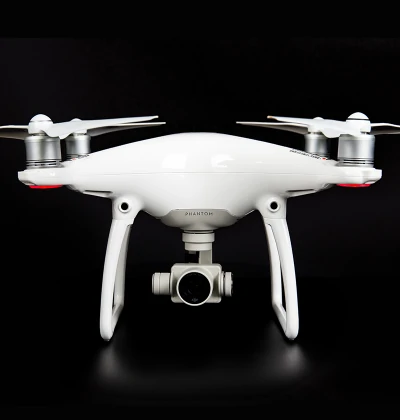

Aerospace & UAV
WJ Prototypes is your 3D manufacturing partner from prototype to large scale production.

Consumer Electronics
New Product Introduction Solutions for Consumer Electronics.

Robotics & Automation
Need some assistance bringing your robotic device or parts from the sketch-board to reality?

Medical Devices
The medical industry needs high quality, dependable and safe parts and products.

Automotive
New Product Introduction Solutions for Automotive

Industrial Machinery
The main purpose of industrial prototyping is to take the product from drawings into the real world.


ISO 9001 is a general quality management standard that any company in any industry can use. AS9100 is the aerospace version: it contains all of ISO 9001 and adds requirements for aviation, space and defense. If you build or buy flight hardware, AS9100 is usually what your customers expect. If you work in other sectors, ISO 9001 is normally enough.
This guide explains where the two standards overlap, what AS9100 adds, what certification costs in the United States, and how to read a supplier’s certificate when you are sourcing prototypes or low-volume parts.
AS9100 incorporates every ISO 9001 requirement and layers aerospace-specific controls on top, so an AS9100 system also meets ISO 9001 but not the other way around.
The added requirements center on risk, configuration management, product safety, counterfeit-parts prevention, project management and supplier control.
One U.S. certification body estimates 3 to 6 months for companies with a mature ISO 9001 system and $10,000 to $30,000 for initial certification.
For buyers, the certificate’s scope matters as much as its name: check the sites, processes and products it covers.
Early prototypes often move under ISO 9001 controls, with aerospace paperwork such as first article inspection added as the part matures.
ISO 9001 is ISO’s quality management system standard. Its requirements define how to establish, implement, maintain and continually improve a QMS, and ISO lists ISO 9001:2026 as the current sixth edition, published September 16, 2026, for organizations of any size or sector. ISO’s own guidance says the system should fit how the organization actually works, built on process management, customer focus, risk-based thinking and continual improvement without unnecessary bureaucracy.
AS9100 is the aerospace standard. It is published by SAE International, and ANAB describes it as an aerospace quality management system standard that incorporates the entirety of ISO 9001 and adds requirements for aviation, space and defense organizations. The current revision is SAE AS9100D:2016, which incorporates ISO 9001:2015 and states that customer, statutory and regulatory requirements take precedence when they conflict with it.
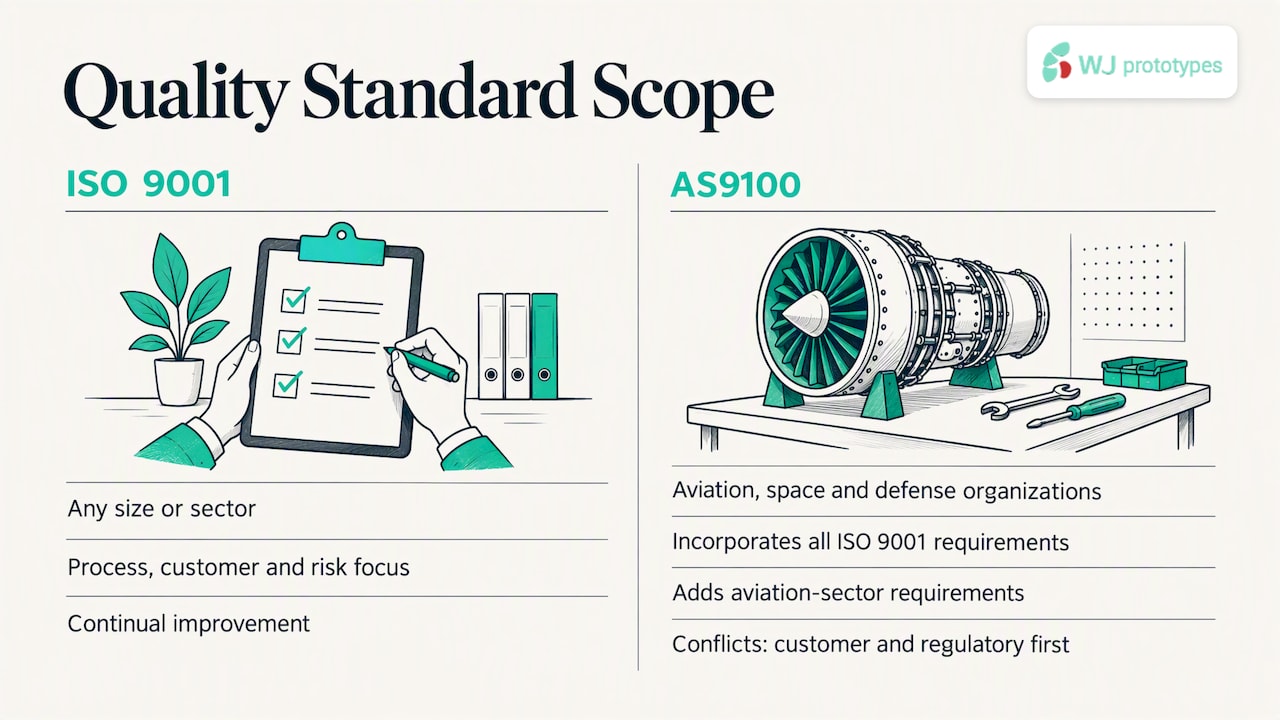
Both follow the same Plan-Do-Check-Act logic and the same basic clause structure, which is why DNV calls AS9100 “built upon” the ISO 9001 foundation. Because ISO 9001 has just moved to a new edition, check the IAQG and your certification body for how AS9100 will align with it before you plan a certification timeline.
Point | ISO 9001 | AS9100 |
|---|---|---|
Industry | Any sector | Aviation, space and defense |
Publisher | ISO | SAE International (AS9100D:2016) |
Relationship | Stands alone | Includes all of ISO 9001 plus additions |
Risk | Risk-based thinking | More detailed risk management, including operational risk |
Extra controls | None specific to aerospace | Configuration management, product safety, counterfeit parts, project management |
Supplier oversight | General control of external providers | Tighter flow-down and supplier management |
Certification body | Any accredited body | Body accredited to the AS standards under IAQG rules |
Typical buyer expectation | General quality assurance | Aerospace primes and their supply chain |
The table compresses a lot, so the next sections go through the practical differences.
DNV lists the additions as risk management, configuration management, product safety, counterfeit-parts prevention, project management, special requirements and supplier management. NQA’s summary of the 2016 revision adds human factors, post-delivery support, design and development, and raw-material testing to the list of areas added or strengthened. Here is what that means on the shop floor.
ISO 9001 asks you to think in terms of risk. AS9100 asks you to manage it in a structured way across operations, with product safety treated as a named concern. For a machine shop, that can mean documented risk assessments on critical features and a clear route for raising a concern before a part ships.
An aerospace part has to be traceable to the exact drawing revision, material lot and process it was made with. If a drawing changes, the system must show which parts were built to which revision. Generic ISO 9001 systems often handle revisions well, but AS9100 makes the discipline mandatory and auditable.
AS9100 requires controls that keep counterfeit or unapproved parts and materials out of the product. In practice that means certified material traceability, approved sources and incoming verification, a topic we cover from a sourcing angle in our guide to aerospace-grade CNC parts from China.
Aerospace programs are planned in stages with defined reviews. AS9100 expects structured project management and a way to identify special requirements, such as critical items or key characteristics, and carry them through production.
An AS9100 organization must pass requirements down to its suppliers and monitor them. This is the clause that matters most to anyone selling into the supply chain, because your customer’s flow-down becomes your obligation.
Yes. Amtivo notes that an AS9100 certificate means the organization is also meeting ISO 9001 requirements. NQA adds that the two are designed to work in tandem, so you must satisfy ISO 9001’s foundations to get AS9100.
There is a practical wrinkle. Many certification bodies issue separate certificates, or a single certificate that lists both standards, and some customers still ask to see an ISO 9001 certificate by name. Ask your certification body how it will word yours.
The standards are even sold together: ANSI’s webstore offers the SAE AS9100D and ISO 9001 requirements set as a PDF at $642.00. Check the listing for the current edition and price before you buy.
ISO 9001 suits general manufacturers, electronics suppliers, automotive component makers, medical device contract shops (alongside sector standards) and almost any company that wants a recognized quality system.
AS9100 is for organizations that design, develop or provide aviation, space and defense products and services. The family has siblings: AS9110 covers maintenance organizations and AS9120 covers distributors. NIST says AS9100 helps products meet Department of Defense, FAA and NASA quality requirements, and its MEP National Network offers ISO 9001 audits, implementation and training, and can help shorten AS9100 implementation.
The real decider is usually the purchase order. If your customer’s flow-down clauses call out AS9100, that is your answer. If they do not, ISO 9001 plus good inspection records may be all a program needs.
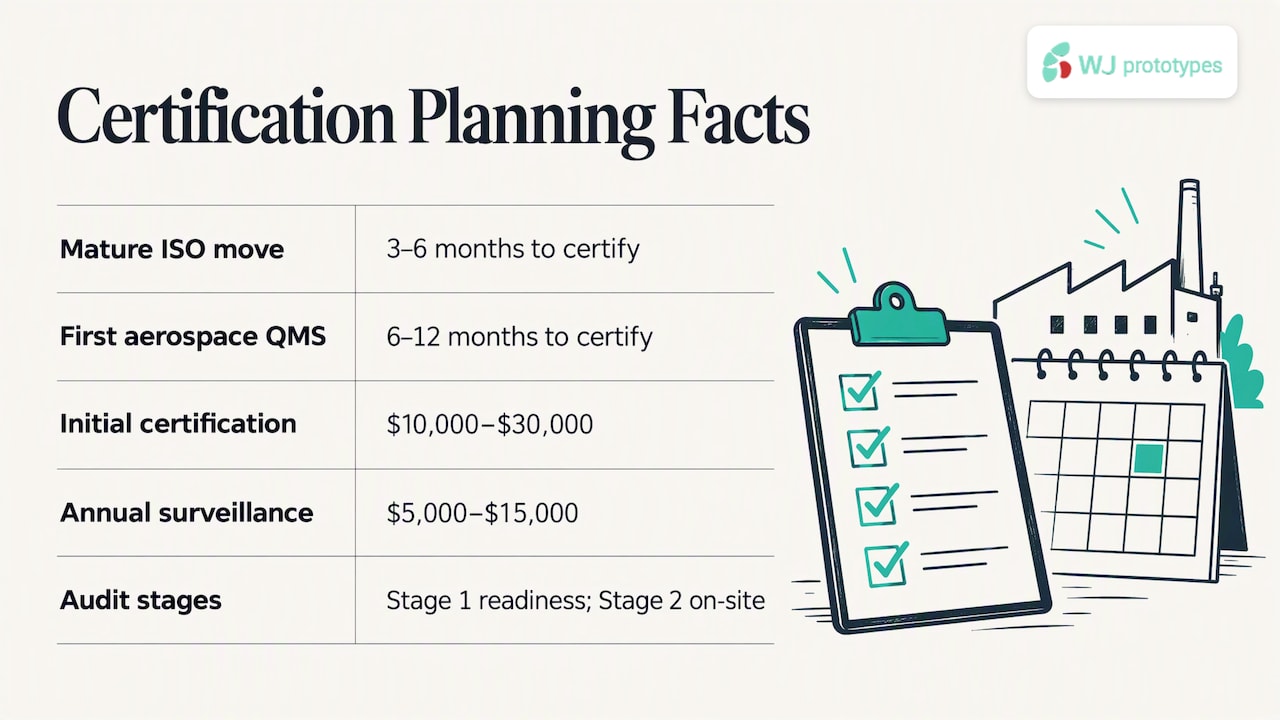
Certifications must come from a body accredited to the AS standards by an accreditation body recognized by the IAQG ICOP scheme, such as ANAB. Auditors then check whether the business follows documented, repeatable procedures, and the process runs in two stages: a Stage 1 readiness review of documentation and a Stage 2 on-site implementation audit.
One U.S. certification body, PJR, estimates 3 to 6 months for companies moving from a mature ISO 9001 system and 6 to 12 months for a first aerospace QMS. It puts initial certification at about $10,000 to $30,000 depending on size and complexity, with annual surveillance audits adding $5,000 to $15,000. Treat these as planning ranges and get quotes from several accredited bodies.
Run a gap analysis against the AS9100 requirements.
Train the people who touch aerospace work.
Update documentation with aerospace processes: configuration control, counterfeit prevention, special requirements.
Audit internally against the new requirements and close findings.
Hold the management review, then book Stage 1 and Stage 2 with an accredited body.
This is the sequence Amtivo describes, and the shared high-level structure is why the effort is smaller than starting from nothing.
A certificate is a starting point. When you qualify a manufacturer, check these items:
Standard and revision. ISO 9001 or AS9100D, and which edition.
Scope statement. It should name the processes you are buying, such as CNC machining, sheet metal or additive manufacturing.
Sites. The certificate applies to the listed location, not the whole company group.
Issuing body. Confirm accreditation and look the certificate up with the issuer.
Validity. Certificates run on a three-year cycle with annual surveillance, so check that it is current.
Inspection capability. CMM reports, material certs and, for flight parts, first article inspection per AS9102. Our first article inspection guide walks through the forms and costs.
Scope is where buyers get caught. A shop certified for one site or process does not automatically extend that coverage to a subcontracted finish or a second facility.
Early-stage prototypes, test fixtures, UAV airframe studies and engineering models rarely need full AS9100 flow-down. Teams usually need dimensional accuracy, material traceability and clean documentation. Production flight hardware is where AS9100 expectations and customer-specific requirements arrive in full.
That is why many aerospace engineers split sourcing: fast iteration with an ISO-certified prototype partner, then a move to an AS9100 supply chain when the design freezes and the program’s contract requires it. Our aerospace prototyping process guide and prototype QA guide for aerospace, automotive and medical cover how the documentation grows with each stage. If your customer’s contract clauses require AS9100 on the part itself, confirm that before you place the order.
We are an ISO-certified manufacturer, and we see the same question from engineers and procurement teams every week: which standard does this part really need? Our answer is to start from the contract, not the certificate logo.
Most aerospace projects begin as prototypes: brackets, housings, ducting, fixtures, UAV components. At this stage the buyer needs reliable dimensions, material traceability and quick feedback on manufacturability. We build that around a documented quality system, instant online quoting, no minimum order quantity and a dedicated project manager who keeps the drawing revision, the material callout and the inspection requirements in one thread.
When a program needs more, we work with you on inspection documentation such as first article reports, and on the process controls your drawing calls out. We encourage buyers to send their quality requirements with the RFQ, so we can confirm up front what we can document and what the customer’s flow-down demands.
The strongest supplier relationships we have are the ones where quality expectations were written down on day one. That is what any quality standard, ISO 9001 or AS9100, is ultimately for.
Nas
If you are prototyping aerospace or UAV hardware, we machine, print, fabricate and cast parts with the materials and finishes your drawing specifies. Start with CNC machining for metal and plastic parts, sheet metal fabrication for enclosures and brackets, or DMLS metal 3D printing for complex geometries. Upload your files for an instant quote, and list any certificate, inspection report or material cert requirements in the notes. You can also see how we approach aerospace and UAV projects.
Use this short decision path:
Does your contract or customer name AS9100? Then pursue or require it.
Do you sell to aerospace primes in the future? Build on ISO 9001 now, and use a gap analysis to plan the step up.
Are you buying prototypes or engineering models? Prioritize traceability, inspection records and a clear quality plan, and confirm what documentation the part needs.
Are you buying flight-critical production parts? Require AS9100 certification with a scope covering the process, plus the inspection and flow-down your program specifies.
For safety-related requirements on metal parts, see our piece on aerospace metal fabrication safety standards, and for tolerance expectations, precision CNC machining for aerospace tolerances.
It is not better in general, it is more specific. AS9100 contains all of ISO 9001 and adds aerospace controls, which is what aviation, space and defense customers expect. For a company outside that supply chain, ISO 9001 is the right fit.
You do not need a separate ISO 9001 certificate, but you must meet ISO 9001’s requirements, because AS9100 is designed to work in tandem with it. Many companies certify to ISO 9001 first because it shortens the later AS9100 effort.
PJR estimates about $10,000 to $30,000 for initial certification, plus $5,000 to $15,000 a year for surveillance audits. Your cost depends on company size, number of sites and complexity, so request quotes from accredited bodies.
PJR gives 3 to 6 months for companies with a mature ISO 9001 system and 6 to 12 months for those building an aerospace QMS from scratch, per its AS9100 page. NQA also requires the system to have operated for at least three months before the audit.
Only a certification body accredited to the AS standards by an accreditation body recognized under the IAQG scheme, such as ANAB. Check the issuer before you accept a supplier’s certificate.
SERVICES
RESOURCES