



- Room 1807, Unit 9, Building 2, Shangxing Commercial Street, Shangde Road, Shangxing Community, Xinqiao Subdistrict, Bao'an District, Shenzhen City, China
CONTACT US

WhatsApp


Contact Us
Our team is on stand by, waiting toassist you.

Videos
A large collection of educational videos and tutorials.

About Us
Learn about our company, leadership, and mission totransform manufacturing.

Privacy Policy
Applies to all personal information collected through and/or processed in connection.


Aerospace & UAV
WJ Prototypes is your 3D manufacturing partner from prototype to large scale production.

Consumer Electronics
New Product Introduction Solutions for Consumer Electronics.

Robotics & Automation
Need some assistance bringing your robotic device or parts from the sketch-board to reality?

Medical Devices
The medical industry needs high quality, dependable and safe parts and products.

Automotive
New Product Introduction Solutions for Automotive

Industrial Machinery
The main purpose of industrial prototyping is to take the product from drawings into the real world.
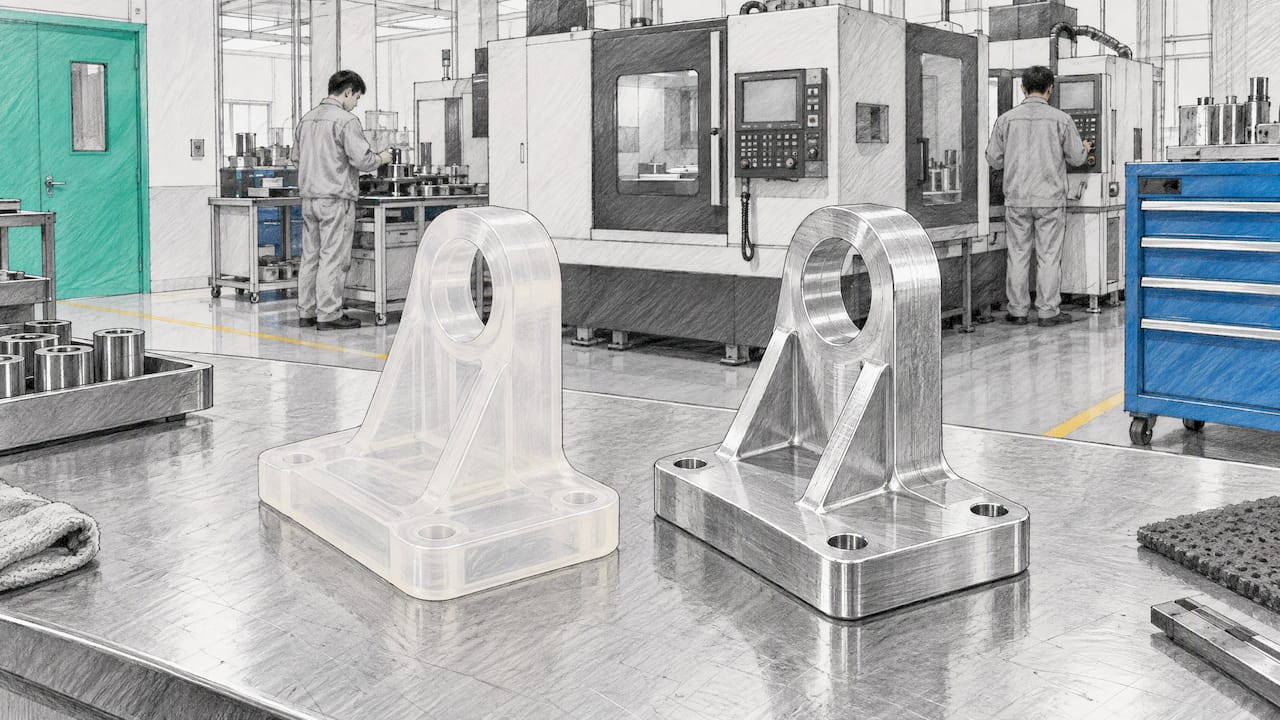
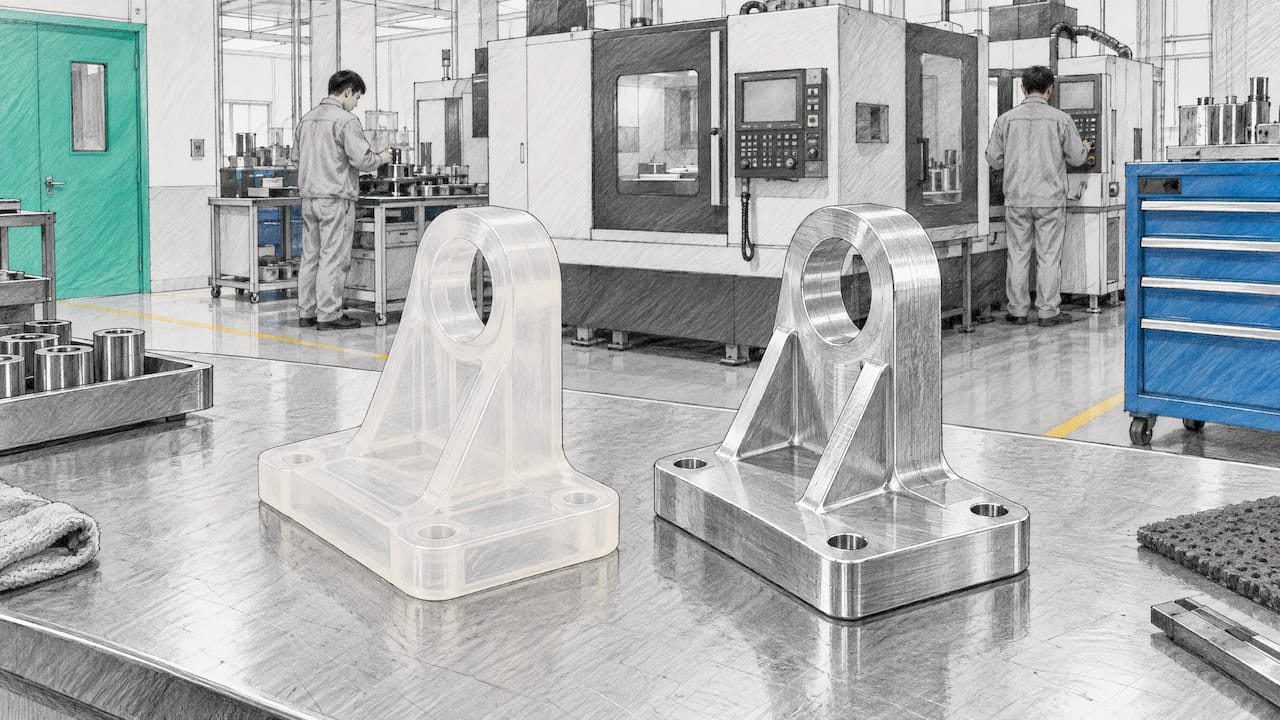
Choose the material by the question the prototype has to answer. If you are checking form, fit, feel or a housing, plastic gets you there faster and for less. If you are validating load, fatigue, heat or conductivity, build it in metal, because a structural test only means something on structural material. Under roughly 100 units, machined metal or printed nylon often wins on cost. Above 1,000 units, molded plastic usually does. We build both at WJ Prototypes, so the choice below is about your part, not about what we happen to have in stock.
Every prototype exists to retire a specific risk. Name the risk first and the material usually follows.
Rabbit Product Design describes plastic prototypes as the right tool for validating form, feel and visual character, and, when made with soft tooling, production-plastic traits such as gates, weld lines, sink, shrinkage and warpage. The same source puts structural performance, fatigue, mechanical cycles, thermal management, electrical conductivity and metal-on-metal mating fit on the metal side, since structural validation requires structural materials.
| What you need to learn | Usually the better first prototype | Typical processes |
|---|---|---|
| Shape, ergonomics, look | Plastic | SLA, FDM, vacuum casting |
| Snap fits, housings, assembly fit | Plastic | SLS, MJF, CNC machining |
| Production-plastic behavior | Plastic, in the production resin | Injection molding |
| Load, fatigue, wear | Metal | CNC machining, DMLS |
| Heat sinking, conductivity | Metal | CNC machining, die casting |
| Enclosures and brackets in sheet | Metal | Sheet metal fabrication |
The table is a starting point. A medical handheld may need plastic for the shell and aluminum for the internal frame, and the honest answer is two prototypes built in parallel.
The process decides what a part can look like, what it costs and how close it is to the eventual production part, so it helps to know the map.
Machining is the bridge between the two worlds. The same CNC cell can cut an aluminum bracket and a polycarbonate cover, which is why many teams run both materials through one process for a first comparison.
Metals are strong, rigid, hard, tough and heat resistant, and they behave the same in every direction, according to a University of Rochester robotics materials guide. Plastics are much lighter and weaker than mild steel, and they can be transparent or electrically insulating, which is often exactly what a product needs.
RMA Engineering’s September 2026 guide notes that an unfilled polypropylene bracket will visibly bow under a load an aluminum one would shrug off. Adding 30% glass fiber to nylon roughly doubles to triples its stiffness. The same guide points out that aluminum has about one-third the stiffness of steel and one-third the weight, so an aluminum part designed to match a steel part’s stiffness ends up thicker and lands at about half the weight, not a third.
For a designer that means a plastic part is rarely a drop-in copy of a metal one. Ribs, wall thickness and fiber-filled grades all change the result, so the prototype should be made in the grade you intend to ship.
Total Plastics cites unfilled PEEK at about 90 to 100 MPa tensile strength against 240 to 310 MPa for aluminum 6061-T6. Carbon-fiber-reinforced PEEK can reach 689 MPa, beyond aluminum, though at significant material cost. If your design depends on yield strength, test in the metal you plan to use.

Heat is the cleanest dividing line. RMA Engineering lists approximate limits:
| Material | Approximate continuous limit |
|---|---|
| PLA | softens around 130 to 140°F |
| ABS | roughly 175 to 195°F |
| Polypropylene | about 210°F |
| Polycarbonate | 240 to 260°F |
| Nylon | 200 to 300°F, by grade and glass content |
| Silicone | past 400°F |
| Aluminum and steel | beyond any consumer-product temperature |
High-performance grades extend the range. Total Plastics reports that most engineering plastics have continuous service limits between 200°F and 480°F, with PEEK handling up to about 480°F, and that above 500°F the polymer options are essentially exhausted and metal is the correct specification. Reinforcement helps too: glass- and carbon-fiber-filled Zytel grades from DuPont have a heat deflection temperature above 150°C, while the unreinforced grade is above 100°C, as Engineering.com reported.
Plastic wins on weight and on options such as transparency, color and electrical insulation. Metal wins on wear surfaces, conduction and a machined or anodized look. Both take finishing: bead blasting, polishing, painting, anodizing and plating are standard conversations when you request a quote.
Quantity moves the answer more than most teams expect. RMA Engineering states that molded plastic is almost always cheapest above 1,000 units, while under 100 units machined metal or printed nylon often wins. In between, the decision comes down to geometry and how many revisions you expect.
What drives the price on each side:
For a closer look at molding budgets, our injection molding prototype cost guide walks through the numbers for US buyers. For the print-versus-machine call on automotive parts, see our CNC machining vs 3D printing cost comparison.
A practical worked example: an electronics team needs 20 enclosures to test with users and 20 internal heat spreaders. The enclosures go in SLA or MJF plastic, where there is no tooling and revisions are cheap. The spreaders are CNC-machined aluminum, because heat conduction is the thing being tested. Two processes, one project, both quoted together.
The pattern repeats across sectors, with the heat and load limits setting the line.
Metal is the correct specification, per the same source, for sustained temperatures above 500°F, extreme compressive or structural loads, electrical conductivity or thermal transfer, and sharp impact and edge loading. If you are selecting CNC materials for production tooling or machinery, metal materials for CNC machining shows what a materials range covers across ferrous, non-ferrous and plastic stock.
Often, yes. Rapid prototyping and low-volume manufacturing share equipment and lead times, which is what makes bridge production workable.
Our guides on the injection molding workflow and on why molding suits prototyping go deeper if molding is where your program is heading.
Total Plastics is firm that no metal-to-plastic conversion should go straight from design to production. Prototype parts should run through actual service conditions rather than a lab approximation: temperature cycling, chemical exposure, load cycling and assembly fit, all confirmed on real parts before production tooling is committed.
In practice that gives you a three-step ladder:
Skipping the third step is where programs lose money, because a mold built on an unvalidated design is the most expensive place to find a problem.
Sourcing in China works best when the brief removes guesswork. For each part, send:
Our guides on material selection for prototyping from China and the role of materials explain how grade choices affect the result. If the part will be machined, the CNC milled parts design guide covers wall thickness, internal corners and tolerances that keep cost down.
Most material debates we see are really testing debates. Teams argue plastic against metal when the useful question is what the next build has to prove.
Our approach is to quote the same part in more than one process when the answer is not obvious, so you can compare price and lead time side by side. We run SLA, SLS, MJF, FDM, DMLS, CNC machining, sheet metal, vacuum casting, injection molding and die casting under one roof, which means the recommendation is not tied to a single machine.
We are ISO certified, we set no minimum order quantity, and each project has a dedicated project manager. That suits a startup ordering five parts as well as an engineering team moving into a low-volume run.
Our advice: use plastic early and often, move to metal or production-intent resin when the test is structural or thermal, and validate on the real material before you pay for tooling.
Nas
If your project mixes plastic and metal parts, send the files once and compare the options. Our 3D printing service offers instant online quoting, and you can request machined, sheet metal, cast or molded versions of the same part through our CNC machining and injection molding pages.
Only for fit, form and ergonomics. Strength, fatigue, heat and conduction results come from the material you will ship, so a structural or thermal test needs a metal prototype. A plastic version still helps you refine geometry before spending on metal.
Printed plastic is usually the quickest because it needs no tooling or fixturing. Machined parts in either material are also fast, and the time depends on complexity and finish. Molds change the picture: a metal mold typically takes four to eight weeks, according to Formlabs.
A common rule from RMA Engineering is that molded plastic is almost always cheapest above 1,000 units, while below 100 units machined metal or printed nylon often wins. Geometry, tolerance and material grade can move the break-even point, so quote your actual part.
Often you can. Machining, sheet metal and injection molding all scale from prototype to low volume. Printing and vacuum casting suit early and small-batch work, and soft-tool molding bridges to production resin.
Send a 3D CAD file, a 2D drawing for critical dimensions, the target material, quantity, finish and what the part will be tested for. With those, the quote can reflect the right process the first time.
SERVICES
RESOURCES