



- Room 1807, Unit 9, Building 2, Shangxing Commercial Street, Shangde Road, Shangxing Community, Xinqiao Subdistrict, Bao'an District, Shenzhen City, China
CONTACT US

WhatsApp


Contact Us
Our team is on stand by, waiting toassist you.

Videos
A large collection of educational videos and tutorials.

About Us
Learn about our company, leadership, and mission totransform manufacturing.

Privacy Policy
Applies to all personal information collected through and/or processed in connection.


Aerospace & UAV
WJ Prototypes is your 3D manufacturing partner from prototype to large scale production.

Consumer Electronics
New Product Introduction Solutions for Consumer Electronics.

Robotics & Automation
Need some assistance bringing your robotic device or parts from the sketch-board to reality?

Medical Devices
The medical industry needs high quality, dependable and safe parts and products.

Automotive
New Product Introduction Solutions for Automotive

Industrial Machinery
The main purpose of industrial prototyping is to take the product from drawings into the real world.
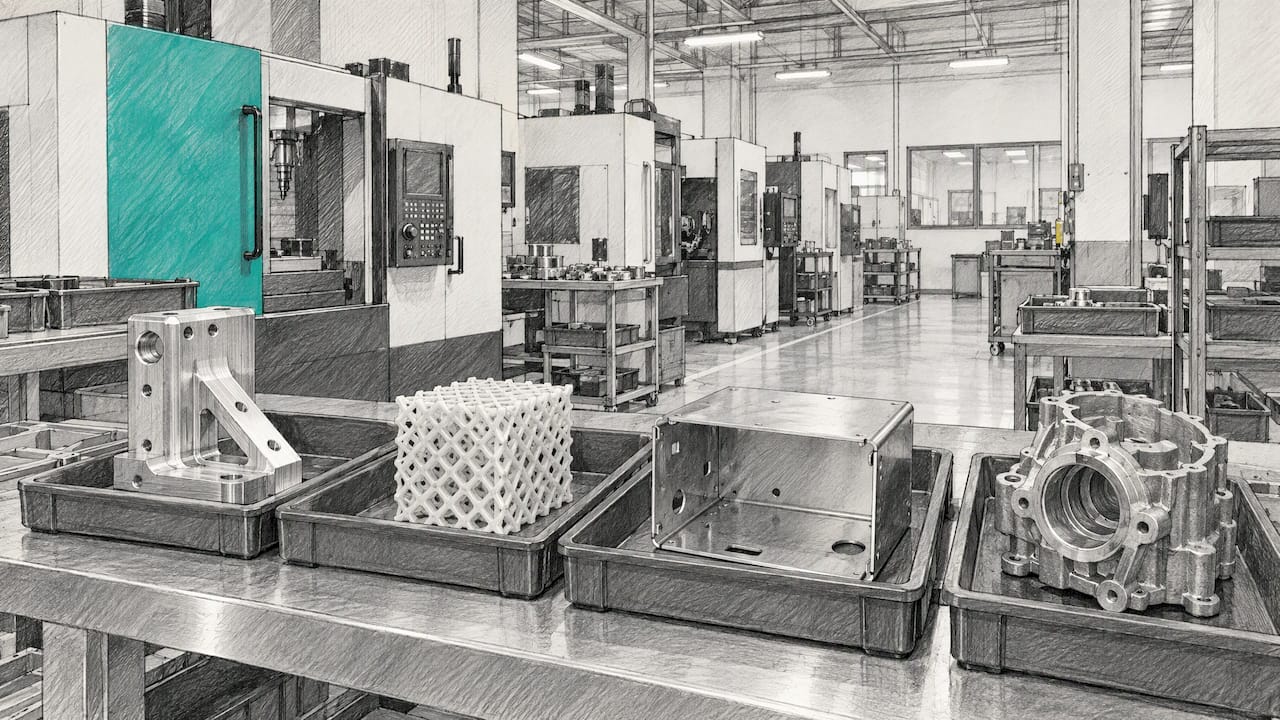

There is no single best manufacturing process. The best one is the process that fits your material, geometry, tolerance and quantity at the lowest total cost. For one to a few hundred parts, that is usually CNC machining, 3D printing, sheet metal work or vacuum casting. For thousands of identical parts, it is usually injection molding or die casting, because tooling cost spreads across the run. This guide shows how the main methods differ, where each one wins, and how to filter your options in a sensible order.
Many guides to “types of manufacturing” mix two different ideas, so it helps to split them.
A manufacturing system describes how a plant organizes work. A Penn State production-process presentation describes job shops as small-quantity custom production, batch production as finite lots with changeover between batches, repetitive production as repeated connected sequences for discrete units, and continuous production as commodity output running year-round. TechTarget adds another split: discrete manufacturing builds assembled products from countable components and bills of materials, while process manufacturing combines ingredients by formula.
A manufacturing process is the physical method that turns material into a shape: cutting, melting and pouring, forcing plastic into a cavity, bending sheet, or fusing powder layer by layer.
For an engineer or buyer ordering parts, the system matters less than the process. A prototype order is effectively job-shop work, whatever the supplier’s plant looks like. The rest of this article is about processes.
Arizona State University classifies manufacturing as formative, subtractive or additive: casting, molding and forging shape material; machining removes material; additive manufacturing builds parts layer by layer.
The trade-off across all three is the same: the more you invest up front in tooling, the less each part costs later. Your quantity decides which side of that trade makes sense.
For a deeper look at the first two ends of that spectrum, our comparison of traditional vs. additive manufacturing on cost, speed and quality goes through the numbers.
Here is how the processes engineers reach for most often compare. Tooling and quantity ranges for injection molding, die casting and machining come from the Department of Energy’s design-for-manufacturing module; the rest is general engineering practice.
| Process | Family | Tooling | Typical economic quantity | Best for |
|---|---|---|---|---|
| CNC machining | Subtractive | Fixtures only | From 1 unit up | Tight tolerances, metals and plastics, functional prototypes |
| 3D printing (SLA, SLS, MJF, DMLS, FDM) | Additive | None | One to low hundreds | Complex geometry, internal channels, fast iteration |
| Sheet metal fabrication | Formative / subtractive | Minimal | Prototype to medium runs | Enclosures, brackets, chassis |
| Vacuum casting | Formative | Silicone mold | Small batches | Production-like plastic parts without steel tools |
| Sand casting | Formative | Pattern | Below 100 units | Large metal parts, rough surface acceptable |
| Die casting | Formative | High (steel die) | 500 to 1,000 and above | Aluminum, zinc and magnesium housings |
| Injection molding | Formative | High (steel or aluminum mold) | Above 10,000 | High-volume plastic parts |
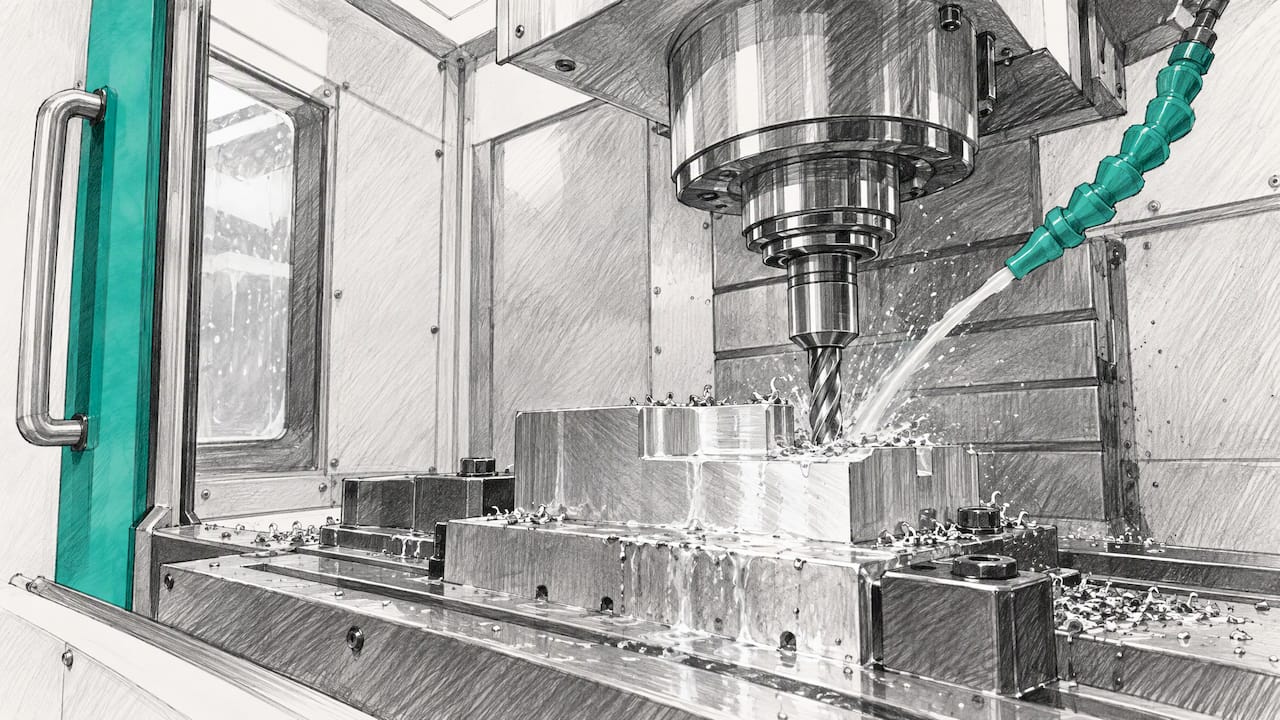
Machining is the workhorse for accurate parts. The DOE process table lists it as economic from a single unit, with turning tolerance of ±0.05 mm and production rates of 1 to 50 parts per hour. It handles a wide range of metals and plastics, which is why it is the default for functional metal prototypes. Material choice drives cost and finish, so review the CNC machining materials before you finalize a drawing.
Additive is a family, not one process. SLA gives smooth, detailed resin parts. SLS and MJF produce durable nylon parts without support structures. DMLS prints metal. FDM is the fast, low-cost route for early form checks. Our overview of the key types of additive manufacturing explains which one fits which job.
MIT researchers describe additive manufacturing as enabling complex internal geometries, mass customization and shorter lead times for small batches, while noting that cost, throughput and quality trade off against resolution and process settings. In practice that means a part printed at a coarse layer height builds faster but may need more finishing.
The DOE describes casting as pouring molten metal into a mold. Sand casting suits large parts and low counts. MIT’s casting guide says sand casting accommodates most castable metals and quantities from ounces to many tons, with sample lead times of 2 to 10 weeks and production lead times of 2 to 4 weeks. The same guide gives investment casting sample lead times of 5 to 16 weeks and production lead times of 4 to 12 weeks, depending on complexity and later operations.
Die casting forces molten metal into a steel die under pressure. The DOE lists it with high tooling cost, economic quantities of 500 to 1,000 and rates of 5 to 200 parts per hour. The alloy matters: see our page on die casting materials. For a broader tour of the methods, read our practical guide to metal casting methods.
Vacuum casting sits between printing and tooled production. A master pattern, often printed, is used to cast polyurethane parts in a silicone mold. It is a common way to get dozens of production-like plastic parts for testing or pilot builds.
The DOE describes injection molding as forcing heated plastic into a cavity and lists it with high tooling cost, economic quantities above 10,000 and production rates of 60 to 360 parts per hour. Below that quantity, the mold cost per part is hard to justify. Above it, nothing beats molding on unit price and repeatability.
Cutting, bending and joining flat stock covers enclosures, brackets and panels. Tooling is light, lead times are short, and the process scales from a single prototype to medium runs, which makes it a frequent choice for electronics, robotics and industrial equipment.
The order of your decisions matters. NIST states that process selection must satisfy material requirements, form requirements, quantity, production rate and tooling lead time, and it recommends filtering out incompatible materials and processes before evaluating cost and other criteria. That is the right workflow: eliminate first, optimize second.

Write down what the part must do: loads, temperature, environment, regulatory needs, appearance. The DOE’s materials guide says material selection must weigh processing capability, availability, cost, recyclability, regulatory requirements, geometry, loading and performance objectives.
Some materials rule out whole processes. Thermoplastics point to molding, printing or machining. Aluminum and zinc housings point to die casting or machining. Titanium and stainless steel in complex shapes point to DMLS or machining. If you work in a regulated sector such as aerospace, requirements also flow from your customers and the supply chain around you; a primer on aerospace manufacturing supply chain basics helps frame what upstream and downstream partners expect.
Deep internal channels, lattices and merged assemblies favor additive. Thin walls with uniform thickness suit molding and die casting. Prismatic parts with flat faces and drilled holes suit machining. Large flat parts that fold into shape suit sheet metal.
NIST lists supported shapes and features, tolerance and surface roughness among its process-selection variables. Only call out tight tolerances on features that need them. A blanket ±0.05 mm note on a whole drawing can push a part from a cheap process to an expensive one.
This is where most cost mistakes happen. The DOE’s selection flow moves from product requirements through material, geometry, tolerance, surface finish, volume, tooling and special treatments, and only then compares piece cost, capital cost and break-even. Work out the break-even between a no-tooling process and a tooled one before you commit to a mold.
Suppose a plastic housing can be machined or printed at a unit cost that stays roughly flat as quantity grows, or molded with a mold that costs a fixed amount and then yields a much lower unit cost. Plot total cost against quantity. The lines cross at the break-even quantity. Below it, the no-tooling process wins; above it, the mold does.
Two practical points follow. First, the crossover shifts with part size and complexity, so run the numbers per part, not per product. Second, a design change after tooling is expensive, so do not cut the mold until your prototypes have passed testing.
Additive is not automatically cheaper at low volume either. A University of Texas case study found selective laser melting 60% more costly than conventional milling for the studied forming dies, with equipment accounting for 52% of SLM cost and overhead 30%. The study cautions that geometric freedom does not guarantee economic superiority. The lesson is to quote both routes. For automotive parts specifically, our analysis of the cost-effectiveness of CNC machining vs. 3D printing shows how the answer changes by part.
A typical path looks like this:
Material strength is a common worry when moving from printed to machined or molded parts. Our comparison of additive vs. subtractive strength covers what to expect, and the additive manufacturing guide for precision prototyping walks through preparing a part for printing.
Most of the process mistakes we see are not about picking a bad technology. They come from picking too early or too late: cutting a mold before the design is stable, or machining hundreds of parts that a tool would have made far cheaper.
That is why we offer the whole range under one roof: SLA, SLS, MJF, DMLS and FDM printing, CNC machining, sheet metal, vacuum casting, injection molding and die casting. When the same team quotes every route, the recommendation follows your part and your quantity, not the machine we happen to own.
Our approach is to start with the lowest-commitment process that answers your current question. With no minimum order quantity, you can order one part to test a fit, then a small batch, then scale, without paying for tooling you do not need yet. Dedicated project managers and ISO-certified processes are designed to keep each step consistent as you move through them.
If you are unsure which route fits, send the CAD file and tell us the quantity you expect in a year. We will tell you where the break-even is likely to fall.
Nas
If you already know your material and quantity, upload your design for an instant quote and compare routes on one project. For tooled production, see our injection molding and die casting services; for no-tooling work, our CNC machining and 3D printing pages list the available options.
Once you have a short list of processes, check how your files and rules travel with the job.
It depends on quantity. Per the DOE ranges, machining is economic from one unit, sand casting below 100 and injection molding above 10,000. Below a few hundred parts, no-tooling processes are usually cheapest; above that, tooled processes win.
CNC machining and 3D printing are the usual choices because neither needs a mold. Printing is faster for complex shapes, while machining gives tighter tolerances and production-grade materials. Many teams use both at different stages.
Choose by material. Die casting makes metal parts, typically aluminum, zinc or magnesium. Injection molding makes plastic parts. Both carry high tooling costs, so both need a stable design and enough volume to justify the tool.
Yes, for the right parts. It suits low volumes, complex geometry and customized parts, and it avoids tooling. For large runs of simple parts, tooled processes usually cost less per unit, so compare both before deciding.
SERVICES
RESOURCES