



- Room 1807, Unit 9, Building 2, Shangxing Commercial Street, Shangde Road, Shangxing Community, Xinqiao Subdistrict, Bao'an District, Shenzhen City, China
CONTACT US

WhatsApp


Contact Us
Our team is on stand by, waiting toassist you.

Videos
A large collection of educational videos and tutorials.

About Us
Learn about our company, leadership, and mission totransform manufacturing.

Privacy Policy
Applies to all personal information collected through and/or processed in connection.
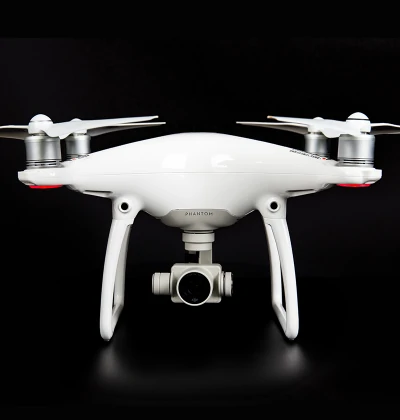

Aerospace & UAV
WJ Prototypes is your 3D manufacturing partner from prototype to large scale production.

Consumer Electronics
New Product Introduction Solutions for Consumer Electronics.

Robotics & Automation
Need some assistance bringing your robotic device or parts from the sketch-board to reality?

Medical Devices
The medical industry needs high quality, dependable and safe parts and products.

Automotive
New Product Introduction Solutions for Automotive

Industrial Machinery
The main purpose of industrial prototyping is to take the product from drawings into the real world.


TL;DR:
Global prototyping partners offer faster, scalable, and cost-efficient solutions for product development.
They mitigate risks through certification, IP safeguards, and strong communication protocols.
Using international partners is now essential for sectors requiring rapid innovation and cross-industry knowledge.
Local prototyping shops feel safe. You know the team, you can drive over for a meeting, and the time zone is never a problem. But that comfort comes at a price most product teams don't fully calculate until a competitor beats them to market. The global prototyping market is projected to reach $39.67B by 2030, growing at an 11.41% CAGR, and that growth is driven by teams in aerospace, automotive, and medical sectors who have already made the switch. This guide breaks down what global prototyping partners actually are, the real advantages they offer, how to manage the risks, and how to choose the right one for your next project.
| Point | Details |
|---|---|
| Global partners accelerate innovation | Harnessing international prototyping networks helps teams iterate faster and outpace competition. |
| Cost and speed benefits | Global platforms offer lower costs, scalable capacity, and shorter development cycles. |
| Risk management is achievable | Quality and IP risks are manageable with proper vetting and clear processes. |
| Smart partner selection is vital | Choosing the right global partner means evaluating capabilities, credentials, and responsiveness. |
A global prototyping partner is an international manufacturer or service platform that delivers rapid prototyping and low-volume production to product teams anywhere in the world. They are not simply overseas factories. The best ones function as engineering allies, offering industrial prototyping explained through deep domain knowledge, flexible capacity, and access to technologies that most regional shops cannot match.
Core services typically include:
Beyond the machines, what distinguishes a true global partner is their ability to guide you through the full prototyping process guide, from design-for-manufacturability feedback to material selection and seamless NPI (new product introduction) handoffs.
They also carry the certifications that regulated industries demand: ISO 9001, AS9100 for aerospace, IATF 16949 for automotive, and ISO 13485 for medical devices. That combination of capability and compliance is rare in purely local networks.
"Startups using global platforms achieve faster scaling, with the product prototyping market growing at 11.41% CAGR to reach $39.67B by 2030, reflecting accelerating global adoption across regulated industries."
The shift is real, measurable, and accelerating. Teams that understand what these partners actually offer stop treating them as a cost-cutting fallback and start using them as a strategic asset.
With a clear definition in place, let's break down why so many top teams are making the switch. What are the real, measurable benefits?
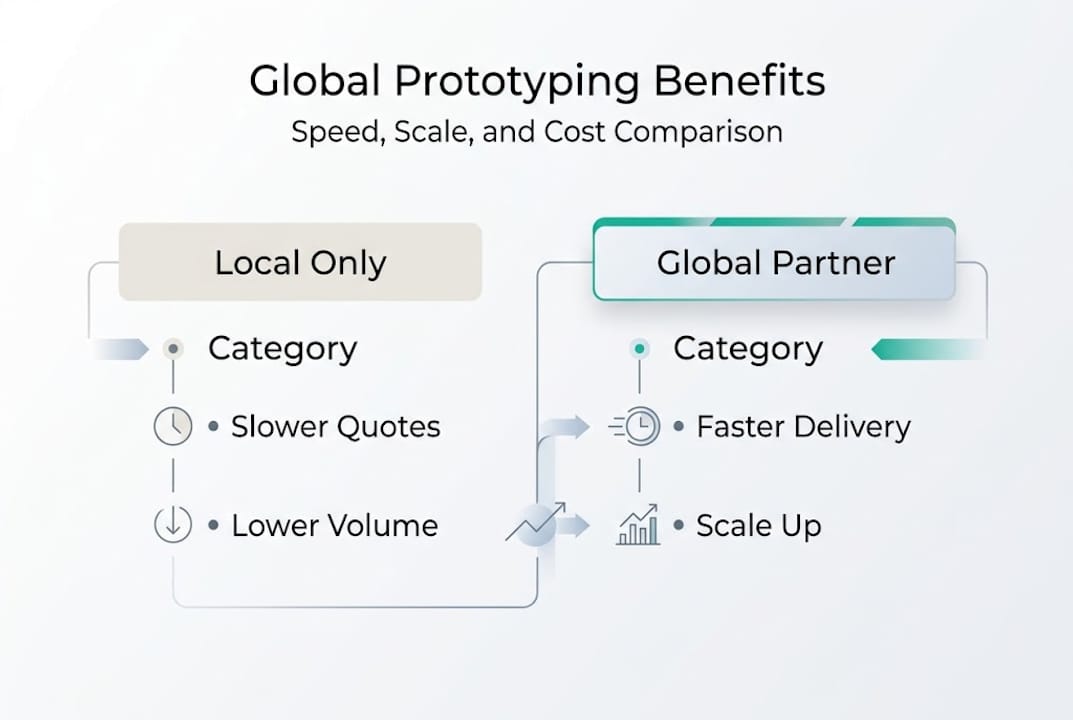
Global partners compress your development timeline in ways that local shops structurally cannot. When your engineering team in Detroit finishes a design revision at 5 PM, a manufacturing partner in Shenzhen is already starting their morning shift. That overlap means rapid prototyping streamlines processes across time zones, cutting idle time out of your iteration cycle. Instant digital quoting, parallel production workflows, and round-the-clock capacity mean a part that takes two weeks locally can come back in five to seven days.
Scalability is the second major advantage. When a medical device startup lands a pilot contract and needs to jump from 20 units to 500, a global partner absorbs that spike without rescheduling your entire queue. Local shops often hit capacity walls at exactly the wrong moment.
Cost is the third lever. Reducing costs with global partners is not just about cheaper labor. It is about competitive pricing from larger supplier networks, lower overhead per part, and the ability to run multiple technologies in one facility without coordinating across five vendors.
| Factor | Local-only team | Global-enabled team |
|---|---|---|
| Quoting speed | 2 to 5 days | Same day or next day |
| Prototype lead time | 10 to 20 days | 5 to 10 days |
| Scale-up flexibility | Limited by local capacity | On-demand surge capacity |
| Per-unit cost at low volume | Higher overhead per part | Competitive network pricing |
| Technology access | Regional equipment only | SLA, SLS, DMLS, CNC, and more |
Startups using global prototyping platforms consistently reduce time-to-market, which directly impacts valuation and investor confidence in competitive sectors.
Pro Tip: Schedule design reviews at the end of your business day so your global partner can begin production overnight. You wake up to parts already in progress, not a queue waiting to start.
Expanding internationally comes with new challenges. Here is how leading teams manage the risks and maintain confidence.
The four risks teams worry about most are inconsistent quality, IP leakage, communication barriers, and supply chain disruptions. Each one is real. None of them is unavoidable.
Quality is the most controllable risk. Reputable global partners hold certifications that require documented process controls, measurement traceability, and regular audits. Precision engineering for quality is not a marketing claim when an AS9100 or ISO 13485 audit backs it up. Ask for first-article inspection reports and material certifications before committing to a partner.
IP protection concerns are legitimate, especially in medical and aerospace. The best global partners use:
Communication is often underestimated as a risk. Bilingual project managers, dedicated account contacts, and structured update schedules eliminate most friction. If a partner cannot give you a clear answer within 24 hours, that is a red flag regardless of their price.
Supply chain resilience comes from working with partners who have multi-source material procurement and transparent production tracking. Digital audit trails and real-time status dashboards are now standard at leading platforms.
The global market growing to $39.67B reflects growing trust in these systems. Teams are not just tolerating global partners. They are depending on them.
Pro Tip: Run a small paid test project before committing to a full program. Evaluate communication speed, part quality, and documentation rigor. A $500 test can save a $50,000 mistake.
Once the benefits and risks are clear, the next step is making an informed choice and setting up for success. Here is how to evaluate and engage the right global partner.
Start with manufacturing capabilities. A partner who can handle CNC, injection molding, and additive manufacturing under one roof reduces coordination overhead and keeps your supply chain tight. Review their cost-effective prototyping guide approach and ask for documented case studies in your specific sector.
Follow this sequence when vetting a new partner:
The rapid prototyping benefits you gain depend heavily on how well you set up the engagement from day one.
| Question to ask | Why it matters |
|---|---|
| What certifications do you hold? | Confirms compliance with your sector's standards |
| Can you share a first-article inspection report? | Proves documented quality process |
| How do you handle design-for-manufacturability feedback? | Reveals engineering depth |
| What is your NDA and IP protection process? | Protects your confidential files |
| What is your lead time for a 50-unit run? | Sets realistic timeline expectations |
| Do you have experience in aerospace/medical/automotive? | Validates sector-specific knowledge |
Diverse manufacturing capabilities and verifiable global track records are the clearest signals that a partner can scale with you, not just handle your first order.
Best practice: start small, iterate fast, and scale only with partners who have already proven their process on your parts.
Here is an honest take on what the new global reality means for product teams.
Conventional wisdom still treats local as the safer default. We disagree. The innovation gap between local-only teams and globally-enabled ones is widening, not closing. Teams working with international partners gain access to cross-industry learning that simply does not exist in a single regional ecosystem. A medical device team learns from automotive-grade tolerance practices. An aerospace team benefits from consumer electronics speed benchmarks. That cross-pollination accelerates problem-solving in ways that no local network can replicate.
In sectors where time-to-market defines survival, an international partner is not a fallback option. It is a competitive necessity. The teams who treat global partners purely as a cost play are missing the bigger picture. The real value is in the cost-effective strategies that free up your internal engineers to focus on innovation rather than logistics. Choose a global partner for capability, speed, and access to technologies your local market cannot provide. Cost savings are a welcome side effect, not the primary goal.
If you are considering accelerating your next project with a trusted global partner, here is how to take the next step.
At WJ Prototypes, we work with product development teams in aerospace, automotive, and medical sectors who need precision, speed, and reliability from a single manufacturing partner. Our services cover rapid CNC machining across a wide range of CNC machining materials, vacuum casting, and injection molding materials for functional low-volume runs. Whether you are developing a flight-critical bracket or a Class II medical device housing, our solutions for automotive prototyping and other regulated industries are built around your compliance and timeline requirements. Request an instant quote or contact our engineering team to discuss your next project.
Explore competitive Rapid Prototyping Solutions with expert support from WJ Prototypes.
Whether you're comparing suppliers or looking to optimize costs, our team can help you evaluate the best option for your project.
👉 Request A Quote now or email us at info@wjprototypes.com to get started.
A global prototyping partner is an international manufacturer or service platform that provides rapid prototyping and low-volume production, often with specialized engineering expertise and access to global manufacturing networks. Startups using these platforms consistently achieve faster scaling than those relying on local-only suppliers.
They operate 24/7 production cycles, run parallel workflows across continents, and carry larger capacity reserves, all of which enable faster prototype iteration and quicker product launches. Global platforms like Fictiv and Xometry have demonstrated measurable reductions in development timelines for startups.
Leading global partners use NDAs, encrypted client portals, and international quality certifications to protect intellectual property and maintain confidentiality throughout the project lifecycle. Secure practices among global partners are now an industry standard at certified manufacturers.
Aerospace, automotive, and medical devices gain the most due to their complex requirements for speed, precision, and scalability. Sector adoption data from 2024 confirms these three industries are the fastest-growing users of global prototyping services.
The market is expected to reach over $39.67B by 2030 at an 11.41% CAGR, driven by demand for faster iteration, flexible capacity, and cross-industry technology access.
Why Outsource Prototyping to China | Cost, Speed & Precision
Why Prototyping in China Drives Down Costs for Manufacturers
Guide To Cost-Effective Prototyping - Reducing Risks and Expenses
Top-Rated Rapid Prototyping in China | Cut Costs & Speed Development
Solving Product Development Challenges - Digital Insurance Platform
Explore competitive Rapid Prototyping Solutions with expert support from WJ Prototypes.
Whether you're comparing suppliers or looking to optimize costs, our team can help you evaluate the best option for your project.
👉 Request A Quote now or email us at info@wjprototypes.com to get started.
SERVICES
RESOURCES