




- Room 1807, Unit 9, Building 2, Shangxing Commercial Street, Shangde Road, Shangxing Community, Xinqiao Subdistrict, Bao'an District, Shenzhen City, China
CONTACT US

WhatsApp


Contact Us
Our team is on stand by, waiting toassist you.

Videos
A large collection of educational videos and tutorials.

About Us
Learn about our company, leadership, and mission totransform manufacturing.

Privacy Policy
Applies to all personal information collected through and/or processed in connection.


Aerospace & UAV
WJ Prototypes is your 3D manufacturing partner from prototype to large scale production.

Consumer Electronics
New Product Introduction Solutions for Consumer Electronics.

Robotics & Automation
Need some assistance bringing your robotic device or parts from the sketch-board to reality?

Medical Devices
The medical industry needs high quality, dependable and safe parts and products.

Automotive
New Product Introduction Solutions for Automotive

Industrial Machinery
The main purpose of industrial prototyping is to take the product from drawings into the real world.
TL;DR:
- Selecting the right prototype material prevents delays, redesigns, and regulatory issues.
- Core material families include plastics, metals, and composites tailored to specific testing needs.
- Narrowing options to a few trusted materials and considering future substitutions enhances efficiency.
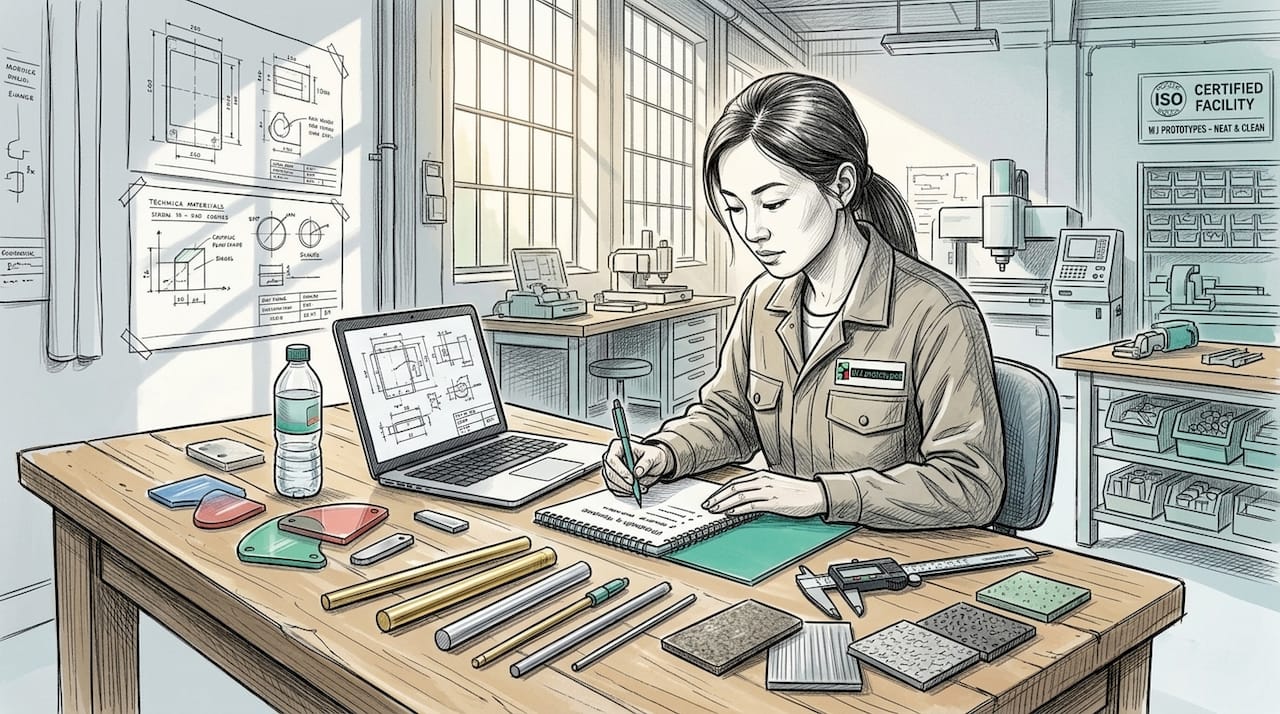
Picking the wrong material for a prototype isn’t just a budget problem. It can push your timeline back by weeks, force costly redesigns, and put regulatory approval at risk. Product teams in aerospace, automotive, and medical face this pressure constantly: dozens of materials, competing trade-offs, and no margin for guessing. A well-structured prototyping materials list cuts through that noise. It gives your team a clear, repeatable framework for evaluating options against real project requirements before a single part is machined or printed. This guide walks you through selection criteria, major material families, specialty options, and a practical comparison method that makes the final call easier.
| Point | Details |
|---|---|
| Define selection criteria | Set clear criteria to evaluate materials for prototyping, balancing performance, speed, and cost. |
| Choose core material families | Plastics, metals, and composites cover most prototyping needs, each with distinctive advantages. |
| Consider specialty materials | Elastomers and ceramics address unique requirements not met by common options. |
| Use comparison tables | A concise comparison table simplifies decision-making for material selection. |
| Streamline sourcing | Prioritize materials readily available and adaptable for low-volume production to avoid delays. |
Before you list a single material, you need to define what you’re actually asking materials to do. Skipping this step is one of the most common reasons prototype iterations run long and over budget. A clear material selection framework forces your team to agree on priorities before opinions take over.
Start by evaluating these core criteria:
Material selection impacts prototype performance and production speed, which means a poorly chosen material doesn’t just fail in testing. It can derail your entire development schedule.
Cost and speed trade-offs are real, but they shouldn’t dominate your criteria list. A cheap material that requires three extra iterations ends up costing more than a premium option that passes validation on the first run. Think in total project cost, not unit material cost.
Pro Tip: Build a simple scoring table. List your top five criteria in columns and score each candidate material from 1 to 5. It takes 30 minutes and saves weeks of back-and-forth during the review process.
Finally, connect your materials list to your prototyping steps from day one. A material that works for early-stage form prototypes may not suit functional validation, so your list should flag which materials serve which stage.
With your criteria in place, you can start populating your list with the main material families. Plastics and metals dominate rapid prototyping for their versatility and cost, but composites earn their place in demanding structural applications.
Plastics
Metals
Composites
Understanding material performance factors helps you match material families to specific testing goals rather than defaulting to the most familiar option.
| Material type | Relative cost | Processing speed | Scalability to production |
|---|---|---|---|
| Plastics | Low to medium | Fast | High (injection molding) |
| Metals | Medium to high | Moderate | High (CNC, casting) |
| Composites | High | Slow | Moderate (tooling required) |
For teams working on the additive manufacturing workflow, plastics and metal powders like aluminum and stainless steel dominate early-stage builds before transitioning to wrought or cast metals for production.
Pro Tip: Test hybrid combinations for specific scenarios. A nylon structural frame with overmolded TPU seals, for example, can validate both structural and sealing performance in a single prototype without committing to a full assembly redesign.
Beyond plastics and metals, specialty materials unlock unique performance advantages that standard options simply can’t deliver for certain prototype requirements.

Elastomers are the first line of defense when you’re prototyping seals, gaskets, dampers, or flexible interfaces. Silicone elastomers handle temperatures from -60°C to over 200°C and are biocompatible, making them standard in medical device prototyping. Polyurethane elastomers offer a wider Shore hardness range and are frequently used in vacuum casting for low-volume runs of over-molds and grip components.
Ceramics serve a narrow but critical role. When you need electrical insulation, extreme heat resistance above 1000°C, or superior wear resistance in a tight form factor, alumina or zirconia ceramics become relevant. Sourcing specialty materials for ceramic prototypes requires planning because machining ceramics demands diamond tooling and longer lead times.
Here’s a quick reference for specialty materials and their niche applications:
Elastomeric and ceramic materials are increasingly used for specialized prototype performance, particularly as aerospace and medical regulations push teams toward materials with proven field records.
Emerging alternatives like high-performance polymers and bio-based resins are worth tracking. They’re not ready to replace titanium or silicone in most applications yet, but they’re shifting cost curves quickly.
Pro Tip: Run material testing protocols in parallel with design iteration, not after. Catching a thermal or chemical failure at week two instead of week eight can save more project time than any process optimization.
Knowing the material families is step one. Matching them to your specific industry and prototype stage is where the real decisions happen. Industry application determines optimal material selection, and the table below gives you a starting point for three major sectors.
| Material | Automotive | Medical | Aerospace |
|---|---|---|---|
| ABS / Nylon | Concept models, interior trim | Casing prototypes | Non-structural mockups |
| Aluminum | Brackets, heat sinks, structural parts | Surgical tool housings | Structural frames, heat exchangers |
| Titanium | High-stress fasteners | Implants, bone plates | Primary structure, landing gear |
| Silicone elastomer | Door seals, vibration mounts | Seals, catheters, skin interfaces | Tubing, environmental seals |
| Carbon fiber | Body panels, aero components | Prosthetics, braces | Primary airframe, control surfaces |
| Ceramic | Brake components, wear pads | Dental, implantable sensors | Thermal protection systems |
To turn this into a project-specific materials list, follow these steps:
“The best material for a prototype isn’t always the best material for production. Engineers who plan for that transition from day one avoid the most expensive redesign cycles.”
When choosing your prototyping method, factor in how your material choice affects process compatibility. Some materials only work with specific manufacturing methods, which locks in both cost and lead time simultaneously. For cost-effective prototyping, pairing the right material with the right process from the start is one of the highest-leverage decisions you can make.
Here’s the uncomfortable truth: exhaustive materials lists often slow prototyping down rather than speed it up. We’ve seen engineering teams spend more time debating material options than actually building parts. The list becomes a committee exercise instead of a decision tool.
The real discipline is ruthless narrowing. Experienced engineers work with three to five core materials per project, chosen based on what’s available from suppliers they already trust. That’s not corner-cutting. That’s the effective prototyping guide reality: supplier lead times and minimum order quantities matter just as much as material spec sheets.
Another thing teams consistently overlook: future-proofing for material substitutions. Regulatory approvals, supply chain disruptions, and material shortages are all real risks. If your prototype design is built around a single material with no viable substitute, you’ve created a fragile development path.
When choosing prototyping services, ask your vendor about their standard material inventory. Aligning your materials list with what your partner already stocks removes lead time risk and keeps iteration cycles short.
Building a solid prototyping materials list is where successful product development begins, and having a manufacturing partner with deep material expertise makes the process faster and less risky. At WJ Prototypes, our engineers support material selection across a full range of processes, from CNC machining materials including aluminum, steel, and titanium, to flexible injection molding materials covering engineering-grade plastics and high-performance polymers. For low-volume runs and functional prototypes, our vacuum casting service supports polyurethane and silicone elastomers with fast turnaround. Get an instant quote and connect with our team to match your project requirements to the right materials.
ABS and aluminum dominate rapid prototyping for their value, offering an accessible balance of performance, machinability, and low per-part cost across most common prototype geometries.
Prioritize biocompatibility, ISO 10993 compliance, and sterilization compatibility first, since regulatory needs drive medical prototyping material selection before mechanical properties are even considered.
Low-cost materials may fail under functional testing conditions or miss regulatory thresholds, because material choice affects speed, cost, and quality throughout the entire development cycle.
Composites excel in aerospace for their strength-to-weight ratio, but require careful process selection and regulatory documentation to qualify parts for flight or structural use.
SERVICES
RESOURCES