



- Room 1807, Unit 9, Building 2, Shangxing Commercial Street, Shangde Road, Shangxing Community, Xinqiao Subdistrict, Bao'an District, Shenzhen City, China
CONTACT US

WhatsApp


Contact Us
Our team is on stand by, waiting toassist you.

Videos
A large collection of educational videos and tutorials.

About Us
Learn about our company, leadership, and mission totransform manufacturing.

Privacy Policy
Applies to all personal information collected through and/or processed in connection.
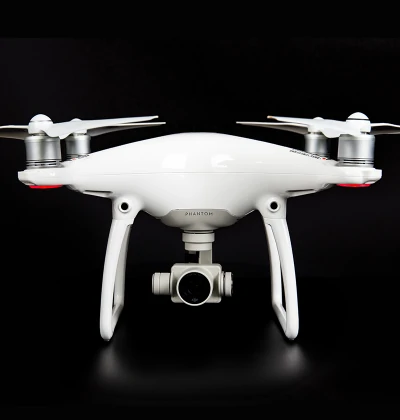

Aerospace & UAV
WJ Prototypes is your 3D manufacturing partner from prototype to large scale production.

Consumer Electronics
New Product Introduction Solutions for Consumer Electronics.

Robotics & Automation
Need some assistance bringing your robotic device or parts from the sketch-board to reality?

Medical Devices
The medical industry needs high quality, dependable and safe parts and products.

Automotive
New Product Introduction Solutions for Automotive

Industrial Machinery
The main purpose of industrial prototyping is to take the product from drawings into the real world.
TL;DR:
Multi-material prototypes combine different properties in one build, enabling more realistic testing.
They reduce manufacturing time and costs by cutting assembly steps and catching issues early.
Sector-specific applications include lightweight aerospace structures, complex automotive parts, and medical models with tissue-like flexibility.
Single-material prototypes force engineering teams into an uncomfortable choice: optimize for strength or flexibility, rigidity or compliance, but rarely both at once. That trade-off costs time, money, and design fidelity. Multi-material prototypes enable enhanced design flexibility by combining materials with different properties in a single build, letting you validate real-world performance without waiting for final production tooling. For product development managers in aerospace, automotive, and medical sectors, this shift is not incremental. It changes how teams prototype, iterate, and ultimately launch. This article breaks down how multi-material prototyping works, where it delivers the biggest gains, and how to handle the technical challenges that come with it.
| Point | Details |
|---|---|
| Greater design freedom | Combining multiple materials unlocks new possibilities for functional and aesthetic prototypes. |
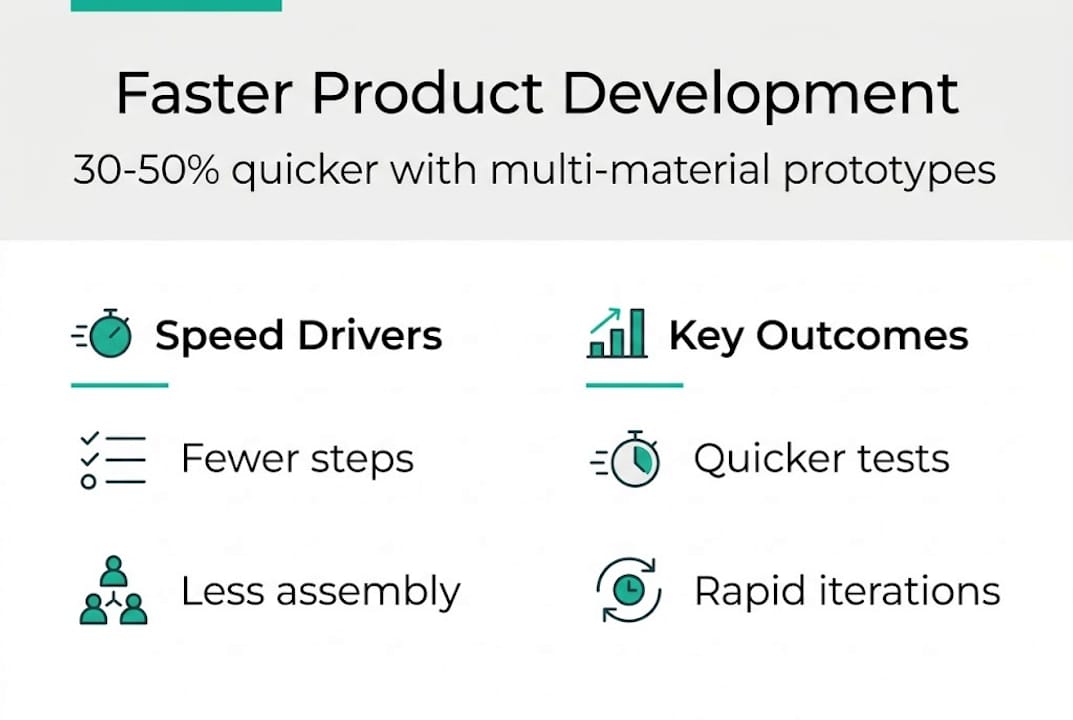
| Accelerated development | Multi-material prototypes often cut development cycles by 30-50% for engineering teams. |
| Lower costs | Reduced assembly and less wasted material mean significant savings for product managers. |
| Industry-specific benefits | Aerospace, automotive, and medical fields see stronger, more tailored prototypes for complex needs. |
| Technical challenges exist | Addressing bonding and compatibility issues requires smart material choices and testing. |
A multi-material prototype is a part or assembly fabricated using two or more distinct materials in a single build process. Instead of bonding separate components after the fact, the materials are integrated during fabrication, creating a unified structure with varied mechanical, optical, or tactile properties across different zones.
This is fundamentally different from single-material prototyping, where you pick one material and accept its uniform properties throughout. Multi-material builds let you place a rigid skeleton where you need load-bearing capacity and a flexible skin where you need compliance, all in one job.
Several additive manufacturing technologies make this possible:
| Feature | Single-material | Multi-material |
|---|---|---|
| Property variation | None | High (stiffness, color, hardness) |
| Assembly steps | Fewer | Reduced or eliminated |
| Build complexity | Low | Medium to high |
| Testing realism | Limited | Close to end-use |
Process considerations matter too. Interface bonding between dissimilar materials is the most common failure point. Anisotropy, meaning directional differences in strength based on build orientation, affects both single and multi-material parts but becomes more complex when two materials meet at an interface. Material compatibility must be confirmed before committing to a build.
Explore multi-material printing basics to understand which combinations work best for your application.
Pro Tip: Match your prototyping method to the end-use test you plan to run. PolyJet excels for form and ergonomic validation. FDM co-extrusion suits functional mechanical testing. CNC hybrid builds are best when dimensional accuracy is critical.
The benefits of multi-material prototyping are not theoretical. They show up in project timelines, budget lines, and test results.
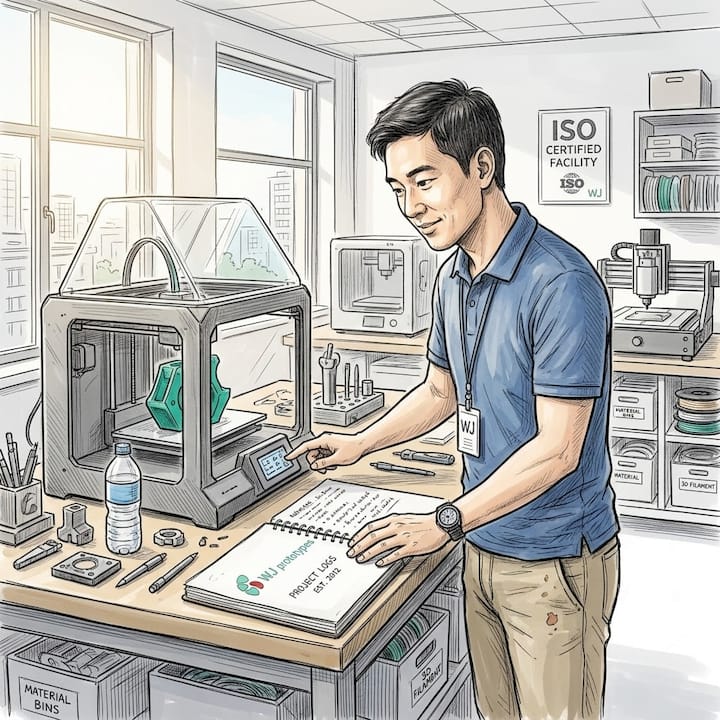
Speed. Printing complex parts in one job reduces assembly steps and accelerates design iterations, cutting time to market measurably. An aerospace bracket that previously required bonding two subcomponents can now come off the build platform ready to test.
Cost. Less assembly, fewer fasteners, and reduced material waste translate directly into lower prototype costs. Fewer late-stage design changes, enabled by more realistic early prototypes, reduce the expensive rework that plagues traditional development cycles. This connects to broader cost-saving prototyping strategies that smart teams are already using.
Performance fidelity. When your prototype behaves like the final product, your test data is worth more. You catch real failure modes instead of artifacts of the prototyping process itself.
Here is how the numbers compare:
| Metric | Single-material prototype | Multi-material prototype |
|---|---|---|
| Assembly steps | 3-6 | 0-2 |
| Iteration cycle time | 5-10 days | 2-5 days |
| Design issues caught early | ~40% | ~80% |
| Labor cost per prototype | High | Reduced by 20-35% |
The path to faster, leaner development looks like this:
This is what streamlined manufacturing looks like in practice: fewer handoffs, less waste, and faster decisions.
Pro Tip: Teams that adopt multi-material prototyping early in the design phase detect up to 80% of design issues before tooling is committed, dramatically reducing product risk and late-stage engineering change orders.
General benefits only go so far. What matters to your team is whether multi-material prototyping solves real problems in your sector.
Aerospace. Weight and structural performance are non-negotiable. Strut lattice structures show higher energy absorption under load compared to solid single-material alternatives, with some configurations absorbing up to 80% more energy. Multi-material lattice prototypes let aerostructure teams test impact absorption, stiffness gradients, and load paths rapidly, without committing to expensive tooling. Read the full aerospace application guide for sector-specific process recommendations.
Automotive. Interior and exterior components increasingly combine tactile, structural, and optical requirements. A dashboard prototype needs rigid mounting points, soft-touch surfaces, and transparent lens zones, all in one part. Multi-material builds deliver this in a single job, enabling testing under real driving conditions. Explore how automotive prototyping innovation is reshaping development timelines.
Medical. Anatomical models for surgical planning require tissue-like compliance in soft zones and rigid structure in bone analogs. Custom prosthetics need bio-mimetic flexibility at joints and load-bearing strength at attachment points. Multi-material prototyping delivers both in one build, enabling clinicians and engineers to validate designs before committing to production.
Top advantages by sector:
Multi-material prototyping services achieve 30-50% faster development cycles, detect 80% of design issues early, and deliver up to 25% improvement in manufacturability optimization across high-stakes industries.
Adopting multi-material prototyping without understanding its limitations is a fast path to wasted builds and missed deadlines. The challenges are real, but they are manageable with the right approach.
Layer anisotropy. All additive processes create parts with directional strength differences. In multi-material builds, this is compounded at material interfaces. A part loaded perpendicular to the build direction will behave differently than one loaded parallel to it. Design for the load direction from the start.
Material compatibility. Not every material pair bonds reliably. Interface bonding is critical to structural integrity; mismatched thermal expansion coefficients or chemical incompatibility can cause delamination under mechanical or thermal stress. Always verify compatibility data before finalizing a material combination.
Interface weakness. Even compatible materials can fail at their boundary under shear or peel loads. Graded material transitions improve shear strength by up to 320% compared to abrupt interfaces. This means designing a gradual blend zone between materials rather than a sharp boundary.
Here is how to mitigate the most common technical pitfalls:
Review interface bonding challenges and material selection strategies to build a robust process from the ground up.
Pro Tip: Use empirical validation methods like FEA simulation or Taguchi design of experiments to verify multi-material prototype performance under your specific load cases before scaling to higher volumes.
Most discussions about multi-material prototyping focus on speed and cost. Those gains are real, but they miss the deeper shift happening in product development organizations that use these tools well.
The real value is workflow transformation. When a team can build and test a functionally realistic prototype in two days instead of two weeks, it does not just iterate faster. It changes what the team is willing to try. Design decisions that once required committee approval because of the cost of getting them wrong become low-stakes experiments. That shift in organizational risk tolerance is where sustainable innovation comes from.
Multi-material prototyping also closes the gap between disciplines. Mechanical engineers, industrial designers, and regulatory specialists can all evaluate the same physical artifact instead of debating CAD models. That shared reference point accelerates decisions and reduces miscommunication.
The teams we see move fastest are not the ones with the most advanced equipment. They are the ones who have restructured their prototyping value chain around rapid physical validation. Multi-material capability is the enabler. Organizational willingness to act on what prototypes reveal is the multiplier. Challenge your team to ask not just "how fast can we build this?" but "what decisions can we make today that we could not make yesterday?"
For product teams ready to put these insights into practice, the right manufacturing partner makes the difference between a promising concept and a validated, market-ready design. WJ Prototypes supports aerospace, automotive, and medical development teams with rapid, high-precision prototyping services built for complex, multi-material requirements. Whether you need CNC machining materials for hybrid builds, CNC machining services for tight-tolerance components, or vacuum casting for realistic overmold simulations, WJ Prototypes delivers fast turnaround with ISO-certified quality. Request an instant quote and connect with our engineering team to find the right prototyping approach for your next product.
Explore competitive Rapid Prototyping Solutions with expert support from WJ Prototypes.
Whether you're comparing suppliers or looking to optimize costs, our team can help you evaluate the best option for your project.
👉 Request A Quote now or email us at info@wjprototypes.com to get started.
Multi-material prototypes enable enhanced design flexibility by combining properties like flexibility and rigidity in one part, reducing assembly steps and producing more realistic test results than single-material alternatives.
Aerospace, automotive, and medical sectors benefit most, using multi-material builds to cut development cycles and produce prototypes that accurately simulate end-use performance. Strut lattices show higher energy absorption in aerospace applications, while medical teams use them for surgical planning models.
Key challenges include material compatibility, interface bonding strength, and layer anisotropy. Interface bonding and anisotropy can be addressed with graded material transitions and build orientation planning before committing to full production runs.
Multi-material prototyping achieves 30-50% faster development and detects up to 80% of design issues early, significantly compressing the time between initial concept and market-ready design validation.
Role of Materials in Prototyping: Impact on Speed and Cost
Material Selection in Aerospace & Automotive Prototyping
Fast Prototyping Turnaround in China | Speed Up Product Development
Rapid Prototyping Guide | 5 Important Steps To Prototype Design & Manufacturing
Modern Web Development Tools 2026: 45% Faster Builds
Explore competitive Rapid Prototyping Solutions with expert support from WJ Prototypes.
Whether you're comparing suppliers or looking to optimize costs, our team can help you evaluate the best option for your project.
👉 Request A Quote now or email us at info@wjprototypes.com to get started.
SERVICES
RESOURCES